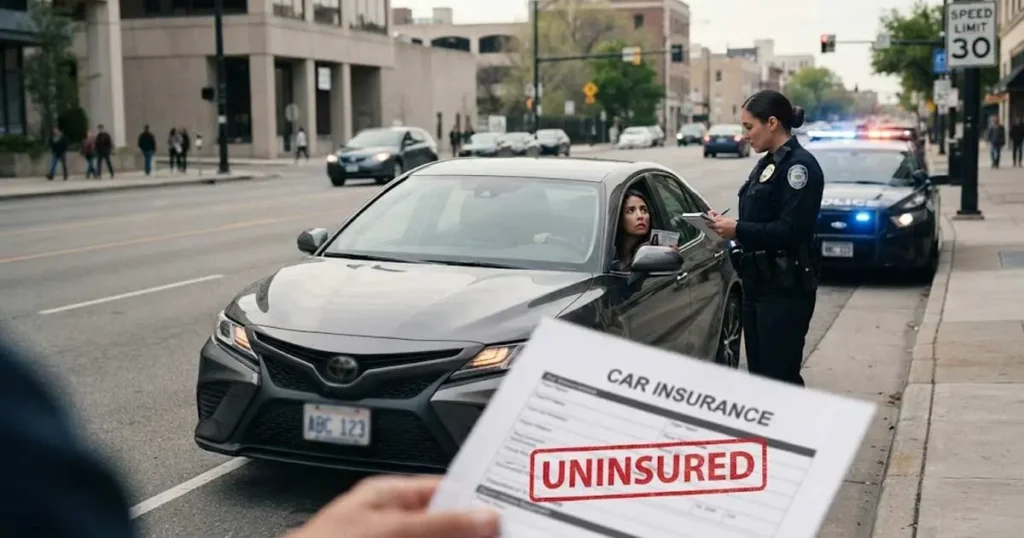

Yes, it is illegal to drive without insurance in Texas. Under Texas law, driving without car insurance is illegal, whether you are the owner or a borrower. This rule is for all drivers on Texas roads. The penalties for driving without car insurance in Texas vary from financial fines for a first-time offense to jail time if an uninsured driver causes a serious accident. The key to understanding this legal obligation is to know the specific statutes, the TexasSure enforcement system and the complete penalty structure.
Key Takeaways
- The Texas Transportation Code Chapter 601 makes it illegal to drive without insurance in Texas. Driving without car insurance is illegal, whether you own or borrow a vehicle.
- Texas mandates minimum coverage of 30/60/25: $30,000 per person, $60,000 per accident and $25,000 property damage.
- A first offense will result in a fine of $175 to $350 and a three-year $250 annual surcharge, for a total of $750 in surcharges in addition to the fine. The fines for a second or subsequent offense range from $350 to $1,000 with the same $250 annual surcharge for three years.
- When someone’s life is lost or they are seriously injured, you can be fined up to $4,000 and jailed up to one year if you cause an accident without insurance.
- Texas has a state-funded electronic insurance verification system called TexasSure, which enables law enforcement to verify insurance status during any traffic stop.
- Texas does not allow any grace period for lapsed car insurance coverage. Once your policy expires or is cancelled, you are uninsured and will have to pay penalties.
- In 2022, an estimated 13.8 percent of Texas drivers were uninsured, making uninsured motorist coverage a nearly essential coverage to add to any Texas policy.
Texas law requires vehicle owners to have insurance
Texas Transportation Code Section 601.051 requires all owners and operators of motor vehicles to provide proof of financial responsibility, which is usually in the form of liability insurance. This coverage is for damages and injuries that you cause in an accident.
Texas Transportation Code Chapter 601 requires drivers to carry at least a minimum amount of liability insurance or provide proof of financial responsibility.
Texas has a minimum coverage requirement of 30/60/25. The bare minimums are $30,000 for liability cover for each injured person and up to $60,000 per accident, and $25,000 for property damage liability.
You can pay a deposit or cashier’s check of at least $55,000 to the county judge instead of buying insurance to demonstrate financial responsibility. This option is not commonly utilized by private passenger vehicle drivers, but is recognized under Texas law.
Texas does not allow any grace period for lapsed car insurance coverage. When your policy ends or is cancelled, you are uninsured and subject to penalties.
TexasSure is Texas’s Real-Time Insurance Verification System
TexasSure is a state-funded electronic database established to help lower the number of uninsured vehicles that are on the road in Texas, and insurance companies in Texas report policy information for all of their customers to TexasSure. This allows Texas Department of Public Safety to be notified of the lapse or cancellation of a policy. It also allows law enforcement officers to check an insurance policy’s status when they pull over a car.
The TexasSure electronic verification system keeps a record of insurance status and enables law enforcement to verify coverage at the scene of a traffic stop. The system was designed to decrease the number of uninsured drivers and to save money for responsible drivers. When your policy lapses, your record is noted, and you could be penalized even before you commit another offense.
This real-time verification capability eliminates the assumption on which Texas drivers rely, that an officer can’t immediately verify their insurance status. Even if you have insurance, you can be ticketed for driving without insurance if you are stopped by police without proof of insurance and they are unable to check with TexasSure. If that is the case, you can contest the ticket in court and provide evidence of coverage.
The complete Texas car insurance no-pay consequences
First Offense
The first time you make a mistake, you will be fined $175 to $350. There is also a $250.00 annual surcharge for 3 years (total $750.00).
The court may reduce the fine if a person who has not been found guilty of this offense is not able to pay the fine in the amount of $175 or more. Texas has an economic hardship provision which is unique in comparison to most states, which do not have formal fine reduction processes for first-time offenders who are unable to pay the minimum penalty.
The second and subsequent offenses are handled as follows:
In Texas, the consequences for driving without car insurance are harsher if you are caught a second or later time. You’ll have to pay fines of $350 to $1,000. The court could also order your vehicle to be impounded for 180 days, in which case you can apply for its release by showing evidence of financial responsibility.
Under Texas Transportation Code Section 601.263, you will have to pay $15 per day for up to 180 days if your vehicle is impounded. These charges can easily accumulate and make it even harder. You will also need to present proof of financial responsibility for two years and fees for the impoundment to get your car back.
License Suspension
If you get two or more convictions for driving without insurance, your license will be suspended. It can be reinstated by submitting an SR-22 form with proof of insurance to the Texas Department of Public Safety and keeping your insurance in place for two years. There will also be a $100 reinstatement fee and any other outstanding fees.
Serious Accident While Uninsured
You can be fined up to $4,000 and up to one year imprisonment depending on the severity of the collision and injuries if you are responsible for causing serious injury or death. You will need to submit an SR-22 form for three years following the crash and your car registration as well as license will be suspended for up to 2 years.
One of the most severe escalations of penalties for uninsured driving in the country. A Texas first offense does not involve jail exposure, but if a serious accident occurs without insurance, there is a real criminal liability. This is a more severe penalty than Ohio‘s, which has no jail time for any uninsured driving offense, and is comparable to the most serious case in Florida, where driving on a suspended license exposes you to misdemeanor charges.
Texas is a Fault-Based State: Civil Liability for Uninsured Drivers
Texas is a fault-based state for car accidents, meaning that the at-fault driver will be responsible for all damages caused by the accident. If you don’t have insurance, you would be on the hook for the costs of medical bills, pain and suffering, property damage, lost wages and other related expenses, which could be financially devastating.
Being caught driving without insurance may mean that you are personally liable for any damage or injury that you cause, which can lead to lawsuits or wage garnishment.
Additionally, you will be 100 percent liable for any and all physical injuries and property damage resulting from the accident that you caused.
The fault-based system in Texas is quite different from Florida’s no-fault PIP system. In Florida, the first medical costs of all drivers will be covered by their own insurance, no matter who is at fault. In Texas, at fault driver’s liability insurance is the primary source of compensation for the other party. In Texas, the uninsured at-fault driver has no insurance to cover those claims, and his or her personal assets are completely at risk.
A Driver Responsibility Program Surcharge – A Financial Responsibility in Texas that is Unique!
One of the most unique financial responsibilities in this state series is the surcharge imposed by the Driver Responsibility Program on uninsured driving violations and one that many drivers do not consider when determining the true cost of an uninsured driving violation.
The fine for a first offence is $175 to $350 and there is an annual surcharge of $250 for the following three years. Second and subsequent violations will result in a fine of $350 to $1,000 and the $250 annual surcharge for three years will still be in effect.
The surcharge is $750 for a three year period for both the first and second offense. The total financial burden incurred by the violation for three years is $175 for the first offense. If it is a second violation the cost is $1,000 and if it is a third violation the cost is $1,750 before impoundment fees, SR-22 costs, or premium increases are added on.
For comparison, benchmark drivers in Texas pay an average of $666 a year in car insurance. In Texas, the penalties for a first offense of any charge exceed the cost of two years of average liability coverage.
SR-22 Requirements in Texas
To restore a suspended license, submit proof of insurance to the Texas Department of Public Safety on an SR-22 form and keep the insurance for two years.
Drivers found guilty of driving without insurance are often required to file form SR-22 for two years after the date of their recent conviction. The filing of an SR-22 will be for three years in the event of a serious accident.
An SR-22 is not an insurance policy. A certificate issued by your insurer to the Texas Department of Public Safety that you have the minimum coverage. The filing requirement will force your insurance provider to report to the state if your coverage lapses during the SR-22 period, thus making it a constant insurance compliance monitoring process.
What if I Lose My Proof of Insurance in Texas?
If the driver can prove to the court that they were driving with car insurance at the time of the ticket, then the case should be dismissed.
Even if you have insurance, you can be ticketed for driving without insurance if you are stopped by the police without proof of insurance and he or she cannot prove your insurance policy with TexasSure. You can try to appeal the fine by pleading not guilty in court, either in person or by mail.
This is a significant difference between proof and coverage for Texas drivers. TexasSure’s real-time verification allows officers to be able to verify coverage online in many cases, although it is not foolproof. If you get a citation even if you have an active policy, take a copy of your policy to court for the date of the citation.
Texas’s Uninsured Driver Problem
Currently, an estimated 20 percent of Texas drivers are uninsured. As of 2022, 13.8 percent of drivers were uninsured in Texas.
One in seven Texas drivers is uninsured, making it more likely that you will get into a collision with an uninsured driver than in most states. Underinsured and uninsured motorist coverage is an optional coverage that Texas drivers can add to their auto insurance policy. These additional policy provisions are crucial for protecting accident victims in the unfortunate event that they are involved in an accident with an uninsured driver.
The impact of driving without insurance on future premiums in Texas
Driving without insurance can have further consequences other than legal and monetary fines. If you’re convicted of driving without insurance, you’ll be considered a high-risk driver, which will increase the cost of your insurance when you do get covered. Some states may require an SR-22 form, also known as a certificate of financial responsibility, which can also raise insurance premiums, especially for high-risk drivers.
When a driver has been uninsured, they may be considered a high-risk driver and the premiums may be much higher if they are reinstated.
How Texas Compares to Other States
Texas has a real-time electronic verification system, a unique annual surcharge structure, and jail exposure for serious accidents, making it a unique case in this series.
| Feature | Texas | Ohio | Florida | California |
| First offense fine | $175-$350 | Up to $500 | $150-$500 | $100-$200 base |
| Annual surcharge | $250 x 3 years ($750 total) | None | None | None |
| Second offense fine | $350-$1,000 | Higher than first | $250-$1,000 | $200-$500 base |
| License suspension | Yes (2+ offenses) | Yes (first offense) | Up to 3 years | Yes (accident) |
| Jail time possible | Yes (serious accident) | No | Yes (suspended license) | No |
| Electronic verification | TexasSure real-time | Yes | OIVS continuous | Yes |
| Insurance system | At-fault | At-fault | No-fault | At-fault |
| Minimum coverage | 30/60/25 | 25/50/25 | PIP $10k + PDL $10k | 30/60/15 |
The Driver Responsibility Program (DRP) surcharge is $250 per year for three years in Texas, but not in Ohio, Florida or California, leaving the total amount of money that can be collected from one violation in Texas very different than in these three states.
Also Read: Is It Illegal To
Discover expert and legal perspectives
Attorneys who have been practicing for over 50 years, combined, at Anderson and Cummings confirm that even a minor traffic stop or fender bender can lead to fines, surcharges, and legal problems if not covered by insurance. Insurance does more than just help keep other drivers safe, it also helps keep you financially safe.
But the consequences of being at fault in a crash without insurance can be severe, according to Parker Law Firm Fort Worth. You may be liable to face up to $4,000 in fines, and if someone gets seriously injured or killed, you may find yourself in jail for up to one year. You could also lose your driver’s license and car registration. The penalties can be quite costly and difficult to recover from, to you and the injured parties.
According to lawyers at Baumgartner Law, Texas has a fault-based system for car accidents, which means that the driver who caused the accident is responsible for any damages that occur. If you are not insured and cause an accident, this can have a profound impact. If the insurance company does not pay for the damages, you could be liable for medical bills, lost wages, property damage, and other damages.
Conclusion
Texas Transportation Code Chapter 601 makes it illegal to drive without insurance in Texas and the penalties are for all drivers on all public roads in the state. There is no grace period allowed in Texas for uninsured coverage, and TexasSure’s electronic verification is done in real-time, allowing officers to verify insurance coverage during any traffic stop.
Texas’s penalty system is unique among the states included in this series. A first offense will result in fines of $175 to $350, plus the $250 per year Driver Responsibility Program surcharge, which equals $925 or more. After $1,750 combined fines and surcharges, impoundment, reinstatement and premium increases are added to a second offense. The most serious direct criminal consequence in this four-state comparison is the potential for fines up to $4,000 and up to one year in jail for causing a serious accident or death without being insured.
In Texas, having an active driver’s license does not mean you are exempt from getting auto insurance coverage; otherwise, you might face severe legal and financial penalties. The most sensible and legally sound path is to keep the liability coverage, have proof of insurance with them at all times and include uninsured motorist coverage, as about 1 in 7 Texas drivers is currently driving without insurance.
To find out if it’s illegal to drive without insurance, check out Is It Illegal to Drive Without Insurance?
Frequently Asked Questions
1. In Texas, is it against the law to drive without insurance?
Yes. Whether you are the owner or a borrower, Texas law makes no exception for driving without car insurance. Texas Transportation Code Chapter 601 requires all drivers to have at least $30,000 in liability coverage, $60,000 in coverage, and $25,000 in coverage.
2. How much is the penalty for driving without car insurance in Texas?
The first offense will result in a fine of $175 to $350. The fines for a second offence are $350 to $1000. There are also $250 surcharges for each offense for three years (or $750 total).
3. Can you go to jail for driving without insurance in Texas?
Not for the first or second offense. A fine of up to $4,000 and up to one year in jail for causing a serious injury or death in a collision to which you are responsible.
4. What is TexasSure?
TexasSure is a state-funded electronic database that enables the Texas Department of Public Safety to be notified when a policy lapses or is canceled, and allows law enforcement officers to check an insurance policy’s status when they pull over a car.
5. What is the maximum period of license suspension for driving without insurance in Texas?
Your driving license will be suspended if you have been convicted of driving without insurance twice. If you want to have it reinstated, you’ll need to submit proof of insurance to the Texas Department of Public Safety with an SR-22 form and keep the insurance in place for two years.
6. Does Texas have grace periods for lapsed insurance?
There is no grace period for car insurance in Texas. If your policy ends or is cancelled, you are uninsured and will be penalized.