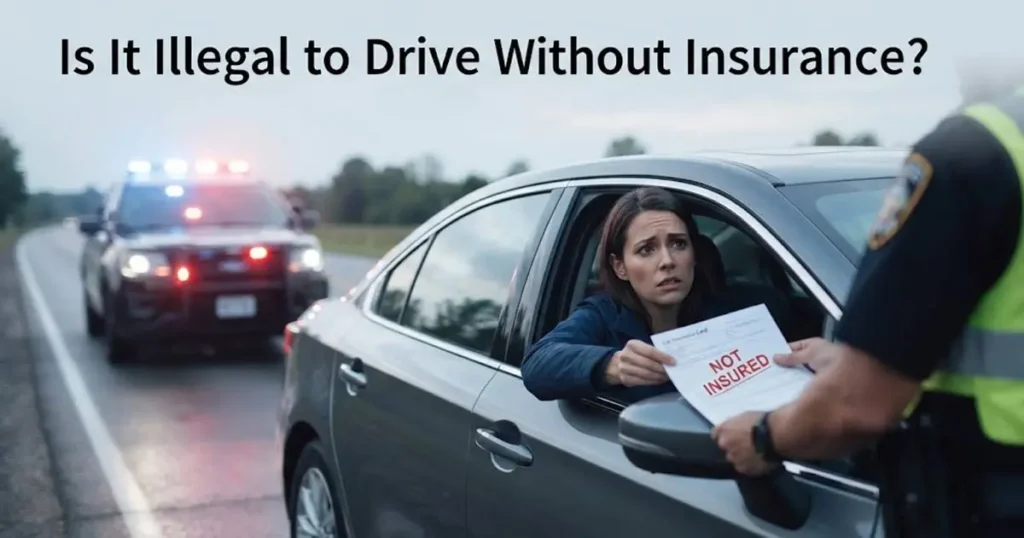

Yes, it is a crime in Florida to drive without insurance. No ifs, ands, or buts, it’s against the law in Florida to drive without insurance. Under Florida law, all registered vehicles in the state must be covered by minimum insurance coverage at all times, not only while you’re operating the vehicle, but while it’s registered. Florida’s mandatory coverage requirements are unusual among U.S. states, in that the state has a no-fault insurance system that is distinct from most states. It’s important to know the exact laws, no-fault system, and penalties that apply to every Florida driver to understand this legal requirement clearly.
Key Takeaways
- Florida Statute 324.022 and the Florida Financial Responsibility Law make it illegal to drive without insurance in Florida. Registered vehicles must be covered at all times by the state.
- Florida is a no fault insurance state, thus, there are specific rules regarding coverage. All registered vehicles are required to have $10,000 in Personal Injury Protection and $10,000 in Property Damage Liability coverage at all times.
- First offense fines are between $150 and $500, and there is a reinstatement fee of $150 to $500 to get your license and registration back. A second violation in three years will result in a $250 to $1,000 fine and a $250 reinstatement fee. The reinstatement fee for third and subsequent offenses can be as high as $500 in addition to fines.
- Possession of a driver’s license and vehicle registration may be suspended for as long as three years. Suspensions for insurance related offenses are not available in Florida for hardship.
- The Florida Online Insurance Verification System keeps track of coverage on an ongoing basis. If your insurer notifies them, the DMV automatically notates your license for suspension.
- About 20.4 percent of Florida drivers do not have insurance, and Florida is one of the top states for the percentage of uninsured drivers in the country.
- Violating a suspended license is a criminal misdemeanor, which is a more serious offense than the original insurance violation.
Florida law requires drivers to be insured
Yes, it’s illegal to drive without insurance in Florida. The Florida Financial Responsibility Law requires all registered vehicles to be covered by a minimum amount of auto insurance coverage.
At the very minimum, Florida mandates $10,000 in Personal Injury Protection and $10,000 in Property Damage Liability coverage. These two coverages are the minimum insurance required for any vehicle registered in the state.
Florida is a no fault insurance state, which means your insurance will cover your injuries and damages in an accident, regardless of who is at fault. This is the hallmark of Florida’s insurance system and what sets it apart from most other states when it comes to insurance requirements.
Florida is unusual among U.S. states, in that it does not require bodily injury coverage for private vehicles, which pays for the costs associated with others’ injuries or death if you are responsible for an accident. But, in many serious car accidents, the most expensive part of the case is the bodily injury coverage.
All vehicles with a Florida license plate and registration are required to meet these requirements. Before canceling the insurance on the vehicle, you must transfer the plate to a different car that has the minimum insurance, or surrender the plates.
The No-Fault System in Florida: What It’s All About
One of the biggest legal differences for drivers who move to Florida from other states is the no-fault system. It has a basic impact on insurance in a crash.
PIP pays up to 80 percent of your and any passengers’ personal injuries. This holds true for any collision, whether the fault lies with you or someone else, and your coverage is the first financial barrier of defense in any accident.
Florida is unusual among U.S. states in that it does not require bodily injury coverage for private vehicles, which pays for the costs associated with others’ injuries or death if you are responsible for an accident.
The consequence in practice is huge. If a Florida driver causes a serious accident that results in injuries to another person, he or she could be directly liable for the damages if the injured party’s injuries are more than what the PIP coverage provides. If the at-fault driver doesn’t have bodily injury liability, their personal assets are at risk.
Florida’s Online Insurance Verification System: Automatic Enforcement
This is the tool used to enforce the insurance compliance program in Florida, making it one of the most proactive in the nation.
The FLHSMV’s electronic notification system, the Online Insurance Verification System, continually compares vehicle registration data to information provided by insurance carriers. If your insurance company notifies them of a lapse in coverage, which is a legal requirement, the state’s system automatically notifies them that your driver’s license and vehicle registration are at risk.
It’s a good idea to keep your car insurance policy up to date. If it lapses, then your insurer will notify the Florida Department of Highway Safety and Motor Vehicles. The agency will require you to submit evidence of purchase of a new policy prior to the expiration of the old policy, including a deadline.
No legal grace period. There are penalties for not having insurance coverage at all times.
Most importantly, there are no hardship licenses for insurance related suspensions. An insurance suspension is not a suspension that allows you to drive for a limited period of time for work, school or medical reasons, it is a suspension that you are legally grounded by. Florida Statute 316.646 clearly states that there are no exceptions to this policy.
The full Florida penalty for driving without insurance
It’s important to know the full extent of the penalties in Florida, as the state has several distinct financial penalties other than the fine itself.
First Offense
The first offense is a fine of $150 to $500, and $150 to reinstate your license and registration.
Second Offense
A second violation in three years will result in a fine of $250-$1,000 and increased reinstatement fees. Second offenses will be charged a reinstatement fee of $250.
Third Offense and Beyond
The fines can be $1,000 or higher for subsequent violations and may include vehicle impoundment. A third and subsequent offense will be charged $500 for reinstatement.
If you were involved in an accident without insurance, these numbers do not include any out-of-pocket accident costs, legal fees or court costs. Both your driver’s license and vehicle registration are suspended. They must be reinstated by means of proof of current active insurance policy in Florida, payment of reinstatement fee and payment of any outstanding fines. You will not be able to drive legally until all three steps are done.
Does not driving insurance in Florida constitute a crime?
Driving without insurance is a non-criminal traffic violation for a first offense. Penalties are financial and administrative, and do not involve jail time.
But the story takes a turn for the worse in certain cases.
It is a misdemeanor to drive without car insurance and may result in arrest and jail time. Similarly, if you present false insurance papers to police, you can be charged with a first degree misdemeanor, which carries a fine of up to $1,000 and up to a year in jail.
You won’t end up in jail for failing to have insurance, but you will be subject to severe penalties and consequences. However, if you were to drive on a suspended license, repeatedly not carry car insurance and be involved in moving violations and accidents, or forge insurance documents, you could face jail time.
Many states, such as Florida, require drivers to have car insurance and impose harsh penalties for not having it. Fines, license suspension and vehicle impoundment are usually the penalties for the first offense, but individuals who commit multiple offenses or are at fault in a crash when uninsured may be subject to more severe penalties, such as jail time.
What If You Cause an Accident Without Insurance in Florida?
If you let someone drive your uninsured car and they get into an accident, you as the owner of the car are liable for the damages. They will be personally responsible for damages and injuries they cause.
Since driving without car insurance in Florida is illegal, you’ll be fined if you are involved in an accident or pulled over without proof of insurance. Your driver’s license, registration and plates may be suspended for three years. All accident-related damages, such as injuries, repair costs, lost wages and legal costs, could be your responsibility.
If you are at fault for an accident, you are also responsible for any damages.
What to do about insurance lapses in Florida?
If you intend to drop your insurance for any reason, you’ll need to surrender your plates before the insurance expires. Otherwise, the FLHSMV may suspend your driver’s license, registration and vehicle tags for up to three years, or until you cancel a policy (whichever is earlier).
Florida has a statute that mandates that your license and registration be suspended if you do not have insurance for any length of time, even one day, until you can prove you have a new policy and pay the fees.
There are steps to be taken in reinstating after a lapse. You now have a new insurance policy and need to call the FLHSMV or your local clerk of court to find out how much you owe. Once you have insurance and fees paid, you can start to reinstate your license. The FLHSMV must be provided with proof of new insurance. This proof can be sent electronically directly to the state by many insurers, the quickest way of doing it.
Florida’s SR-22 and FR-44 Requirements
An SR-22 form is a certificate that proves you have the minimum required auto insurance.
You will also have to obtain an SR-22 or FR-44, which will make you a high-risk driver.
In addition to SR-22, Florida has FR-44, which is used for different purposes. An FR-44 is a special form for DUI license suspensions and requires more coverage than the minimums. SR-22 insurance requirement for non-DUI insurance related suspensions. They both need to be submitted by your insurance provider to the FLHSMV and kept on file for the time before you have your license back.
The Consequences of Driving Without Insurance in Florida
The premiums will probably go up if you don’t have car insurance in Florida, but the exact amount will vary by car insurance company. Fines for driving without insurance can make your car insurance 7 to 45 percent higher. Drivers can expect to pay an average of 28 percent higher in premiums, plus fines, fees, and out-of-pocket costs, and be liable for license suspension.
The average car insurance cost in Florida is already one of the highest in the country. This 28% on top of Florida’s already high rates is a significant long-term financial impact, and more than a short-term saving if you opt out of coverage.
Why the law matters in Florida’s Uninsured Driver Problem
About 20.4 percent of Florida drivers do not have car insurance. This places you in the company of almost 20 percent of drivers without a financial safety belt, making Florida one of the most dangerous states for insured drivers.
Recent studies estimate that 20 percent of Florida drivers are uninsured. Personal injury protection would cover up to $10,000 for your initial medical bills and wages lost, no matter who was at fault.
This statistic is the reason Florida has the requirement for PIP. One in five drivers in Florida is uninsured but even an uninsured driver is expected to have some coverage under the no-fault PIP system, which means that when an uninsured driver gets into an accident, the at-fault driver is not expected to have coverage.
Exemptions to Florida’s Insurance Requirement
Drivers who have a net worth of over $40,000 may be able to provide proof of financial responsibility instead of purchasing car insurance.
If you have a net worth of $40,000 or more or a business has many vehicles, you might be able to self-insure by filing a certificate of proof of financial responsibility with the state. Certain vehicles, like government owned vehicles or farm equipment, might not have to be covered by insurance. The owner of a vehicle that is not in use and has given up the license plate may not be obligated to keep the vehicle insured.
These exemptions only cover a small percentage of Florida drivers. Most registered drivers have no choice but to have continuous PIP and PDL insurance on their vehicles at the state required levels.
How Florida is doing in comparison to other states
The no-fault insurance system in Florida and the state’s unique coverage mandates make it different from California and Texas.
| Feature | Florida | California | Texas |
| First offense fine | $150-$500 | $100-$200 (base) | $175-$350 |
| Reinstatement fee | $150 (first) | None specified | None specified |
| License suspension | Up to 3 years | Yes (accident-related) | Yes |
| Hardship license available | No | Not for insurance suspension | Limited |
| Criminal classification | Non-criminal infraction | Infraction | Misdemeanor (third offense) |
| Minimum required coverage | PIP $10,000 + PDL $10,000 | 30/60/15 liability | 30/60/25 liability |
| No-fault system | Yes | No | No |
| Uninsured driver rate | Approx. 20.4% | Lower | Lower |
| Max suspension length | 3 years | 4 years (accident) | Varies |
The most unique aspect of Florida’s auto insurance law is the no-fault legislation.The no fault law is the most unique aspect of the Florida auto insurance law, which is different from California and Texas. Those two states are no-exculpatory fault states, meaning that the insurance company of the driver at fault pays for the other party’s damages. Under the Florida PIP law, all drivers’ own policies cover their initial medical costs, no matter who is at fault.
Also Read: Is It Illegal To
Expert and Legal Perspectives
Unlike some other suspensions, Florida All Risk Insurance confirms that there aren’t any hardship licenses available for insurance-related suspensions in Florida. Florida Statute 316.646 is a clear-cut statute with no exceptions.
In Florida, it is not illegal to drive without insurance, but it is illegal to leave the scene of an accident if you caused it, notes Todd Miner Law.
TGS Insurance says it’s not worth the risk to not have car insurance in Florida. Being uninsured can disrupt your finances and your life, from fines and license suspension to the potential of huge out-of-pocket costs.
Conclusion
It is illegal not to have insurance in Florida (Florida Statute 324.022) and the Florida Financial Responsibility Law. The state requires $10,000 in PIP coverage and $10,000 in Property Damage Liability coverage for every registered vehicle. This requirement is automatically enforced by Florida’s Online Insurance Verification System, which alerts drivers to any gaps in coverage and suspends their license and registration as soon as it is discovered.
The penalties are monetary and administrative and are very serious. You could lose your driver’s license, registration and plates for up to three years. The fines for reinstatement increase with each infraction, from $150 to $500. There is no hardship license for insurance suspensions. Premiums rise 28 percent, on average, after a lapse. It is a criminal misdemeanor to drive on a suspended license and can result in jail time.
Florida has an enforcement system to ensure that all drivers on the road are shielded from financial liability when they are at fault in an accident with an uninsured motorist, as about 20% of drivers in Florida are currently uninsured. The best and most protective way is to keep policies and PDL in place at all times, and to turn in your plates to the FLHSMV before any policy expires.
To find out if it is illegal to drive without insurance in the country, go here: Is It Illegal to Drive Without Insurance?
Frequently Asked Questions
1. Is it illegal to drive without insurance in Florida?
Yes. The minimum Personal Injury Protection and Property Damage Liability coverage required by Florida law for all registered vehicles is $10,000 each. In Florida, driving without insurance isn’t a small matter.
2. Can you go to jail for driving without insurance in Florida?
Driving without insurance is a traffic infraction that is not a crime for a first offense. Penalties are financial and administrative only and do not involve imprisonment. But driving without insurance coverage on a suspended license is a misdemeanor that can result in arrest and jailing.
3. In Florida, what is the maximum number of days that your license can be suspended for driving without car insurance?
Your driver’s license and vehicle registration can be suspended for up to three years.
4. Does Florida have a grace period for lapsed insurance?
No legal grace period. If you don’t have continuous coverage, you’ll be penalized.
5. What is the minimum insurance coverage in Florida?
Florida has insurance requirements of $10,000 in Personal Injury Protection (PIP) and $10,000 in Property Damage Liability (PDL). PIP insurance pays for your medical bills if you are involved in an accident, regardless of fault, and PDL insurance pays for damage to someone else’s property in an accident.
6. What are the consequences of driving without insurance in Florida?
Fines for driving without car insurance could cost you as much as 45 percent more for insurance than if you had been insured. Drivers can expect to see an average of 28 percent increase in their premiums.