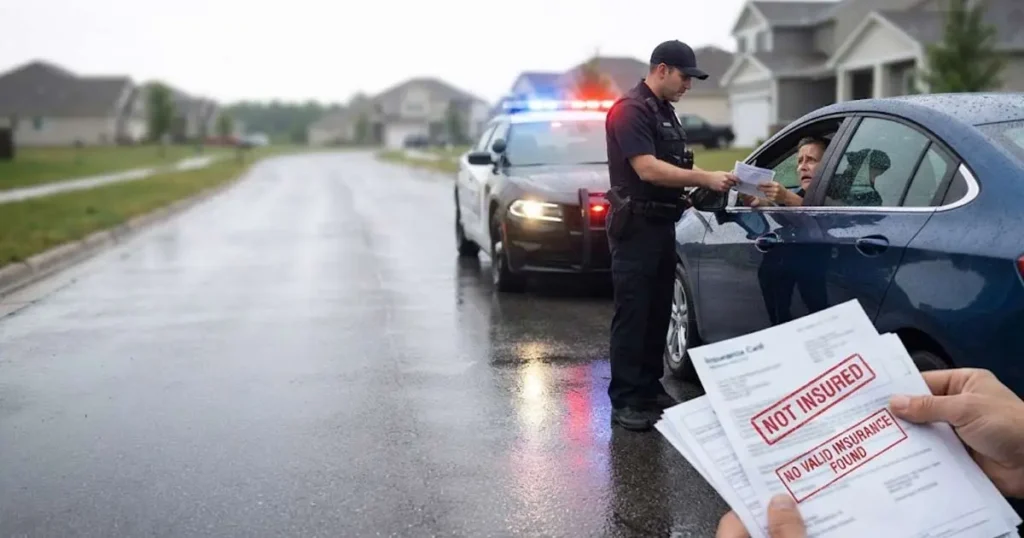

Arizona law requires drivers to have insurance coverage as it makes them vulnerable to the road and other people. All drivers must have a minimum amount of liability insurance in accordance with Arizona Revised Statutes Section 28-4135 in case of any damages or injuries that may occur in an accident. This will mean that if an accident occurs, the person at fault has the financial resources to cover any damages to their property or injuries to the other people involved, and will not be left to cover the entire bill themselves. Arizona’s penalty system is unique in this series because it has a very clearly tiered three offense escalation system, each with varying suspension periods of three months, six months and one year, and a pure comparative negligence civil system which permits even highly at fault drivers to recover a proportionate amount of damages.
Key Takeaways
- Arizona Revised Statutes Section 28-4135 makes it illegal to drive without insurance in Arizona. Under Arizona law, all vehicles used on a public road must be insured.
- Arizona car insurance laws also require that insurance be provided not only for driving a vehicle, but for registration of the vehicle as well. If you don’t have continuous coverage, you may be penalized even if your car is not being driven.
- The minimum liability insurance limits in Arizona are 25/50/15, which means $25,000 for coverage of bodily injury per person, $50,000 for coverage of bodily injury per accident, and $15,000 for coverage of property damage per accident.
- The penalty for a first offense of driving without insurance is $500 and a three-month license suspension. The penalty for driving without insurance for the third offense within three years is a $750 fine and suspension of your license and registration for six months. Third offense, within three years of two or more prior offenses, will result in a $1,000 fine, one year license, registration and license plate suspension.
- While you won’t be arrested or jailed for driving without auto insurance in Arizona, you may be subject to other serious penalties, including license suspension and fines of up to $1,000.
- Arizona has a pure comparative negligence system. This can allow each party involved in an accident to be found at fault for a certain percentage of the accident, and the amount of compensation they receive can be proportionately reduced. If you are 99% at fault, you can still receive 1% of the damages.
- Arizona Statutes Section 28-04084 provides one exception for owners who deposit a certificate of financial responsibility with the Office of the Arizona State Treasurer for $40,000.
Arizona law requires drivers to maintain car insurance coverage
Arizona Revised Statute Section 28-4009 is the state’s insurance law for motor vehicles. The key Arizona auto insurance requirements include that all Arizona-registered vehicles must have a motor vehicle liability policy.
A person operating a motor vehicle on a highway in this state shall have evidence within the motor vehicle of current financial responsibility applicable to the motor vehicle. The evidence can be presented on a wireless communication device that is in the motor vehicle.
It is a different offense to not have car insurance coverage than to not be able to show proof of coverage. Having insurance doesn’t mean you’ll be able to show it if you’re pulled over or in an accident, and that’s an administrative violation, just like a seat-belt ticket. In Arizona, your citation might be dismissed if you can provide the court with proof of valid insurance for the date of the citation on or before your court date.
Arizona Motor Vehicle Division is the source for officers to check insurance status in real time throughout the state. A gap of even a few days may surface following a traffic stop or involvement in a car accident.
Arizona’s Minimum Insurance Requirements: 25/50/15
Arizona car insurance laws require coverage of at least $25,000 for injuries to a single person, $50,000 coverage for multiple people injured and $15,000 coverage for damage to the property of another person. All registered vehicles, such as cars, trucks, motorcycles and mopeds, are covered by these insurance minimums.
These are the minimum legal requirements and not the protection that most drivers require after a serious car accident. The damage to property and medical expenses for major collisions often exceed the minimum coverage limits. Motorists can opt for extra coverage options, such as collision, comprehensive, medical payments, and underinsured and uninsured motorist coverage, beyond these limits. Uninsured and underinsured motorist coverage isn’t required in Arizona, but a significant percentage of Arizona drivers are driving without insurance, and it may be essential to getting a fair claim settlement after a car accident with an uninsured motorist.
The Complete Arizona Driving without Insurance Penalty Rules and Regulations
First Offense
You will be fined $500 if you are unable to provide proof of insurance when asked and this is your first time. Plus, your state will take away your driver’s license, registration and license plates for three months. You will need to pay $10 and a $10 to $25 application fee to get your driver’s license reinstated. There will also be a $50 fee to retrieve your registration and license plates. Additionally, you may have to submit an SR-22 certificate with your insurance company for three years.
Second Offense Within Three Years
The second insurance citation in 3 years results in $750 and 6 months fine and suspension.
The third and subsequent offenses within three years shall be considered as one offense
The third violation in three years will result in a $1,000 fine and a one-year suspension of the driver’s license, registration and license plates. You’ll have to pay the $10 reinstatement fee, show proof of insurance and fork over a $10 to $25 application fee to get your driver’s license back, plus pay $50 to get your registration and license plates returned. You might need to obtain an SR-22 certificate for three years as well.
The full set of penalties is outlined in the table below:
| Offense | Fine | Suspension Period | SR-22 Requirement |
| First offense | $500 minimum | 3 months | Up to 3 years |
| Second offense (within 3 years) | $750 minimum | 6 months | Up to 3 years |
| Third offense (within 3 years) | $1,000 minimum | 1 year | Up to 3 years |
Direct Statutory Language is provided in the Arizona Revised Statutes Section 28-4135
A violation of this section shall result in a civil penalty as provided by this section as follows: A minimum civil penalty of five hundred dollars shall be imposed by the court for the first violation. On receipt of the abstract of the record of judgment, the department shall suspend the person’s driving privileges or restrict the person’s driving privileges for three months.
Failure to produce evidence of financial responsibility on the request of a law enforcement officer investigating a motor vehicle accident or an alleged violation of a motor vehicle law of this state or a traffic ordinance of a city or town is a civil traffic violation that is punishable as prescribed in this section.
The classification of the civil traffic violation is important. Arizona’s basic uninsured driving violation is not a criminal misdemeanor for a first offense, as is the case in California. Whereas, Tennessee treats even a first offense as a Class C misdemeanor, Arizona’s system is administrative and civil with financial and license penalties.
Is it possible to get into jail for driving without car insurance in Arizona?
Although you can’t go to jail for driving without insurance in Arizona, there are other serious consequences that you may face, including a fine of up to $1,000 and a license suspension.
That makes Arizona one of only three states, along with Ohio and California, that do not have any jail penalties for the base uninsured driving infraction. It is different than Tennessee, where an accident with injury or death becomes a Class A misdemeanor and carries a maximum jail sentence of 11 months and 29 days, and Texas, which imposes a maximum jail sentence of one year for causing a serious accident while uninsured.
Is there an option to reduce or waive the fine in Arizona?
This is a characteristic of the Arizona system of penalties that is not as strongly displayed in other states in this series.
If you are convicted of being uninsured, the state will consider your penalty if you provide proof that you have not been convicted of this offense in the last three years, and proof that you have obtained a six-month car insurance policy that meets the requirements of the car insurance minimum liability set forth in Arizona. The court may excuse your fine, but if your license or registration has already been suspended, then you will have to pay the fees to have your license and registration reinstated.
With a first offense in the past three years, you might be able to plead to have the ticket dismissed or the fine waived and possibly the penalties for your first offense driving without car insurance removed. You should at least be able to show that you were not convicted of driving without insurance in the last two years, or had no more than one conviction on your driving record in the last three years, and that you have obtained auto insurance coverage for at least six months, according to the minimum liability requirements in the state of Arizona.
Arizona is different from most states in this series because the waiver pathway is fine, meaning that there is no penalty for failing to comply with the conditions following the waiver.
SR-22 Insurance in Arizona
Regardless of the citation, there are three penalties that you can expect: at least $500 fine, driving privileges suspended, and an SR-22 requirement for two years. Note that the court may impose further penalties and fines, even if it is your first or fifth offense. SR-22 insurance is also known as a Certificate of Financial Responsibility. It is not a kind of car insurance, but rather a document indicating that the driver has obtained and maintained the minimum amount of car insurance.
This fact is a requirement for getting an SR-22 certificate and many insurance companies consider this high risk. Automobile insurance coverage costs are typically higher for high-risk drivers.
Arizona’s Pure Comparative Negligence System: How It Affects Uninsured Drivers
One of the most unique aspects of Arizona’s civil liability law is the fact that it differs from the laws in other states in this series.
In Arizona, the system of comparative negligence is a pure one. This means that in an accident, each party may be determined to be a certain percentage liable and receive the corresponding percentage of compensation. If you were 10% responsible for the accident and the other party was 90% responsible, you can still receive compensation. Your award will be deducted by 10%, though. You can recover 1% of the damages even if you are 99% responsible.
The pure comparative negligence system is the best civil liability structure that can be provided to uninsured motorists in an accident. Arizona does not have a contributory negligence doctrine like Virginia, which bars any recovery if the injury is 1 percent or less, and doesn’t have a modified comparative fault system like Tennessee, which bars any recovery if the injury is 50 percent or more.
This also implies that fault can be apportioned amongst the parties. For instance it is possible for you to be 40% responsible for an accident and the other party to be 60% responsible. The liability for the expenses resulting from the accident would be divided between the responsible parties.
What If You Cause an Accident Without Insurance in Arizona?
Arizona is a fault-based insurance state. This means that the driver who caused the accident is legally liable for the injuries and property damage caused. With the minimum coverage, you will be covered for the other drivers on the road and you will have limited personal financial exposure after an accident. If you don’t have insurance, you could be liable to civil penalties and wage garnishment after a car accident judgment.
If you get into an accident while driving without insurance in Arizona, you will incur the penalties for driving without insurance no matter who is at fault. Being uninsured can be a challenge to be fairly compensated for damages if you aren’t the at-fault party and can be life-changing and long-lasting if you are the at-fault party. In addition to the legal consequences of driving without insurance, you could easily be responsible for tens of thousands of dollars or more in damages to your vehicle, the other driver’s car repairs and hospital bills, and your own medical care.
If you are uninsured in Arizona and you are at fault in a car accident, the other party may sue you for damages and file a lawsuit against you in court.
Arizona’s Exceptions to Mandatory Insurance
Most individuals follow Arizona’s insurance law and buy a standard policy, but there are other insurance policies available. These options are approved and may necessitate extra documentation and legal supervision. These are generally not used by individual drivers, but rather by businesses. Financial responsibility can be provided by a $40,000 cash deposit with the Arizona Office of the Treasurer, a certificate of self-insurance for fleet owners or large companies, or surety bonds or partial deposits under certain conditions.
These options are only available for a small percentage of Arizona motorists. For the overwhelming majority of registered vehicle owners, continuous 25/50/15 liability coverage is the real-life legal requirement – with no meaningful alternative.
The impact of Driving Without Insurance on future premiums in Arizona
Your auto insurance history will have an impact on the auto insurance premium you pay monthly, bi-annually or annually. Any insurance history gaps will increase your insurance premium.
The fines listed do not include any additional insurance costs, court fees or other financial repercussions that you may face.
Driving without car insurance in Arizona isn’t just about the penalties and fines—it has long-term financial implications. SR-22 filing requirements indicate high-risk status to insurers for two to three years, and lead to significantly higher insurance costs than standard rates for any person convicted of an uninsured driving violation.
How Arizona fits in with other states
| Feature | Arizona | Tennessee | Virginia | Texas | Florida | Ohio | California |
| First offense fine | $500 minimum | Up to $300 | $600 fee | $175-$350 | $150-$500 | Up to $500 | $100-$200 base |
| Second offense fine | $750 minimum | Higher | Escalating | $350-$1,000 | $250-$1,000 | Higher | $200-$500 base |
| Third offense fine | $1,000 minimum | Jail possible | Escalating | Up to $4,000 | Up to $1,000 | Higher | N/A |
| Suspension period | 3/6/12 months by offense | Until proof | Until proof | 2+ offenses | Up to 3 years | First offense | Registration |
| Jail time possible | No | Yes (injury accident) | Yes (fraud) | Yes (serious accident) | Yes (suspended license) | No | No |
| Civil liability | Pure comparative (any % recoverable) | Modified comparative (50% bar) | Contributory (1% bar) | Comparative fault | No-fault PIP | Modified comparative | Comparative |
| Fine waiver option | Yes (first offense) | Limited | No | Limited | No | No | Limited |
The civil liability standard is the most favorable of the seven states in this comparison in Arizona, where there is a pure comparative negligence system. It also has an explicit fine waiver program for first offenders who qualify.
Also Read: Is It Illegal To
Two different perspectives from experts and legal professionals
Arizona drivers who have learned the hard way that a gap in coverage has serious legal and financial implications often turn to the car accident lawyers at The Law Offices of John Phebus for help. If you drive without insurance in Glendale, Phoenix, or any other city in Arizona, you’re not only risking your wallet, but you’re risking your life.
Driving without insurance coverage in Arizona isn’t legal because it places both you and others on the road at risk. Arizona Revised Statutes Section 28-4135 mandates minimum liability insurance for all drivers in case of an accident or injury. That is why it is illegal to drive without insurance in Arizona: if there is no insurance, the system of apportioning financial responsibility for damages collapses and may result in innocent parties being unable to recoup their losses.
In Arizona, driving without car insurance is a serious crime and can result in fines and/or suspension of your driver’s license. During the suspension period, you won’t be able to legally drive or register any vehicle in your name. Rehabilitation of licence involves traffic courses, SR-22 insurance and paying fines.
Conclusion
Arizona Revised Statutes Section 28-4135 make it illegal to drive without insurance in the state of Arizona. All vehicles used on public roads must be insured under the Arizona law and a first violation of the requirement to carry insurance is $500 and a three-month suspension of the vehicle’s license. The fines increase in a graduated manner over a three-year period, with a first offense costing $500 and a fine of $750 for a second offense and $1,000 for a third offense, with penalties also being three months, six months and one year respectively.
The most unique aspect of Arizona’s civil liability system is its approach to the issue of civil liability. Arizona’s strict 50 percent modified threshold for civil recovery falls in the middle of the seven states discussed here, whereas Virginia’s civil recovery system is a strict contributory negligence system, and the pure comparative negligence system allows recovery at any fault percentage.
One thing that Arizona has that most other states don’t is a formal fine waiver system for first-time offenders who show prior clean records and immediate qualification for a six-month policy. This pathway does not remove the license and registration suspension, but can remove the $500 minimum fine for qualifying drivers.
The best way to do this is to keep 25/50/15 coverage in place at all times, have proof on your cell phone or as a physical card, and if your policy lapses, do so quickly to prevent the penalty triggers that are programmed into the Motor Vehicle Division’s database in Arizona.
For the national legal framework on driving without insurance, visit Is It Illegal to Drive Without Insurance?
Frequently Asked Questions
1. Is it illegal to not have insurance in Arizona?
Yes. Arizona Revised Statutes Section 28-4135 makes it illegal to drive without insurance in Arizona. Under Arizona law, all motor vehicles that are operated on public roads must have liability insurance.
2. What is the fine for driving without insurance in Arizona?
Failure to show valid proof of insurance the first time will result in a person paying a $500 fine. The state will suspend the person’s driver’s license, registration, and license plates for three months.
3. Can you go to jail for driving without insurance in Arizona?
No, you cannot go to jail for driving without insurance in Arizona, but you can face other serious consequences, such as suspension of license and fines up to $1,000.
4. What is the minimum insurance that must be carried in Arizona?
Arizona car insurance minimum liability limits are: $25,000 per person for bodily injury, $50,000 per accident for bodily injury and $15,000 per accident for property damage.
5. Arizona’s pure comparative negligence system impacts uninsured drivers how?
Under a pure comparative negligence system, each party to an accident can be found up to 99% liable for the wrong, and he or she will only be entitled to 1% of the damages. You can still recover 1% of the damages even if you are the 99% responsible party.
6. In Arizona, is it possible to avoid paying the no-car insurance ticket?
If you’re convicted of driving without insurance, the state may reduce or waive your penalty if you present proof you haven’t been convicted of this offense within the past three years, and proof you’ve purchased a six-month car insurance policy that meets the Arizona minimum liability requirements.