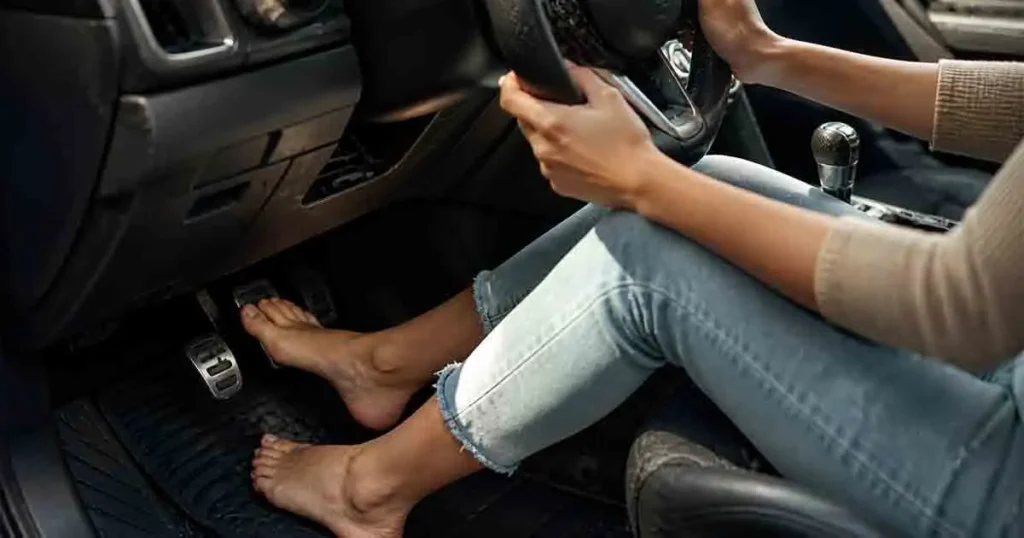

No, it is not against the law to drive with barefoot in Oregon. In the United States of America, you are legally allowed to drive with your bare feet in any state. The Oregon Revised Statutes do not specify a footwear requirement and no officer may give a citation on barefoot driving alone. The state of Oregon does not adopt any official official stand condemning barefoot driving as compared to other states like Iowa, Indiana, and Utah. The state just allows it, as long as the driver is safe in the operation of his or her vehicle. What Oregon motorists must learn is the particular statutory framework that will be applied in case the unsafe driving caused by barefoot driving does result in an accident, and how the Oregon civil liability rules will apply to any accident that occurs as a result.
Key Takeaways
- In Oregon, it is not illegal to drive with bare feet. In the Oregon Revised Statutes, there is no footwear requirement of drivers of a passenger automobile or motorcycle.
- There are no legislations that specifically state that driving with bare feet is not allowed in Oregon. In fact, there are no such laws in any state of the United States.
- In Oregon, it is legal to drive barefoot provided that you can do it safely. Conversely, in case your bare feet make you drive carelessly, you may be fined.
- You can not be quoted just because you drove without shoes. None of the Oregon officers can have a legal ground to stop or give a ticket to you because you are alone in the car driving without shoes.
- The careless driving law under ORS 811.135 and the reckless driving law under ORS 811.140 both apply in cases where the unsafe vehicle operation is contributed by barefoot driving.
- A court may even consider you negligent or even reckless in driving with bare feet should you be involved in an accident.
- Oregon uses a modified comparative fault standard. In case the driving with bare feet is a contributing factor to an accident and your percentage of fault is over fifty percent, you may not recover anything at all.
- In what states is it an offense to drive with bare feet? In the United States, at the state level, in passenger vehicles. Oregon is no exception.
What Oregon Law Says About Barefoot Driving
The Oregon Vehicle Code, which is located in Volume 19, Title 59, Chapters 801 through 826 of the Oregon Revised Statutes, governs Oregon traffic laws. Chapter 811 particularly deals with the rules of the road to drivers. That chapter is completely silent on the particular issue of driver footwear.
No laws that specifically forbid driving with bare feet in Oregon. In fact, there are no such laws in any state of the United States. Nevertheless, certain states and local jurisdictions have rules that are highly discouraging of barefoot driving.
Oregon is one of the states where the driving of a motor vehicle by a driver with bare feet is allowed. In the U.S., no state has any law expressly mandating that drivers wear shoes or other footwear when driving a non-commercial vehicle.
The vehicle code of Oregon does have two statutes, which come into play in case of unsafe results of barefoot driving. ORS 811.135 is concerned with careless driving, which is defined as driving in a way that endangers or would be likely to endanger persons or property. ORS 811.140 deals with reckless driving, which is the conscious disregard of a substantial and unreasonable risk when driving. Both laws do not mention shoes. The two are applicable in situations where the conduct of drivers, irrespective of the reason, leads to unsafe driving.
Can You Drive Barefoot? What can and cannot be done by Oregon Drivers
One of the most asked questions on this topic is whether you can drive with bare feet, and in Oregon the answer is simple.
Are you allowed to drive in Oregon with bare feet?
Yes, entirely. There is no law, rule, or governmental instruction against it.
Is it possible to be ticketed because you were driving in Oregon with your bare feet?
Not to drive barefooted. A citation must have evidence of unsafe driving habits that are related to the lack of footwear.
In case you drive recklessly due to your being barefooted, you can be fined. Conversely, safe barefoot driving has no legal implication.
Drivers who wear bare feet are not pulled over because of not wearing shoes. How could they when officers can not see their feet? However, a policeman can utter something during a traffic stop when he/she is approaching the window of the car. Although a person cannot be given a ticket when driving without footwear, the police can highly recommend the driver to wear some form of footwear in future.
The practical limit in Oregon is evident. Safe barefoot driving is free and unrestricted. Unsafe barefoot driving that results in a traffic incident opens the door to careless or reckless driving citations under ORS 811.135 and ORS 811.140 respectively.
What States Have It as an illegal act to drive with bare feet? A National Overview
It is among the most commonly searched queries when it comes to barefoot driving and the answer is the same nationwide.
There is no law in any states against driving with bare feet. This is a widely held myth in New York to California. A survey of all 50 states and U.S. territories did not find any examples of traffic laws that prohibited driving without footwear.
The sole footwear needs that exist anywhere in the United States are those of motorcycle riders in certain states. Alabama also has a law against barefoot riding of motorcycles under Alabama Code Section 32-5A-245(b). The state of Georgia outlaws it in O.C.G.A. Section 40-6-311(e). None of the other states has a similar statutory ban, and none of them extends to car drivers.
The driving of a motor vehicle by a driver with bare feet is legal in the states such as Oregon. Keep in mind, though driving with bare feet may be legal in your state, the first thing that should be considered is safety.
What are the states that it is illegal to drive barefoot in? In the case of passenger car drivers, the response is no. As far as motorcyclists are concerned, Alabama and Georgia are the only two states that have statutory prohibitions. In Oregon, there is no restriction of any type on either of the two types of vehicles.
The Careless and Reckless Driving Statutes in Oregon: What the Barefoot Drivers need to know
This is the most significant legal aspect of Oregon barefoot drivers, and it should be given a lot of consideration.
The Oregon vehicle code is used to draw the line between two degrees of unsafe driving. ORS 811.135 is about careless driving, which is a Class B traffic offense. The reckless driving, which is a Class A traffic offense and has more severe consequences such as the possibility of criminal punishment, is covered by ORS 811.140.
There is a possibility that a court may declare you negligent or even reckless by driving with bare feet. Although driving with bare feet is not a crime, it may be applied in the context of whether you are a reasonably safe driver or not.
The reasonable safe driver standard is the standard used in Oregon. A driver who loses control over his or her vehicle, who fails to brake in time or who causes an accident may be compared to what a reasonably safe driver would have done. In the event that the court finds that a reasonably safe driver in the same situation would have worn proper footwear, the fact that the defendant was barefooted will be held as evidence of failure to meet the standard.
It is significant that you are aware of what to do and how to report the accident, should you have a collision whilst driving with your bare feet in Oregon. Regrettably, the other motorist might sue you on the basis of unsafe driving.
Some of the likely charges that might be incurred as a result of unsafe driving caused by bare feet in Oregon include:
- Reckless driving by ORS 811.135 (Class B traffic violation)
- Negligent driving pursuant to ORS 811.140 (Class A traffic violation)
- Civil liability on negligent driving.
- Lack of due care as required by the ORS 811.005.
The impact of Barefoot Driving Affects the Civil Liability in Oregon
Oregon uses a modified comparative fault rule in civil cases. In this system, the fault is shared equally between all the parties. The percentage of fault that a claimant has committed reduces his recovery and in case he has committed more than 50 percent fault, he is not entitled to recover any compensation whatsoever.
You may lose a personal injury lawsuit because you are in a car accident and you are driving with your bare feet. The fact that a court may find you negligent or even reckless in driving with bare feet, is a fact that can be presented in the case of the other driver suing you on grounds of unsafe driving.
The real-life implication is not insignificant. Barefoot driving provides an opposing party with an easy negligence case in any Oregon accident where the control of the pedals is questioned. The reasonably safe driver standard is a legal framework through which that argument can be made effective in Oregon. A verdict of substantial fault that is related to barefoot driving can diminish or deny the right of the barefoot driver to recover damages.
Barefoot driving will have an impact on your rates in case you have been involved in an at-fault accident. When you drive with your bare feet, you are more vulnerable to reckless driving since it is easy to slip off the pedals or not apply the correct pressure when braking or accelerating. Should an accident occur, should law enforcement find that your failure to wear shoes was a factor in the accident, you are likely to be fined or issued a citation. It also may raise your rates and make you a high-risk driver in the eyes of your insurer. Also, in case driving with bare feet was one of the causes of the accident, your car insurance company might reject your claim.
The Comparison of Oregon with other States
The legal stance of Oregon is in line with the national standard with no formal official safety condemnation and a behavior-based enforcement policy through its careless and reckless driving laws.
| State | Barefoot Driving Legal | Key Legal Distinction | Negligence Standard |
| Oregon | Yes | Careless/reckless driving applies if unsafe | Modified comparative (50% bar) |
| Maine | Yes | Distracted driver law applies if barefoot causes accident | Modified comparative (50% bar) |
| Utah | Yes | Highway Patrol explicitly recommends shoes | Modified comparative (50% bar) |
| Missouri | Yes | State formally condemns as unsafe | Pure comparative |
| Iowa | Yes | State formally condemns as unsafe | Modified comparative (50% bar) |
| Indiana | Yes | State formally condemns as unsafe | Modified comparative (50% bar) |
| Arizona | Yes | Explicitly identified reckless driving risk state | Pure comparative |
| Georgia | Yes (cars) | Motorcycle barefoot riding prohibited | Modified comparative (50% bar) |
| Alabama | Yes (cars) | Only state banning motorcycle barefoot riding for cars too | Contributory (full bar) |
| North Carolina | Yes | Contributory negligence adds severe civil risk | Contributory (full bar) |
| California | Yes | Reckless driving charges possible after accident | Pure comparative |
| Ohio | Yes | BMV advises against barefoot driving | Modified comparative (51% bar) |
| Oklahoma | Yes | No formal position | Modified comparative (51% bar) |
| Florida | Yes | No formal position | Pure comparative |
| Michigan | Yes | No formal position | Modified comparative |
| Texas | Yes | No formal position | Modified comparative |
| Illinois | Yes | No formal position | Modified comparative |
The modified comparative fault system in Oregon is more restrictive than the pure comparative systems in Missouri, California, and Florida, but much more favorable than the contributory negligence bars in North Carolina and Alabama. The fact that there is no formal safety condemnation puts Oregon in a more lenient category than Iowa, Indiana, and Utah among the states that have issued formal guidance.
Barefoot Driving Safety? An Oregon-Specific Assessment
The variety of geography and climate in Oregon provides certain driving conditions in which the safety implications of driving with bare feet should be given a serious consideration.
Genuine Risks
Bare feet may easily slide off the pedals particularly when they are wet or sweaty and this may result in loss of control of the vehicle. Lack of the normal feel and fit of a shoe may mean that the response time to the pedals may be slower, and that may increase the risk of accidents. Bare feet are more prone to cuts, abrasions or more severe injuries due to broken glass or sharp metal fragments in the case of an accident.
Other hazards unique to the Oregon driving conditions are:
- Driving along the coast and beaches: The scenic Pacific coastline of Oregon attracts a lot of summer traffic. Wet and sandy feet on drivers returning to the beach after a day of fun in the sun are one of the most dangerous barefoot driving situations in the state.
- Rain and wet conditions: The Oregon climate is infamously wet, which means that road spray and vehicle floor moisture are not a seasonal issue, but a year-round problem. Wet feet on wet pedals have the greatest risk of slippage.
- Mountain and canyon roads: The Cascade Range and Columbia River Gorge roads in Oregon have a high frequency of use and need high precision of braking on steep grades where reliability of the pedal is essential.
- Rural roads: A large part of Oregon is made up of rural two-lane roads where unexpected hazards demand reliable and instant pedal action.
- Winter conditions: Oregon has higher elevations which receive a lot of snow, cold bare feet on cold pedals lowers sensitivity and braking reliability significantly.
When Can You Drive Barefoot Safely?
It can be safer to drive with bare feet at times. Driving with shoes off is a common practice among many people. Perhaps you have tight shoes and your feet are sore after a hard day. It is completely understandable that you may want to kick off your shoes on your long drive home.
In certain cases, it may be safer to drive with bare feet than with shoes that are unsafe. Some types of shoes could get stuck and cause a motor vehicle accident. Large shoes render it hard to adequately manage the gas pedal, brake pedal and clutch.
The comparison of footwear risks below is based on the overall safety agreement:
| Footwear Type | Pedal Control | Risk Level |
| Barefoot | Moderate | Medium |
| Flat sneakers | High | Low |
| Flip-flops | Low | High |
| High heels | Very low | Very high |
| Heavy boots | Low-Moderate | Medium-High |
| Sandals | Low | High |
The majority of specialists state that you are supposed to wear closed-toe shoes with rubber soles. Rubber soles are more tractionable and controllable, whereas closed toes can protect your feet during an accident.
Barefoot Driving Is Best Avoided in Oregon
Although it is legal in some jurisdictions, certain Oregon driving conditions render barefoot driving a rather poor practical decision:
- Following visits to the beach or coastal areas: Wet, sandy feet on the Pacific coast of Oregon represent the most slippery and the most likely source of a careless driving citation following an accident.
- Rainy season: the wet climate of Oregon makes the floor moisture and foot slippery a problem in all seasons rather than just in summer.
- Mountain and Cascade driving: The mountain roads in Oregon require a steady and accurate use of the pedals due to steep grades, sharp turns, and uneven road surfaces.
- Portland city traffic: Frequent stop-and-go traffic in the largest city in Oregon requires reliable and immediate response of the pedals.
- Night driving in the rural areas: Low visibility and unpredictable road conditions on the rural roads in Oregon demand consistent foot-to-pedal contact.
Expert and Legal Views
Lawyers at Tillmann Law Personal Injury Lawyers, a Portland-based personal injury firm that serves Multnomah County, confirm that driving barefoot is not only legal in Oregon but also cannot be cited on its own. Their published advice points out that the other driver might seek to sue you on the basis of unsafe driving after a barefoot-related accident, and that there is a possibility that a court could find a driver negligent or even reckless due to driving with bare feet. They advise that one should consult a seasoned personal injury lawyer as soon as possible after any type of accident where the driver was wearing bare feet in Oregon.
LawInfo states that no state has a driving law that states that it is illegal to drive with bare feet. Their examination confirms that the careless and reckless driving laws of Oregon, though not targeting footwear, in particular, offers the legal avenue through which consequences of barefoot driving are addressed in the state when unsafe vehicle operation is involved.
Insurify, a nationally recognized insurance comparison resource, found that drivers with an accident on their record pay an average of $170 per month in insurance premiums compared to 140 by drivers with clean records. At-fault accident involving a barefoot in Oregon can thus have long-term insurance cost implications far beyond any fine or immediate citation.
Also Read: Is It Illegal To
Conclusion
In Oregon, it is legal to drive with bare feet. The Oregon Revised Statutes contain no footwear requirement on passenger vehicle operators or motorcyclists, no such officer may lawfully cite you to barefoot driving on its own, and Oregon is not alone in this legal position, but is in agreement with every other state in the country. The urban legend that barefoot driving is an offense is well documented and has been disproved by over thirty years of state official confirmation.
What the Oregon drivers ought to know is the particular statutory framework that is applicable when the outcome of barefoot driving is unsafe. The legal framework of which barefoot driving may lead to citation and civil liability after an accident is the ORS 811.135 and ORS 811.140, which cover careless and reckless driving, respectively. The modified comparative fault standard of Oregon has the effect of mitigating or completely removing your right to recover damages in their entirety.
The rainy climate and the variety of terrain in Oregon, including coastal beaches and mountain passes and urban freeways, provide year-round conditions in which the quality of foot-to-pedal contact is of great importance. The most viable and legally safeguarding habit would be to have a consistent pair of flat, closed-toe driving shoes with rubber soles in the car at all times.
Frequently Asked Questions
- Does Oregon have any law prohibiting driving with bare feet?
No. In the Oregon Revised Statutes there is no clause that forbids driving with bare feet. The legality of all drivers with normal passenger cars and motorcycles in the state is full.
- Do you think you can legally drive in Oregon without any legal risk, with your feet bare?
It is legal and without citation to drive barefoot provided that you operate your vehicle safely. In the event that the use of barefoot driving is a contributor to unsafe driving or an accident, the statute on careless driving under ORS 811.135 or the statute on reckless driving under ORS 811.140 might apply.
- In the United States, where is it unlawful to drive with bare feet?
Nowhere, for passenger car drivers. None of the U.S. states have a law that forbids driving barefoot in the ordinary passenger cars. The only two states that have had specific footwear requirements are Alabama and Georgia, and both are only required of motorcycle riders.
- Which states are it unlawful to drive with bare feet?
None, among car drivers. The other states that have statutory prohibitions are only the Alabama under Alabama Code Section 32-5A-245(b) and Georgia under O.C.G.A. Section 40-6-311(e). Barefoot motorcycle riding is also allowed in all other states including Oregon.
- What is the impact of the modified comparative fault standard in Oregon on barefoot drivers?
In the modified comparative fault standard of Oregon, the distribution of fault is proportionate. In case the driving on bare feet is found to have been a cause of an accident, and that your total fault was more than 50 percent, then you are not permitted to recover any compensation whatsoever.
- Is it safer to drive barefoot than in flip-flops in Oregon?
In many cases, yes. Flip-flops may fall off or get stuck under the pedals, posing a more immediate threat than bare feet in most situations. But wet feet in Oregon beaches or rainy weather present a particular high-risk situation where flat and closed-toe sneakers with rubber soles are the obvious safest choice.