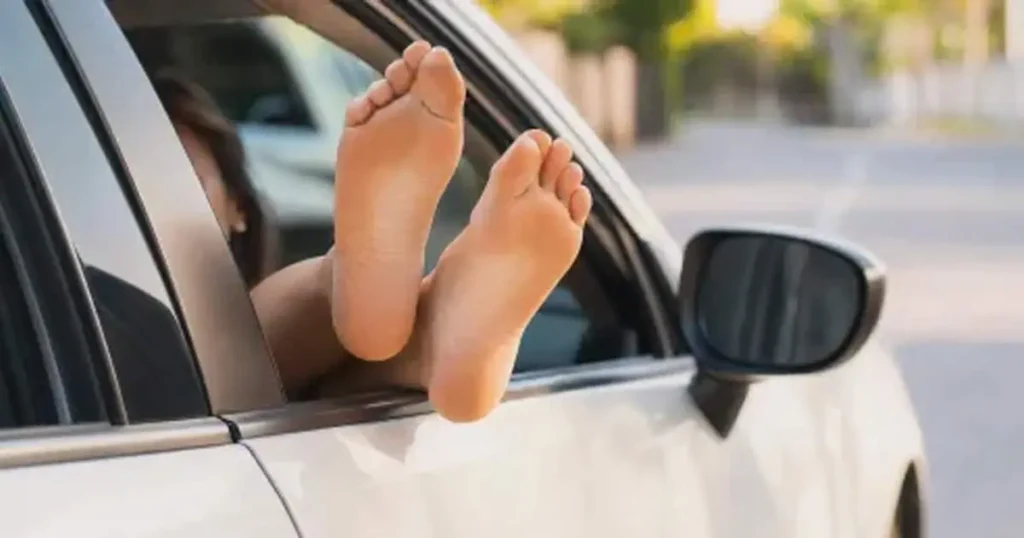

It is not illegal to drive barefoot in Utah. It is not only not illegal to drive barefoot in Utah, it is not illegal to drive barefoot in any state. There is no footwear law in the Utah Code, and you cannot be cited for driving barefoot in Utah. What Utah does have is the Utah Highway Patrol, which has made one of the strongest official statements of any state police department in the nation on this topic. It is legal to drive barefoot. The Highway Patrol advises against it. It’s important for all Utah drivers to understand the pros and cons of that argument.
Key Takeaways
- It’s legal to drive barefoot in Utah. The Utah Code makes no provision for passenger vehicle drivers to wear shoes.
- According to the Utah Highway Patrol: “There is no state law that requires shoes to be worn while driving a motor vehicle. However, common sense should prevail and shoes should be worn. It is much easier and safer to operate a vehicle while wearing shoes.”
- Utah is one of the few states to have made an official safety recommendation against barefoot driving, joining Indiana, Iowa and Missouri in this regard.
- You can’t be ticketed for barefoot driving. A Utah law enforcement officer cannot issue you a ticket or pull you over for driving barefoot.
- Personal injury attorney Craig Swapp says it is legal to drive barefoot in all 50 states. But it’s not legal. The National Highway Traffic Safety Administration (NHTSA) estimates that 16,000 accidents are caused by pedal misapplications each year.
- Utah has a modified comparative fault system. If you drive barefoot and are more than 50 percent at fault in an accident, you may be unable to recover any damages.
Utah Code on Driving Barefoot
The Utah Code is the home of the state’s traffic laws, which are found in Title 41, Motor Vehicles. The code is not specific about what drivers should wear on their feet.
There is no specific requirement in Utah law that drivers wear shoes. However, the Utah Highway Patrol encourages common sense in this regard, and recommends that shoes be worn to make driving safer and easier.
No states have laws prohibiting barefoot driving while operating an automobile. So it’s legal to drive barefoot in Texas, Florida, North Carolina, Tennessee, Indiana, Utah, or any other state.
The criteria for enforcement in Utah, like all states, is the driver’s conduct and control of the vehicle. A driver who drives safely, stays in their lane and does not cause an incident will not be punished for their footwear. The Utah Code’s failure to mention footwear is in line with the national standard.
Utah Highway Patrol’s Statement: An Important Point
This is the critical difference between Utah and other states and what all drivers need to know.
The Utah Highway Patrol’s statement on barefoot driving reads: “It is not a Utah law to wear shoes while driving a motor vehicle. However, common sense should prevail and shoes should be worn. It is much easier and safer to operate a vehicle while wearing shoes.”
This statement is significant for a number of reasons. It is clear, explicit and issued by the state’s main highway enforcement agency. It explicitly states that there is no law, while at the same time offering a safety recommendation with the authority of the patrol. The Utah Highway Patrol makes this information more available than most state agencies.
Utah specifically advises against driving barefoot. In Utah, there is no law requiring shoes be worn when driving. But it is recommended that shoes be worn. It is much safer to drive with shoes on.
This is a significant statement in civil litigation and insurance claims. An insurance company or defense attorney who can cite the Utah Highway Patrol’s published policy as supporting a negligence claim has an advantage over those in other states where police have issued no official statement.
Is it Illegal to Drive Barefoot in Utah?
No. Utah law enforcement cannot pull over or ticket barefoot drivers.
Drivers are not stopped for bare feet. How can they if the police can’t see their feet? But an officer may make a comment during a traffic stop when pulling up to the driver’s window. Although one cannot be issued a traffic ticket for driving barefoot, it is possible that the police officer may strongly recommend the driver wear footwear in the future.
The danger is when unsafe driving is involved. Utah’s traffic code includes reckless and negligent driving provisions that apply when a driver loses control of his or her vehicle, no matter why.
If you’re barefoot when you have an accident, you could be charged with negligence if your lack of footwear contributes to your accident.
In Utah, unsafe driving with bare feet could lead to charges of:
- Negligent driving
- Reckless driving
- Careless driving
- Failure to maintain vehicle control
In all these cases, the charge is directed at the unsafe driving, rather than bare feet per se.
The Impact of Utah’s Modified Comparative Fault Standard on Shoeless Drivers
A modified comparative fault standard is used in civil cases in Utah, as per Utah Code Section 78B-5-818. This standard allocates fault among the parties on a percentage basis. The claimant’s recovery is diminished by their share of the fault, and if the claimant’s fault is greater than 50 percent, they are not entitled to recover anything.
If you are in an accident without shoes, you might be found negligent if being shoeless contributes to your accident. And, if you are in a car accident, you should wear shoes. It could reduce the risk of fractures or foreign objects.
The practical implication is meaningful. In any Utah accident where control of the pedals is an issue, barefoot driving provides a convenient argument that is backed by the Utah Highway Patrol’s public statement. These can be used to assign fault which reduces or eliminates the barefoot driver’s recovery.
Your rates will go up if you are at fault. If you are in an accident, and the police determine your bare feet contributed to the accident, you will likely be fined or issued a citation. This could also raise your rates and make you a higher-risk driver in the eyes of your insurance company. Also, if your barefoot driving was a factor in the accident, your car insurance may not pay your claim.
The Impact of Barefoot Driving on Insurance Claims in Utah
Beyond the possibility of civil liability, barefoot driving may impact the decisions of Utah insurance companies, even if no citation was issued.
Utah drivers need to know that the Utah Highway Patrol’s statement provides insurers with an unusually strong official statement to support the argument that a barefoot driver did not use common sense while driving. If this argument is successful, it can result in lower compensation or a denial of the claim for any accident where control of the pedals is in question.
You also don’t know when your car might break down or require maintenance, and you do not want to be without shoes. Driving safety is of the highest priority, so do what you can to be safe.
This argument is moot if you carry a pair of flat driving shoes in the car.
How Utah Ranks
The Utah combination of legality and an official recommendation for safety from the Highway Patrol places it in a unique position among the U.S. states.
| State | Barefoot Driving Legal | Official Safety Position | Negligence Standard |
| Utah | Yes | Highway Patrol explicitly recommends shoes | Modified comparative (50% bar) |
| Missouri | Yes | Formally condemned as unsafe | Pure comparative |
| Iowa | Yes | Formally condemned as unsafe | Modified comparative (50% bar) |
| Indiana | Yes | Formally condemned as unsafe | Modified comparative (50% bar) |
| Ohio | Yes | BMV advises against it | Modified comparative (51% bar) |
| Arizona | Yes | Reckless driving risk if accident | Pure comparative |
| Georgia | Yes (cars) | No formal position | Modified comparative (50% bar) |
| California | Yes | CHP confirms no restriction | Pure comparative |
| North Carolina | Yes | No formal position | Contributory (full bar) |
| Alabama | Yes (cars) | Warns against motorcycle barefoot riding | Contributory (full bar) |
| Tennessee | Yes | Formally condemned as unsafe | Comparative |
| Oklahoma | Yes | No formal position | Modified comparative (51% bar) |
| Florida | Yes | No formal position | Pure comparative |
| Michigan | Yes | No formal position | Modified comparative |
| Texas | Yes | No formal position | Modified comparative |
| Illinois | Yes | No formal position | Modified comparative |
The Utah modified comparative fault standard is less permissive than the pure comparative fault standard in Missouri, but similar to Iowa and Indiana. The Highway Patrol’s published recommendation strengthens the civil liability case against barefoot driving in Utah over states without clear guidance.
Is Barefoot Driving Safe? A Utah-Specific Assessment
The Utah Highway Patrol’s statement is based on real concerns about traffic safety. The variety of driving conditions in Utah, from freeways in Salt Lake City to mountain passes and desert roads, make these concerns especially pertinent.
Genuine Risks
One of the reasons you shouldn’t take your shoes off is because your bare foot is more likely to slip off the pedals. Or, more likely than if you have a shoe on. If you are wearing slippery shoes such as heels or flip-flops, then the risk of falling off the pedal is even greater. There is even the risk of the shoe slipping, getting caught on the pedal and causing even further harm.
Other dangers unique to driving in Utah include:
- Mountain driving: Utah’s canyon roads and mountain passes require frequent, precise braking. Reliable grip on the pedals is needed on steep downhill grades where bare feet can’t provide the same.
- Winter conditions: Utah receives a lot of snow. Frozen bare feet on frozen metal pedals greatly diminish pedal feel and effectiveness in the state’s common winter weather.
- Desert heat: Southern and western Utah are very hot in summer. Hot car interiors warm pedals, making bare feet uncomfortable and distracting.
- Highway driving: Utah’s size means many trips involve long distances, where the lack of shoe support leads to foot fatigue.
When Bare Feet Are Safer
It’s safer to drive barefoot than in heels or flip-flops. Safety experts rank some footwear as more hazardous than bare feet.
Certain types of shoes and laces can catch and pose safety hazards. You may be better off driving barefoot if you have to drive in loose shoes. Each year, people are involved in accidents or close calls when their shoes get stuck or stop them from reaching the brakes. Anything that increases your stopping distance can be a cause of a car crash.
The footwear risk comparison below is typical:
| Footwear Type | Pedal Control | Risk Level |
| Barefoot | Moderate | Medium |
| Flat sneakers | High | Low |
| Flip-flops | Low | High |
| High heels | Very low | Very high |
| Heavy boots | Low-Moderate | Medium-High |
| Sandals | Low | High |
When You Shouldn’t Drive Barefoot in Utah
While barefoot driving is legal in Utah, certain driving conditions are best avoided for bare-footed drivers:
- Mountain driving in winter: Cold, snow and ice make winter mountain driving the most dangerous time for bare-footed drivers in Utah
- Canyon roads: Canyon roads’ steep inclines and sharp curves require precise and sustained control of the pedals
- After water sports: Utah’s plethora of lakes, rivers and hot springs create the slippery conditions at highest risk for pedal slip
- Desert summer driving: Southern Utah’s hot climate makes it uncomfortable and unsafe to drive barefoot in a hot car
- Long interstate trips: Utah’s long highway drives cause foot fatigue without shoe protection
Expert and Legal Perspectives
Craig Swapp, a personal injury attorney with Craig Swapp and Associates, a prominent Utah-based law firm, has confirmed that barefoot driving is legal in all 50 states, and has also stated that the National Highway Transportation Safety Administration (NHTSA) data indicates that 16,000 crashes are caused by pedal application error annually. He advises that while barefoot driving is legal, the case for safety and footwear is supported by federal accident statistics.
Flickinger Boulton Robson Weeks, a Utah personal injury law firm that has served accident victims throughout the state since 1993, offers specific advice. Their research confirms that barefoot driving is not illegal in Utah but that it can lead to a negligence citation if lack of footwear contributes to an accident. They recommend that the safety and legal protection benefits of driving with shoes on is an opportunity that should not be missed.
LawInfo, a national legal information website reviewed by lawyers, reports that no state law prohibits barefoot driving. Their research supports the conclusion that the Utah Highway Patrol’s advice is a safety endorsement, not a legal prohibition, but one that does have legal implications in civil court and insurance claim settlements.
Also Read: Is It Illegal To
Conclusion
It’s legal to drive barefoot in Utah. There is no mandatory footwear requirement for passenger vehicle drivers in the Utah Code, no police officer can legally issue you a citation for driving barefoot in Utah, and Utah is in the same legal position as all other states in the nation. The barefoot driving myth has been widely debunked, and in Utah, like the rest of the country, barefoot driving is not prohibited by law.
The unique aspect of Utah is the Utah Highway Patrol’s published policy formally advising drivers to wear shoes for safety reasons. This is one of the most explicit statements by a state law enforcement agency in the US. It is not punishable by law but it raises a practical issue in determining fault in any accident involving pedal control. Under Utah’s modified comparative fault system, a substantial allocation of fault for barefoot driving can reduce or even void your claim for damages.
The simplest precaution is also the best. Always have a pair of safe, flat and closed-toe shoes in the car. In Utah, where the Highway Patrol has recommended shoes are easier and safer, this practice eliminates an official state policy from being used against you in any insurance or court case.
Frequently Asked Questions
1. Is it illegal to drive barefoot in Utah?
No. There is no law in the Utah Code against barefoot driving. All drivers in the state are free to drive barefoot.
2. What does the Utah Highway Patrol think of barefoot driving?
The Utah Highway Patrol has released a statement stating that there is no law against barefoot driving, but that it does recommend drivers wear shoes because it is easier to drive with shoes. This is among the strongest public safety statements by any state police department in the nation.
3. Will I be pulled over in Utah for driving barefoot?
No, just for driving barefoot. A police officer cannot issue a citation for barefoot driving alone. A citation can only be issued if the driver is engaging in unsafe driving or if barefoot driving is deemed to have caused an accident.
4. What are the effects of the Utah modified comparative fault system?
Utah Code Section 78B-5-818 is a proportionate fault statute. If driving barefoot contributed to the accident, and you are found to be more than 50 percent at fault, you will be barred from recovering damages.
5. Will the insurance company hold barefoot driving against me in Utah?
Yes, potentially. It can be used as an element in establishing fault, or to reduce or reject a claim. The Utah Highway Patrol’s recommendation provides insurers with an official “stamp of approval” that they would not have in states where law enforcement has not taken a position on the issue.
6. Is it safer to drive barefoot than in flip-flops in Utah?
In many cases, yes. Flip-flops can slip off or get caught under pedals, which is more dangerous than bare feet in most instances. Open-toe sneakers with a flat sole are the safest footwear overall, and consistent with the Utah Highway Patrol’s published advice.