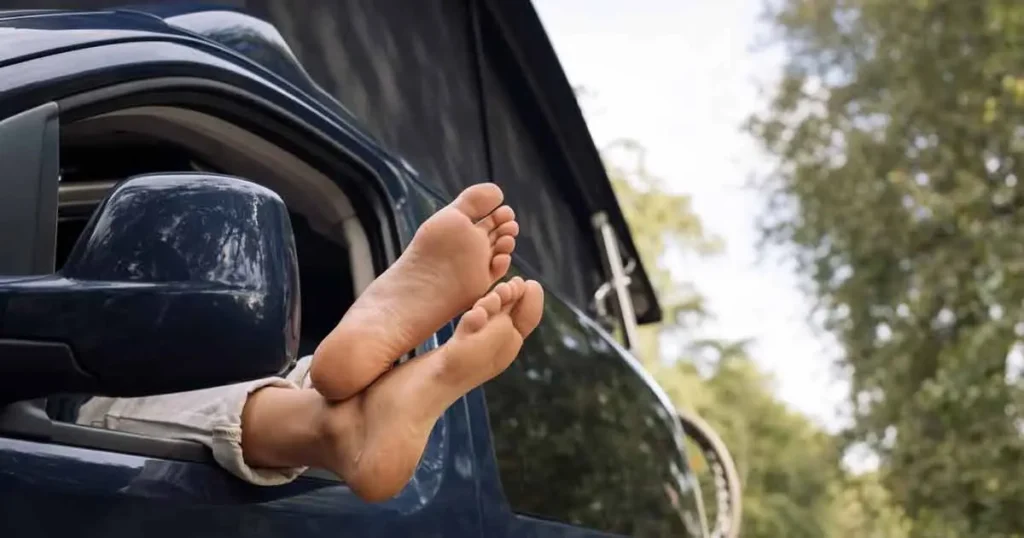

No, it is not illegal to drive barefoot in California. The California Vehicle Code does not specify any footwear requirements of drivers, so one can drive a vehicle with no footwear. A cop cannot stop you because you are barefooted and no ticket can be given because you drove barefooted. The question of law is decided. What is still applicable to California drivers is the independent issue of civil liability, insurance risk, and the real-world safety issues that come into play when barefoot driving is a factor in the loss of vehicle control.
Key Takeaways
- In California, it is not unlawful to drive without shoes. The California Vehicle Code does not specify any footwear requirements of drivers.
- California Highway Patrol has affirmed that no state laws exist to ban driving with bare feet.
- You cannot be cited solely for driving without shoes. No police officer can legally give a ticket to barefoot driving.
- California has a comparative negligence system. In case it has been determined that driving barefoot has resulted in an accident, it is able to lower your compensation in a proportional manner.
- In California, barefoot motorcycle riding is not illegal, as it is in Alabama, which is the only state to explicitly forbid it.
- Even in cases where there is no citation, insurance companies can increase the amount of barefoot driving as a cause of accident claims.
- The barefoot driving myth is common throughout California, although it is not legal.
What the California Vehicle Code Says About Barefoot Driving
The Vehicle Code of California is one of the most detailed traffic laws in the nation that encompasses licensing, registration, road regulations, equipment regulations and driver behavior. It is completely silent on the topic of footwear.
The California Vehicle Code does not have any particular laws against driving a vehicle with bare feet. Moreover, the federal laws do not prohibit driving with bare feet.
However, contrary to the common assumption, there is no exact law in California that can outlaw driving without shoes. The California Vehicle Code does not directly deal with the problem of barefoot driving.
California, like any other state, has its standard of enforcement which revolves around driver conduct and control of the vehicle. A driver who is safe, disciplined in the lane and does not cause an incident will be spared a legal penalty no matter what he or she is wearing on his or her feet.
In all the states of the United States, including California, it is legal to drive without shoes. The only way that you could be cited was when the officer on the scene of the accident thinks that you caused a crash due to your inadequate footwear.
Is it Legal to be Pulled Over or Ticketed in California due to Barefoot Driving?
No. California law enforcers have no statutory right to pull over or cite a driver on the grounds of driving barefooted.
Police is not allowed to stop you on the basis of not wearing shoes.
In case a driver did get stopped by a law enforcement officer and he saw his bare feet, he cannot issue a citation.
This is different when unsafe behavior comes into the picture. California Vehicle Code Section 23103 deals with reckless driving, which is defined as driving a vehicle with willful or wanton disregard of the safety of people or property. Driving barefoot is not up to this standard.
Being barefoot would not suffice to get a negligent driving ticket. A motorist would be forced to be doing something unsafe with bare feet. An example is that one might cite lifting the pedal with the toes or removing shoes when driving actively.
Some of the unsafe driving charges that may be incurred due to barefoot driving are:
- Negligent driving
- Impetuous driving in violation of the California Vehicle Code 23103.
- Loss of control of the vehicle.
All these accusations are directed at the behavior, rather than the lack of shoes.
The impact of Barefoot Driving on Liability in California
The state of California uses pure comparative negligence in civil actions. This implies that the blame is shared among all the parties and the recovery that a claimant obtains is less than the percentage of his/her fault. In contrast to Alabama or North Carolina, where contributory negligence is used and may preclude damages altogether, California permits a driver to recover damages despite being at fault.
This does not however imply that barefoot driving does not have any civil risk.
Although driving with bare feet is not a crime, it can be one of the contributing factors in case a driver is involved in a motor vehicle accident. This may influence car insurance claims and legal action in case it is discovered that a lack of proper footwear is one of the factors that led to an accident.
Should there be an accident where the driver at fault was barefooted, then the other party or their insurance company could use it as an aggravating factor and claim that the driver was not taking the right precautions and would place a greater percentage of fault on them. In other instances, insurance firms may attempt to employ any circumstance such as driving without shoes to reduce their liability or evade paying compensation.
There is no legislation specifically stating that driving with bare feet is permissible but there is also no legislation that states that it is illegal. A barefoot driver can be found negligent in case driving with barefoot is one of the causes of an accident. To determine the liability in civil liability, barefoot driving is equated to other potentially negligent acts, under California comparative negligence laws.
The practical implication is simple. It is legal to drive barefoot. Pedal control is one of the factors that come against you in court and insurance negotiations in any accident where the issue of control is doubted.
In California, Is it Legal to Ride a Barefoot Motorcycle?
Yes. California does not impose a restriction on the motorcyclists as Alabama, the only state in the country to have a statutory prohibition on barefoot riding of motorcycles.
California has no laws against riding a motorcycle without shoes. Although helmets are required, there are no requirements for other riding gear. Police and traffic safety authorities recommend wearing shoes and protective eyewear, but it is not required.
Safety agencies and the California Highway Patrol have always suggested proper footwear to motorcyclists because of the risk of exposure to road debris and the risk of injury in an accident. That suggestion is not legally binding, though. A California motorcyclist who rides barefoot does not commit a statutory offense.
Comparison of California with other states
The state of California has the same legal stance on barefoot driving as the rest of the country, with one significant difference between the state and some others in the manner in which the civil liability is addressed.
| State | Barefoot Car Driving | Barefoot Motorcycle Riding | Negligence Standard |
| California | Legal | Legal | Comparative (partial recovery allowed) |
| Alabama | Legal | Illegal by statute | Contributory (full bar on recovery) |
| North Carolina | Legal | Legal | Contributory (full bar on recovery) |
| Tennessee | Legal | Legal | Comparative (local ordinances may apply) |
| Texas | Legal | Legal | Comparative (modified) |
| Florida | Legal | Legal | Comparative (modified) |
| Michigan | Legal | Legal | Comparative (modified) |
| Ohio | Legal | Legal | Comparative (modified) |
| Oklahoma | Legal | Legal | Comparative (modified) |
The comparative negligence system in California is more accommodating to barefoot drivers as compared to contributory negligence states. A discovery that barefoot driving was a cause of an accident will diminish your recovery, but not completely wipe it out. Such a difference is relevant in high-value accident claims.
Is Driving with Barefoot safe? A California-Specific Assessment
The legal issue is addressed. The question of safety should be given its own fair analysis, especially to the California drivers who have to deal with numerous driving conditions, such as the congested urban freeways and the winding coastal roads and mountain passes.
Genuine Risks
- Wet /sweating feet decrease the grip on the pedals and the chances of slipping are high.
- No protection against injury in a collision or floor debris is afforded by bare feet.
- Manual transmission cars have a higher pressure on the clutch pedal, and bare feet cannot press it as effectively.
- The longer a driver drives with his feet uncovered, the higher the chances of having blisters or discomfort which causes more distraction and the more unsafe it becomes to drive with the feet uncovered with time.
When Bare Feet Can Be the Better Choice
Certainly, it can be safer to drive with barefoot than with flip-flops. When an individual has flip-flops and has to drive, it may be wiser to take off the flip-flops and walk with bare feet. Individuals who get into accidents due to the slipping of their flip-flops on car pedals may also be charged with reckless driving.
The overall safety agreement is summarized by the footwear risk comparison below:
| Footwear Type | Pedal Control | Risk Level |
| Barefoot | Moderate | Medium |
| Flat sneakers | High | Low |
| Flip-flops | Low | High |
| High heels | Very low | Very high |
| Heavy boots | Low-Moderate | Medium-High |
| Sandals | Low | High |
A survey in England found that 1.4 million traffic accidents per year might be due to improper use of footwear. As many as 60 percent of those surveyed said they do not drive in the right shoes. Although that information is based on European drivers, the same principle can be applied to California roads.
When It is Best to Avoid Barefoot Driving in California
Even in legal settings, some California driving conditions increase the risk in practice significantly:
- Driving on the coast following a visit to the beach: Wet, sandy feet are a serious risk of pedal slip.
- Freeway driving: High speeds demand consistency and reliability in responding to the pedals.
- Manual transmission cars: The use of the clutch requires more foot pressure and accuracy.
- Mountain roads: Unpredictable gradients, frequent and controlled braking is needed.
- Night driving: There is less room to spare in responding to the delay because of reduced visibility.
The easiest thing to do that will remove all these issues is to have two flat, closed-toe driving shoes in the car. This is a habit that many California drivers who visit the beach have adopted to specifically transitioning between sand and road.
Professional and Legal Views
Peter M. Liss, a criminal defense and traffic lawyer based in Vista, confirms that barefoot driving is completely legal in California and that any ticket based on this alone can be contested in court. His advice is in line with the accepted interpretation of the California Vehicle Code: the law does not target shoes, but unsafe conduct.
According to lawyers in LA Century Law, a car accident litigation firm with a long history of litigating personal injuries in San Bernardino, the law is lenient, but the perceived danger of driving barefoot may be used against a driver in a court of law. They note that jurors who think that barefoot driving ought to be criminalized might be tempted to conclude that negligence exists when it is not necessary by the legal standard.
FindLaw, a respected source of legal information nationally, reports that no California law criminalizes barefoot driving, and that any reckless driving accusation would demand proof of an act well above the lack of footwear.
Also Read: Is It Illegal to
Conclusion
In California, it is not illegal to drive with bare feet. The California Vehicle Code does not specify any footwear, the California Highway Patrol has officially asserted this stance, and no officer may legally issue a citation to a driver on the basis of barefoot driving in isolation. This stance is in line with all other states in the country.
The point that California drivers ought to learn is that legal permissibility and civil safety are two distinct issues. The comparative negligence system in California implies that barefoot driving will not eliminate your recovery but will cut it down in case it has been identified to have played a role in an accident. That is a substantially improved result compared to the contributory negligence states, but it remains a decrease that can be prevented by careful footwear habits.
The most feasible solution is to have flat, closed-toe driving shoes in the car at all times. It dispels all the liability argument, eradicates the safety risks and is free to keep as a habit.
Frequently Asked Questions
1. Can you drive barefoot in California?
No. The California Vehicle Code has no law against driving barefoot. Both car and motorcycle drivers are free to use it.
2. Can a police officer in California pull me over and ticket me because I was driving with bare feet?
No. A barefoot driving is not a legal reason to issue a citation by an officer. Unsafe driving behavior is also a requirement to cite.
3. Does barefoot driving have any impact on a personal injury claim in California?
Yes, potentially. California applies comparative negligence, i.e., fault is apportioned equally. When it is established that you were driving barefoot and this has contributed to the accident, your portion of the blame is more and you are less likely to receive compensation.
4. Is it legal to ride a motorcycle barefoot in California?
Yes. California does not mandate motorcyclists to wear footwear. The use of helmets is mandatory, but not any other equipment, such as shoes. Footwear is recommended by safety organizations, but is not legally mandatory.
5. Do shoes have to be worn when driving in California DMV?
No. California DMV discourages driving barefoot on safety grounds, but this is not legally binding. There is no footwear requirement mentioned in DMV handbook or in the Vehicle Code.
6. Is it safe to drive barefoot than it is to drive in flip-flops in California?
In many cases, yes. Flip-flops are often known to be more hazardous than bare feet as they may fall off or be trapped by the pedals. The safest in general are flat, closed-toe sneakers with a firm sole.