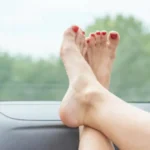

No, there is no law against driving barefoot in North Carolina. The North Carolina General Statutes do not provide any section that necessitates the drivers to wear shoes and the state DMV handbook does not mention the footwear requirement. A motorist who has been pulled over by the police cannot be mentioned due to his being barefooted. With that said, there are two different considerations: legality and safety. In case it is discovered that you were driving barefoot and that it compromised your ability to control your vehicle, the traffic laws of North Carolina allow you to be cited as having driven recklessly or carelessly, and the rules of contributory negligence could have an impact on your position in any claim of an accident.
Key Takeaways
- In North Carolina, there is no law against driving with bare feet. It is not forbidden by any statute in the North Carolina General Statutes.
- Footwear is not necessary in the NC DMV driver handbook.
- You cannot be ticketed because you were behind the wheel in bare feet.
- Nevertheless, when driving barefoot is a cause of accident or loss of control over the vehicle, you can be cited with careless or reckless driving.
- North Carolina has a contributory negligence system, which is among the most stringent in the nation. Any partial responsibility in a crash can make you ineligible to compensation.
- The identical legal stance is applicable in all 50 states. None of the states in the U.S. prohibit driving barefoot in a regular passenger car.
What the North Carolina Law says about Barefoot Driving
North Carolina does not have any law that restricts driving without shoes. There is no law in the North Carolina General Statutes that states that it is illegal to drive a car without shoes and there are no rules in the NC DMV driver handbook that mandate drivers to wear shoes. Mehta & McConnell
This lack of regulation is nationwide. The state of North Carolina is not an exception as traffic law permits the operation of a motor vehicle by a driver with bare feet.
North Carolina has a legal system that focuses on the conduct of drivers and the regulation of vehicles and not clothing or footwear. The North Carolina General Statutes, which regulates motor vehicles and traffic, is found in chapter 20, and covers reckless driving, impaired operation, and safe vehicle handling, but it does not specify what a driver wears on their feet.
From a statutory standpoint, barefoot driving is allowed in North Carolina. It is affirmed by a number of authoritative sources of law in the state, which refer to the myth that barefoot driving is illegal.
Is it possible to be ticketed in NC due to driving with bare feet?
Not directly, no. In North Carolina, a citation of barefoot driving is not a legal matter that a police officer can issue. But this is not the case when the absence of footwear is related to unsafe driving.
Although the NC law does not forbid driving with bare feet, under some circumstances, a citation can be given by the police. When a driver loses control of his/her vehicle because of misuse of the gas pedal or brake pedal, the officers can deem this to be failure to use the vehicle safely.
The principle of NC law enforcement Sgt. Bethea puts it plainly: As long as you’re driving safely, you’re driving legally, and you’re driving to where you are aware of all the other people on the road, that is what we are concerned about.
Some of the potential charges that may be caused by unsafe driving due to bare feet include:
- Careless driving
- Reckless driving
- Loss of control of the vehicle.
In all such instances, the charge is made against the unsafe conduct, as opposed to the lack of shoes.
Contributory Negligence Rule of North Carolina: A Critical Legal Factor
Herein lies the difference between North Carolina and the majority of other states, and it is an aspect that should be taken into consideration.
Contributory negligence system in North Carolina is one of the most stringent in the country. You can be precluded in recovering damages in case you are found at fault in a crash in 1% or more. This legal criterion causes even the smallest details, such as your footwear, to be crucial. When you were involved in an accident and you were not wearing shoes at the time, and an insurance company can claim that your decision contributed to the accident, this can impact on your compensation recovery.
It is not a hypothetical issue. Insurance adjusters and opposing counsel regularly investigate the events of an accident. Although it is not illegal, barefoot driving can be brought up as an indication of diminished pedal control or a lack of reaction ability. You might not be given a ticket on it, but it can cost you a lot in a civil claim.
Although barefoot driving is not a traffic offense, it can still be regarded as negligent in case it leads to an accident. The driver safety laws in North Carolina stipulate that a driver must have control of their vehicles at all times. In case the shoes you wear, or no shoes, affect your braking, steering, or acceleration capabilities, it may affect the way fault is decided upon in the aftermath of an accident.
Also Read: Is It Illegal To
The Myth Lives on
There are a lot of drivers in North Carolina who think that it is illegal to drive without shoes. This is not the only misconception that the state has and its roots are well documented.
The majority of drivers believe that driving with bare feet is illegal due to warnings in driver education, parental or teacher counseling, lack of understanding of safety rules and misinterpretation of the law on safe driving. The myth was enhanced by some historical evidence of safety campaigns that discouraged barefoot driving.
A man named Jason Heimbaugh approached the motor vehicle departments of each of the 50 states directly in the 1990s, to put an end to the question. All the states affirmed that it is not illegal to drive without shoes. The issue has been resolved in terms of law decades ago. Still going round is the informal advice mistaken with the law prohibition.
Comparisons between NC and other states
The legal status of barefoot driving in North Carolina is the same as that of the rest of the United States.
| State | Barefoot Driving Legal? | Key Note |
| North Carolina | Yes | No statute; control required at all times |
| Texas | Yes | No footwear law in Transportation Code |
| Florida | Yes | Unsafe driving citations possible |
| Michigan | Yes | No provision in Michigan Vehicle Code |
| Tennessee | Yes | Traffic code carries no prohibition |
| Alabama | Yes (cars) | Motorcycle riders may be required to wear shoes |
| California | Yes | Liability implications in accidents |
| Ohio | Yes | Myth persists; no law exists |
| Oklahoma | Yes | Behavior-based enforcement only |
None of the U.S. states have legislations which prohibit barefoot driving. The law used in all states is identical: footwear is not controlled, safe vehicle operation is.
Is Driving Barefoot safe? An Honest Assessment
The safety question and the legal question are different. In North Carolina, the law allows driving barefoot. The question of whether it is prudent or not is a matter of circumstances.
Possible Advantages
Drivers have discovered that wearing no shoes helps them to have a better feel of the pedal. They complain that they have better braking and acceleration with no thick sole between foot and pedal. There are some cases when bare feet may be better than problematic shoes.
Genuine Risks
Safety professionals state that there are some valid concerns:
- Wet or sweaty feet may cause the pedals to slip, decreasing braking power.
- In an accident where foot injury is a possibility, bare feet do not provide any protection.
- Long commutes can cause foot fatigue without the support of a shoe.
- The decreased grip on the pedal surface can influence reaction time.
Pedal malfunctions like a foot slipping off the gas or brake result in up to 16,000 accidents annually as reported by the National Highway Traffic Safety Administration and may be caused by drivers in specific types of shoes like flip-flops and high heels, but also by a lack of contact between the foot and the pedal. Yahoo News
The Footwear Comparison
| Footwear Type | Pedal Control | Risk Level |
| Barefoot | Moderate | Medium |
| Flat sneakers | High | Low |
| Flip-flops | Low | High |
| High heels | Very low | Very high |
| Heavy boots | Low-moderate | Medium-High |
| Sandals | Low | High |
Sometimes, going barefoot can provide superior control to wearing the incorrect kind of footwear. Flip-flops may slip or get trapped under pedals, high heels decrease the contact with and control of the pedal, heavy boots may slow down the response of the pedal, or block the sensitivity of the feet.
The overall advice of legal and safety specialists is similar, flat, closed-toe footwear with a hard and thin sole offers the best control of the pedal and the least legal liability.
Barefoot Driving Is Inadvisable in NC
Barefoot driving has high practical risk in the following conditions even where it is legal:
- Wet weather: Water on feet or floor mats greatly enhances the possibility of pedal slip.
- Heavy traffic: Braking requires complete pedal grip as it is precise and quick.
- Long-distance driving: Barefoot pedal consistency is influenced by fatigue with time.
- New cars: Pedal positions and distance will demand increased foot awareness.
- Night driving: A decrease in visibility makes any delay in braking response more difficult.
One of the reasonable measures is to have a pair of flat, closed shoes in the car. This will be free and the liability issue will be completely removed.
Expert and Legal Viewpoints
Drivers, according to the lawyers of Mehta and McConnell, a personal injury law firm based in Charlotte, NC, can contribute surprisingly to the liability discourse in the aftermath of a car crash in North Carolina, including the footwear they wear. Their advice is that the contributory negligence standard of the state is such that it would be wise of drivers to do away with any aspect that might be described as contributing to unsafe operation.
On several occasions the American Automobile Association has said that barefoot driving is not illegal in the United States but has also said that safety and legality are two distinct issues. They argue that it is the responsibility of the drivers to determine whether they can control the vehicle or not despite the type of footwear they wear.
The existence of the myth is confirmed by a legal study by the lawyer Carl J. Britt Jr., who states that although the myth persists, no state law in North Carolina or elsewhere in the nation attacks barefoot driving as a punishable offense in itself.
Also Read: Is It Illegal to Drive Barefoot
Conclusion
In North Carolina, it is legal to drive with bare feet. It is not outlawed by any statute in the general laws of the state, nor can any officer charge you with it, nor is any footwear requirement imposed on any driver by the NC DMV. All other states in the country share this stand. The barefoot driving myth that it is illegal has persisted because of informal driving tips and misinterpreted road signs, rather than the law.
Safe vehicle operation is what North Carolina does enforce, and enforce strictly. The contributory negligence rule in the state is one of the worst in the country, and this is to say that any circumstance that can be construed to have caused an accident such as the lack of shoes can have a serious impact on your legal position. Wearing no shoes when driving is a right. The question of whether it is a viable decision to exercise or not depends on the road, the weather and what shoes you would have been wearing.
In any case of uncertainty, a good pair of flat, closed-toe shoes will be the surest and least legally problematic choice.
Frequently Asked Questions
1. Is it illegal to drive barefoot in NC?
No. There is no law in North Carolina against driving with bare feet. Your choice of footwear cannot be a ticket.
2. Does a North Carolina police officer have the right to stop you because you were driving with bare feet?
Not because of that reason. A vehicle cannot be stopped just because the driver is barefoot by an officer. Stop can only be made in case unsafe driving behavior is witnessed.
3. Does the contributory negligence law in North Carolina apply to barefoot drivers?
Yes, potentially. In the event of an accident, and an insurer or a court concludes that you have lost control due to driving with bare feet, the contributory negligence standard of North Carolina might prevent you to receive any damages, even when the other driver was the main cause of your loss.
4. Is it safer to drive with bare feet than with flip-flops?
In many cases, yes. The flip-flops are prone to slipping off or getting stuck under the pedals, posing a more dangerous experience than bare feet. Overall, flat, closed sneakers are the safest.
5. Does a state in the U.S. have a ban on driving barefoot?
No. Every state (except 50) allows barefoot driving in regular passenger cars. The only state that has an exception to motorcycles is Alabama, in which there are some footwear requirements to riders, but not drivers of cars.
6. Will my insurance company work against me in a claim by using barefoot driving?
Potentially, yes. Insurers can increase it as an aspect of fault determination especially in North Carolina where contributory negligence is applicable. It does not necessarily prove liability, but can be utilized to create a case against you.