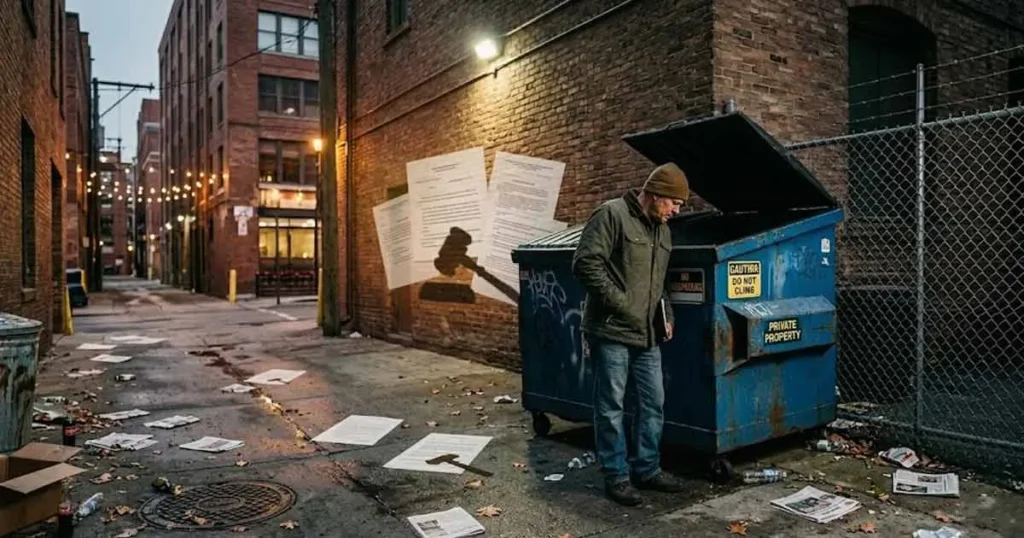

There is no state-wide legislation in Pennsylvania that prohibits dumpster diving. Pennsylvania’s criminal code does not have an explicit section dedicated to the crime of rummaging through garbage. As in all other states, trash left out for public collection is abandoned property and does not have a reasonable expectation of privacy, as determined by the U.S. Supreme Court in California v. Greenwood (1988). However, there are restrictions on that federal permission, and in Pennsylvania, one of the country’s most unambiguous criminal trespass laws exists. The legal landscape changes the moment the dumpster is on private property, behind a fence or near a posted sign. Pennsylvania Title 18, Section 3503 is a clear-cut law and any violation, even for a brief period, can lead to misdemeanor charges.
Key Takeaways
- There is no specific legislation in Pennsylvania that deals with dumpster diving. There is no reference to the practice in state code.
- The federal case of California v. Greenwood (1988) allows dumpster diving on public property in all 50 states, including Pennsylvania.
- The legal threat to anyone approaching a dumpster on private property is from Pennsylvania’s criminal trespass statute, which is found in Title 18, Section 3503.
- In addition to the trespass law, Philadelphia and Pittsburgh have municipal regulations on municipal waste.
- As long as they contain anything, trespass law protects most retail dumpsters in Pennsylvania, including those at Sephora.
- Penalties for criminal trespass in Pennsylvania range from a summary offense (fine only) to a third-degree misdemeanor depending on how the trespass is committed and whether warnings were given.
- Dumping at Sephora in Pennsylvania is a special risk as the majority of store dumpsters are located in enclosed service areas and the company has a corporate policy against dumpster diving.
The law of Pennsylvania does not actually say that
The state of Pennsylvania doesn’t have any regulations on dumpster diving per se. The Pennsylvania Consolidated Statutes does not mention “dumpster diving.” What you will discover is a broad criminal trespass law that applies to anyone approaching a commercial refuse container behind a business, without authorization.
The first step in comprehending dumpster diving in any U.S. state is to refer to California v. Greenwood, 486 U.S. 35 (1988). If so, the Court ruled, garbage placed at the corner of private land has no reasonable expectation of privacy. The entry of any person, including law enforcement, into any garbage without a warrant is not a federal offense. This was in response to a police search, but the reasoning has been used consistently since then in civilian dumpster diving.
This is the federal standard for public property, and does not conflict with Pennsylvania state law. Where it does assert authority is over private property. Nearly all commercially viable dumpsters are located on private property in Pennsylvania.
Pennsylvania’s Criminal Trespass Law: Title 18, Section 3503
The statute most applicable to the Pennsylvania dumpster divers is 18 Pa. C.S. § 3503. This provision clarifies the meaning of criminal trespass and provides penalties for such trespass. It’s not a “generic” trespass law, it’s one of the “cleaner” and “more clearly drafted” trespass laws in the mid-Atlantic.
A person commits criminal trespass if he or she:
- Knowingly enter a building or occupied structure or a separately secured or occupied portion of a building or occupied structure without authority or privilege.
- Enter any structure or building.
- Enter or remain on land or premises after direct communication from the owner or a representative that entry is not permitted.
- Enter posted land on which the posting is reasonably conspicuous.
The third and fourth clauses are the ones that are most relevant to dumpster divers. The third clause holds that criminal trespass starts when a store employee, security guard or property manager instructs you to leave and you do not leave. The fourth clause would apply even if there were No Trespassing signs on the property, but the dumpster itself was not separately marked, provided that entering the property to access the dumpster would trigger the statute.
There are various degrees of penalties for Section 3503:
- A summary offence is used for unlicensed entry where there is no signage or enclosure.
- If entry takes place at a premise that is fenced or posted, a third degree misdemeanor is charged.
- If the entry is to a dwelling or an occupied structure, a second degree misdemeanor is the charge.
In Pennsylvania, a third degree misdemeanor is punishable by up to 1 year in prison and a $2,500 fine. Though the maximum sentence is not usually imposed on first-time offenders, the consequences of a minor misdemeanor conviction on a criminal record should not be overlooked.
Waste Regulations and Commercial Property Rules are currently in effect in Philadelphia
Philadelphia has a complex legal landscape for dumpster divers. Commercial waste is regulated jointly by the city’s Streets Department and Department of Sanitation in the Philadelphia Code, Chapter 10-700, Storage and Collection of Refuse.
The municipal code in Philadelphia defines commercial waste as waste that is dropped off in a container, making it part of the city’s waste stream. Unauthorized removal of materials from commercial containers can be considered a municipal violation in addition to any state trespass charge. That means that a dumpster diver in Philadelphia could be charged with a city code violation and state trespassing in the same incident.
In reality, the areas that are most heavily patrolled in Philadelphia are the commercial corridors. Business districts of Center City, University City, Fishtown and South Philadelphia have private property management companies that have enclosed refuse areas and actively report unauthorized access. Numerous commercial businesses in these areas have security or cameras watching their service alleys and dumpster enclosures.
Philadelphia also has a history of monitoring of dumpsters containing sensitive documents in financial, medical and legal offices, where policies and sometimes police assistance are in place for enforcement specific to identity theft-related dumpster diving businesses.
Pittsburgh: Allegheny County Waste Rules
The City of Pittsburgh’s policy on refuse regulation is embedded in the City’s own municipal code and in the waste management policy of Allegheny County. The City of Pittsburgh Code, Title 6, Part 2 contains provisions that regulate the collection of solid waste and refuse and restrict the removal of items from City-managed or contracted solid waste and refuse containers.
Private waste haulers are used for most commercial properties in Pittsburgh, such as the Strip District, Oakland, Shadyside and Squirrel Hill business corridors. The dumpsters are located on private property behind restaurants, retail stores and office buildings in these areas. These containers are subject to protections under the Allegheny County property rights statute as are containers under the Pennsylvania state trespass statute.
Pittsburgh’s police department processes complaints of dumpster diving on a case-by-case basis. Commercial areas close to large retail areas will usually receive a warning first. Repeat incidents or incidents with enclosures or posted signs are likely to lead to a citation.
Other Pennsylvania cities and municipalities
The dumpster-diving practices of other municipalities in Pennsylvania are in large part a product of their individual ordinances and the local police.
Allentown regulates commercial refuse under its solid waste ordinance, and requires that waste containers not be accessible to unauthorized persons, which applies directly to commercial dumpsters.
There are no specific anti-dumpster diving ordinances in Reading or Erie on record, but trespass law would apply to any container on private property.
In recent years, food rescue and food waste recovery has gained momentum in Lancaster, though there is no dedicated ordinance for refuse access, the county’s agricultural and commercial zones have private property protections.
State trespass law is also the main enforcement tool in Scranton and Harrisburg, and city waste regulations govern access to city containers.
Enforcement is less common but liability remains the same in smaller boroughs and rural townships throughout PA. Enforcement is sparse and trespass is not less applicable in rural counties in Pennsylvania.
Is It Illegal to Dumpster Dive at Sephora in Pennsylvania?
It is the most common question asked about retail dumpster diving in Pennsylvania, and the truth is a combination of legal theory and reality.
Pennsylvania doesn’t have a law banning dumpster diving at Sephora or any other beauty shop. There is no state statute that targets cosmetics stores. The question isn’t what’s in the dumpster it’s where the dumpster is and if the person accessing it has permission to be on that property.
All Sephora stores in Pennsylvania are on private commercial property in a shopping center, strip mall, or stand-alone retail building. These locations always have refuse containers in service areas at the back of the building, often in enclosed areas that are the responsibility of the property management company. It is criminal trespass under Title 18, Section 3503 to enter those areas of service without permission.
In March 2025, Sephora confirmed via its Beauty Insider Community forum that dumpster diving is not allowed at any Sephora store. This corporate policy allows store management and contracted security to request anyone within close proximity to refuse containers to leave. Failure to vacate upon request will lead to a change in the legal status of the situation from trespass to actual trespass in Pennsylvania.
In addition to the legal risk, there is product safety risk associated with Sephora’s disposal practices. The company regularly discards returned products, damaged testers, and products used or contaminated. Bacteria can survive on cosmetics after exposure to temperature and handling, especially cosmetics such as mascara, liquid foundations, and skin treatments. Products recovered from Sephora should not be considered safe for use even if they appear to be in good condition.
For those interested in beauty products that are in excess or have been thrown out, there are a number of non-profit organizations that work with brands to offer product donation programs in legal ways and offer safer access to recovered products in Pennsylvania.
What is legal and not legal in Pennsylvania
In general, it is legal in Pennsylvania:
- Entering a dumpster that is not enclosed, fenced or signed on a public sidewalk or public right-of-way
- Collecting items left at the kerbside that are not marked as prohibited to collect
- Use of private property with express and prior permission of the property owner or representative to access a dumpster
- Taking items out of their own garbage cans
Generally illegal in Pennsylvania:
- Accessing commercial dumpsters in fenced, gated or enclosed areas
- Staying on private property when asked to leave by a property owner, manager or authorized representative
- No Dumpster Access – No Trespassing signs
- Removing materials from containers that are part of a municipal waste stream in cities such as Philadelphia
- Entry into any enclosed dumpster without permission of the property owner, even if it is for the purpose of removing items from the container.
How Pennsylvania is similar and different from neighboring states
| State | State Law | Key Risk | Noteworthy Rules |
| Pennsylvania | No statewide ban | Criminal trespass under Title 18, § 3503 | Philadelphia and Pittsburgh municipal waste codes apply |
| New Jersey | No statewide ban | Trespass on private property | Some municipalities have specific scavenging ordinances |
| New York | No statewide ban | NYC Admin Code prohibits removal from collection containers | NYC is significantly more restrictive than upstate |
| Maryland | No statewide ban | Criminal trespass; some county regulations apply | Montgomery County has specific waste ordinances |
| Ohio | No statewide ban | Criminal trespass; some cities have local ordinances | Columbus and Cleveland have enforcement history |
Pennsylvania is in the middle of the spectrum of regions. It has a more clear and precise trespass statute than many surrounding states, which creates greater legal exposure but also greater clarity. If there is no anti-scavenging ordinance in Philadelphia like New York City’s, then the state trespass law is not a minor instrument in enforcing it, although enforcement in Pennsylvania is less aggressive overall.
Also Read: Is It Illegal to Dumpster Dive in North Carolina
Expert and Legal Perspectives
The real legal liability for dumpster divers, according to legal experts specializing in property and waste law, is trespass not federal law.
Darryl Brown, O.M. Vicars Professor of Law at the University of Virginia, has written that after trash is thrown away, it is usually deemed abandoned property and the person who recovers it is not likely to be charged with theft for the items themselves. It is the act of going on private property that gives him the exposure, not the value of what he finds, he says.
Local enforcement culture can affect the enforcement of trespass provisions against dumpster divers, especially in commercial corridors, notes Jeff Ferrell, professor emeritus at Texas Christian University and author of books on urban scavenging. In many American cities, he says, cops don’t take action to enforce the law, but instead wait for complaints from property managers.
FindLaw states that the Supreme Court’s decision in Greenwood removed the right to privacy in trash that is left outside in public areas, but clearly points out that state trespass law is still in effect for dumpsters in private areas.
Here are some practical tips for staying legal in Pennsylvania
Before approaching any dumpster in PA, answer four questions:
Is the dumpster on public or private property?
A container on the edge of a public sidewalk without any fence or signage is a different legal situation than a dumpster in a service alley behind a strip mall.
Are there any signs posted?
Visible No Trespassing postings will trigger Pennsylvania’s trespass statute. Any sign at a property entrance, on a fence surrounding a dumpster area, or on the container is a legal notice under Section 3503.
Has anyone told you to leave?
If you stay on the property after being given verbal permission by the property owner, employee or security guard, you are considered to be in trespass. The instruction must not be written.
Does the municipality have a waste ordinance?
In Philadelphia and Pittsburgh, in particular, municipal code provisions regarding commercial waste may be independent of state trespass law. Please consult the current city ordinance before proceeding for the specific city.
Also Read: Is It Illegal to Dumpster Dive
Safety and Health Considerations
Beyond the legal risks that come with dumpster diving in Pennsylvania, there are practical risks, too. Pennsylvania commercial refuse containers may include:
- Any sharp edges created by broken glass, metal packaging or industrial materials.
- Chemicals and commercial solvents that have been disposed of improperly.
- Various food waste stages of decomposition, especially during warmer months.
- Cosmetics or pharmaceutical products that have been intentionally contaminated or destroyed prior to disposal.
- Any documents that include personally identifiable information that could cause legal problems if discovered and kept.
Anyone who decides to do dumpster diving in Pennsylvania should wear puncture-resistant gloves, never eat or drink any product that was recovered and clean everything else, whether it looks clean or not, as if it were contaminated.
Also Read: Is It Illegal to
Conclusion
There is no state law that bans dumpster diving in Pennsylvania. Here the California v. Greenwood standard applies and in Pennsylvania, there is no crime in accessing a dumpster without any enclosure or posting on public property. Unfortunately, the problem is that most of the commercially viable dumpsters in Pennsylvania are not public property. They are located behind retail outlets, in service corridors, and within fenced areas on private commercial property. Each of those dumpsters contains a criminal trespass statute, Pennsylvania Title 18, Section 3503, no matter what is in it.
In addition to state trespass law, Philadelphia and Pittsburgh have municipal waste ordinances. Most major retail chains and stores in Pennsylvania, including Sephora, are on private commercial property and have corporate policies that do not allow dumpster access. The best practice in Pennsylvania is to check local ordinances before taking any action, avoid entering enclosed areas or areas that are posted, only approach any commercial container with explicit permission from the owner or management, and leave at once if told to do so by someone who has authority over the property.
If you are not sure, presume that the dumpster is on private property. In Pennsylvania, that’s almost always the case.
Frequently Asked Questions
1. Is dumpster diving legal in Pennsylvania?
There is no state law in Pennsylvania against dumpster diving. The practice is allowed under the federal precedent of California v. Greenwood (1988) on public property. Pennsylvania Title 18, Section 3503, however, does make it a crime to trespass on private property and most commercial dumpsters are on private land.
2. In Pennsylvania, which law covers dumpster diving?
The main act is 18 Pa. Pennsylvania’s criminal trespass statute (C.S. § 3503). It is used when a person enters or stays on private property that is posted or fenced that he or she has no right to be on. There are also municipal waste codes that might apply in Philadelphia and Pittsburgh.
3. Can you be arrested for dumpster diving in Pennsylvania?
Yes, under certain circumstances. Accessing a commercial dumpster in an enclosed or posted area could lead to a misdemeanor charge of the third degree. A person who is told to remove himself or herself from property by an authorized person but fails to do so commits criminal trespass. There may be increasing consequences for repeated offenses.
4. Can you dumpster dive at Sephora in PA?
No, all Sephora locations in Pennsylvania are on private commercial property. Refuse containers are in areas that are not open to the public at these locations. Unauthorized access to those areas is a trespass against state law. In March 2025, the company announced that dumpster diving would be banned at all of its stores.
5. Is there a specific rule for dumpster diving in Philadelphia and/or Pittsburgh?
Chapter 10-700 of Philadelphia’s Municipal Code regulates commercial waste by prohibiting unauthorized removal from the City’s waste stream. Pittsburgh follows Allegheny County waste management regulations as well as the city code. Both cities impose limitations on top of the state trespass law.
6. Does Pennsylvania have a dumpster diving ban?
No Pennsylvania municipality currently requires a specific permit for recreational dumpster diving, unlike Belleville, Illinois. But this may change. Please always refer to the current city code for the city you are diving in.
7. What is the punishment for committing criminal trespass in Pennsylvania?
A summary offense (open land, no enclosure or signage) results in a fine. Posting or enclosing property is a third degree misdemeanor (up to one year in jail and $2,500 fine). A second degree misdemeanor (occupied structures) is punishable by up to 2 years in jail and up to $5,000 fine. First time offenders will not be sentenced to the maximum, but every conviction will have long term repercussions.