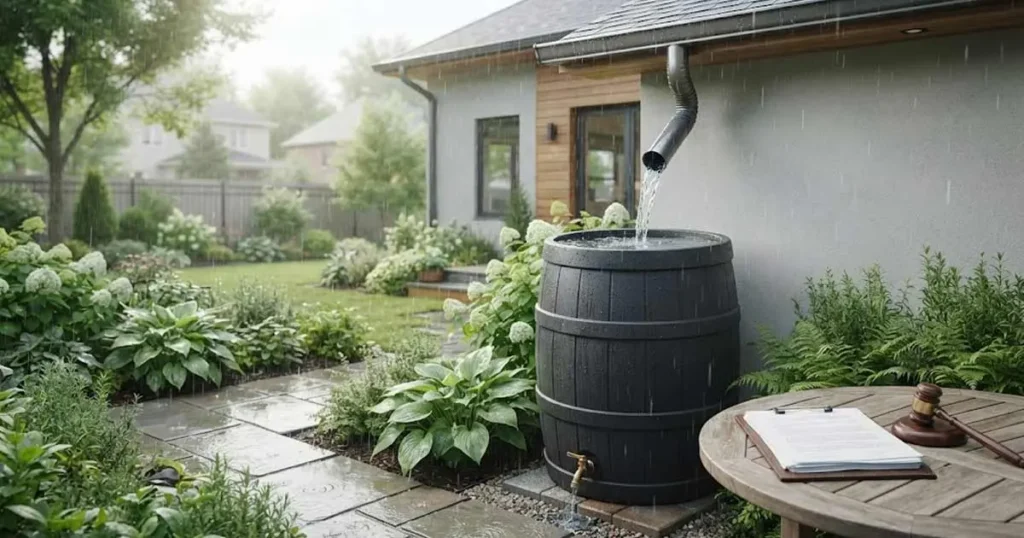

Legal rainwater collection in Colorado, with the strictest regulations of any state in the country. House Bill 16-1005 passed in 2016 allows homeowners to collect up to 110 gallons of rainwater with no more than two rain barrels. Colorado was the first state in the country to completely outlaw backyard rain barrels before this legislation was enacted. The water still needed to be delivered to the state’s rivers and streams to meet the demands of older, senior water rights downstream.
Key Takeaways
- Rainwater collection is legal in Colorado, but only up to 110 gallons per residence, in up to 2 rain barrels.
- Colorado had a near-complete ban on residential rainwater collection before 2016, a ban that was in place in no other state.
- In 2016, House Bill 16-1005 was passed, which provided limited collection. It is applicable to multi-family buildings of four units or less and single-family residences.
- Collected water can only be used outside, for lawns and gardens, on the property where it was collected. It is not suitable for drinking or in buildings.
- The limitation is due to Colorado’s prior appropriation water law that dictates that the rainwater belongs to the water rights holders downstream of the property, not to the property owner that it lands on.
Why can’t you collect rainwater in Colorado?
Today, rainwater collection is not completely prohibited in Colorado, but its history can help to understand why it was prohibited for so long, and why limits are still in place. The doctrine of prior appropriation is a water law tradition shared by the western United States, and is practiced in Colorado. The doctrine states that a raindrop falling on a roof is, legally, the same water that flows down the river, stream and reservoir. The Colorado Division of Water Resources considers the water from precipitation to be “waters of the state” and not the property of the land it lands on.
Colorado water rights are seniority based, meaning they are allocated on a first-come, first-served basis, and are senior to those of other states.Colorado water rights have a long history of being first-come-first-served, and are senior to those of other states. A farmer or municipality with a pre-1800s water right has a legal right to water flow in the river, before the rain barrel of any homeowner. If all the roofs on a watershed capture all the rain before it flows into a stream, then that senior water right could be shorted. This is what the law said that kept Colorado’s rain barrel ban in place until most other states had legalized it.
A brief history of Colorado’s Rain Barrel Ban
- Until 2009: There was a near total ban on rainwater collection for almost all Colorado residents who had access to a municipal water supply.
- 2009: Senate Bill 09-080 provides a narrow exception, where collection may be made for households with certain approved augmentation plans on approved wells.
- House Bill 15-1259 passed the Colorado House in 2015, but failed to pass the legislature at that time. AP news coverage at the time reported that the ban was not widely known and was often ignored, as rain barrels were openly sold in home and garden stores.
- 2016: House Bill 16-1005 was passed and went into effect, allowing for rain barrel collection statewide with the same limits as today.
Colorado’s Current Rainwater Collection Rules
| Rule | Requirement Under HB 16-1005 |
| Maximum storage | 110 gallons total |
| Maximum containers | Two rain barrels |
| Eligible properties | Single-family homes and multi-family buildings with four units or fewer |
| Collection point | Rooftop downspouts only |
| Permitted use | Outdoor irrigation of lawns, plants, and gardens on the same property |
| Prohibited use | Drinking water or any indoor household use |
| Permit required | No permit needed for barrels within the 110-gallon limit |
Colorado State University Extension points out that within these limits, the use of rain barrels does not create or establish any water right of any kind. The barrels are just a way to temporarily and temporarily use the rainwater before it falls to the ground.
Who Qualifies to Collect Rainwater in Colorado
Not all properties in Colorado receive the same amount of water for the rain. Three categories exist.
- Users of standard municipal or tap water. Under HB 16-1005, these households can have up to two rain barrels combined for a total of 110 gallons.
- Pre-existing exempt wells (before May 8, 1972). These properties may have general water use rights, and often can use rain barrels without the same limitation; the well predates the modern requirements for permitting water use.
- Households that have an augmentation plan in Senate Bill 09-080. The additional rain barrels can be added to the approved augmentation plan if the plan specifically addresses the collection of these additional barrels.
If a homeowner is not sure if their property falls into one of these categories they should verify their property status with the Colorado Division of Water Resources prior to installing any system larger than a rain barrel.
Also Read: Is It Illegal To
What Happens If You Exceed Colorado’s Rainwater Limits
Colorado’s rainwater statute is a narrow exception carved out of the state’s broader water rights law, not a standalone rain barrel code with its own fine schedule. Collecting or storing rainwater beyond the 110-gallon, two-barrel limit, or diverting it before it reaches a rooftop downspout, falls outside the HB 16-1005 exemption and can expose a property owner to the same enforcement process used for any unauthorized water diversion, which is administered through the Colorado Division of Water Resources rather than local police. In practice, enforcement against small residential systems is rare, but larger unpermitted cisterns intended to capture significant runoff carry real legal risk and should be reviewed with the Division before installation.
How Colorado Compares to Other States
Colorado’s 110-gallon cap is unusually strict. Nearly every other state in the country places no volume limit at all on residential rainwater collection. California, Texas, Florida, Ohio, Indiana, Tennessee, Virginia, Arizona, and Michigan all permit unrestricted residential collection, and several actively encourage it through tax credits or rebate programs. For a full breakdown of every state’s rules, see our complete US rainwater collection guide, or review individual guides for California,Texas,Florida, and Ohio.
Conclusion
Colorado’s rainwater law reflects a genuine tension between a homeowner’s instinct to catch free water off a rooftop and over a century of water rights law built around scarcity. The state has not banned rainwater collection since 2016, but the 110-gallon cap remains a real limit, not a suggestion, and it exists for a specific legal reason rooted in prior appropriation doctrine. Homeowners who stay within that limit and use the water outdoors have nothing to worry about. Anyone planning a larger system, or unsure which category their property falls into, should confirm the details with the Colorado Division of Water Resources before installing it. For rules in other states, see our full rainwater collection guide.
Frequently Asked Questions
1. Will rainwater collection be illegal in Colorado in 2026?
No. House Bill 16-1005 was enacted in 2016 and rainwater collection is legal as long as the household is within the 110-gallon, 2 barrel limits and uses the water outside on the property.
2. Why can’t people collect rainwater in Colorado?
Not illegal per se but historically, Colorado limited it due to its water law, which is known as “prior appropriation,” meaning that it considers rainfall to be part of the water supply belonging to water rights holders downstream, not the property owner.
3. How many gallons of rain water can I legally collect in Colorado?
House Bill 16-1005 allows for up to 110 gallons total, no more than 2 rain barrels under this bill.
4. Can I drink rainwater that is collected in Colorado?
No. Rainwater collected under HB 16-1005 can only be used for outdoor uses including landscaping and irrigation. It may not be used for drinking or any other purpose in the home indoors without further treatment and specific approval.
5. What is the best way to install a rain barrel in Colorado?
A standard system with a capacity of 110 gallons or less does not need a permit. If the cistern or system is larger than 25 gallons or connected to a well, it will need to be reviewed by the Colorado Division of Water Resources.
6. When did Colorado make rain barrels legal?
In 2016, Colorado passed House Bill 16-1005, allowing for limited use of rain barrels. Prior to this, the state had the nation’s only statewide prohibition on residential rainwater collection, except for a few well owners in 2009.