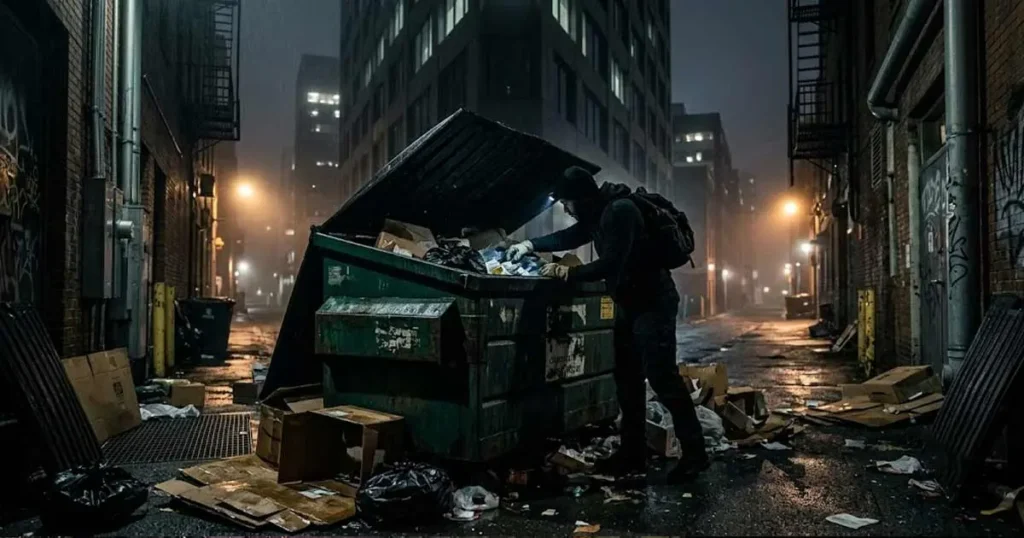

California does not have a state law against dumpster diving. Dumpster diving is a legal grey area in California in 2025. The act is not specifically prohibited by state law, but may be legal or illegal depending on the circumstances. In most cases, it is legal to dive into dumpsters on public property as long as there are no local ordinances in place that prohibit it and the contents are obviously trash. But it’s illegal to take things from dumpsters on private land, and you could find yourself charged with trespassing or theft. The irony of California’s situation is that the state is not only the legal birthplace of the national permission to dumpster dive, but it’s also one of the most complex and actively-regulated local dumpster diving environments in the country.
Key Takeaways
- In the U.S. Supreme Court case of California v. Greenwood (1988), the Court ruled that people have no reasonable expectation of privacy over items left in a dumpster in a public place.
- There’s no state law that explicitly prohibits dumpster diving in California. Items that are left in trash cans for disposal are abandoned property and you can legally remove items from trash cans.
- It is illegal to trespass on private property with dumpsters, as per California Penal Code Section 602. The majority of the commercial dumpsters in California are private property.
- There may be local ordinances prohibiting going through trash in some neighborhoods in Los Angeles and San Diego. Before diving, be sure to read your city’s municipal code, particularly if you dive regularly.
- California Penal Code Section 602 trespass is a misdemeanor with a maximum penalty of up to six months in county jail and a fine of up to $1,000 in aggravated cases.
- Can you dumpster dive at Sephora in California? Yes, in practical terms, yes. Most Sephora stores are on private commercial property and it is illegal to trespass on private property in California, under Penal Code Section 602.
- The state that gave birth to the national law that allows dumpster diving in every state is California, where the case that started it all, California v. Greenwood, was decided by the Supreme Court.
California v. Greenwood (1988)
The Supreme Court case that bears the state’s name is a good place to start learning about California’s legal stance on dumpster diving.
In California, it is legal to dumpster dive because of the 1988 Supreme Court case, California v. Greenwood, which ruled that there is no reasonable expectation of privacy when garbage is put out in the public. This decision extends to every state in the country, which means that anything that gets tossed in the trash in the public area is fair game.
The case began when Laguna Beach police requested a trash collector to collect plastic garbage bags left on the curb in front of Billy Greenwood’s house. The officers searched the bags and discovered evidence of drug use, which they used to obtain a search warrant. Greenwood objected to the search based on his Fourth Amendment rights.
The Supreme Court disagreed, holding that the trash that is placed for public collection has no reasonable expectation of privacy. The decision, in a case from California involving California police, established the national standard that allows dumpster diving in all 50 states. California is the place where the national legal permission was conceived and local laws have most vigorously pushed its boundaries.
The regulations outlined in this document are based on California State Law
There is no state law prohibiting dumpster diving in California. The state considers trash left for disposal as abandoned property, and you can legally remove items from trash dumpsters. But this right is subject to other laws, particularly those relating to private property and trespassing. Care needs to be taken in the location and method of diving.
The three California laws that form the basic legal structure for dumpster diving in California are:
California Penal Code Section 602: California’s general trespass statute. It is illegal to trespass on private property by accessing dumpsters (California Penal Code Section 602). This law applies to a wide variety of trespass situations and to anyone who enters or stays on private property without permission from the owner.
California Penal Code Section 374.3: California’s illegal dumping and litter law. Under this provision, a diver who leaves a dumpster in a condition of disarray may be liable to infraction or misdemeanor charges, and each day after which illegally placed waste is left in the dumpster may be considered a separate offense.
California Penal Code Section 530.5: California’s identity theft law. It is still illegal for one person to use another person’s personal information that they found in the garbage to commit a crime even if they can look through the garbage. Identity theft is an offence against the law. If convicted of identity theft, a defendant could receive a fine and/or jail time.
California Penal Code Section 602 is the most critical of all the laws
Real restrictions occur when accessing sealed containers, when breaking into closed facilities or when taking restricted materials, all of which can lead to fines under local legislation for trespassing.
California Penal Code Section 602 is one of the most comprehensive trespass laws in the nation. It encompasses a wide range of specific circumstances involving unauthorised entry onto property such as entering onto land where signs are set up saying don’t enter, entering onto fenced agricultural land and entering onto or staying on any property after being told to leave.
When dumpster diving is the interest, Section 602 applies when:
- A diver is working in a dumpster in a fenced or gated commercial area.
- A diver who disregards the posted No Trespassing or No Access signage.
- A diver who is told to leave commercial property by management or security but stays.Diver who stays after being asked to leave by management or security.
- A diver enters a dumpster that has been locked or enclosed by breaking the lock or enclosure.
In California, a violation of Section 602 is a misdemeanor in aggravated circumstances and a county jail term of up to six months and a fine of up to $1,000 are allowed.
City-by-City California Rules: Los Angeles, San Diego, San Francisco, and Beyond
The regulation of dumpster diving in California’s cities and towns is one of the most diverse and rigorously enforced in the nation.
Los Angeles
There may be local ordinances in Los Angeles prohibiting trash collection. The City of Los Angeles has provisions in the Municipal Code for managing waste and scavenging in the context of solid waste. The city has a specific scavenging ordinance which bans the removal of recyclable material from city-owned or city contracted recycling containers. The ordinance is enforced more rigorously in commercial areas where revenue from recycling is a substantial part of local government income.
San Diego
Local ordinances may prohibit trash digging in some neighborhoods of San Diego. The City of San Diego’s municipal code contains regulations related to solid waste and illegal access to waste containers. The city’s policy has become more stringent in commercial districts where dumpster diving has caused sanitation and public nuisance problems for nearby businesses.
San Francisco
The scavenging ordinance is among the most enforced in California, in San Francisco. The city has a comprehensive recycling and composting program and scavenging from city-contracted recycling and composting containers is expressly forbidden. The ordinance is enforced by dedicated city inspectors as well as law enforcement, with fines for violations.
Other California Municipalities
There are some counties or cities in California that have trash collection or processing locations that are off-limits to the public. Before attempting to “dumpster dive” it is important to speak with a local California lawyer to prevent legal repercussions.
The majority of the prohibitions are the result of local ordinances to prevent unauthorized access to commercial waste areas. California has a long history of local regulation of waste management, and each of the state’s municipalities must be contacted to verify local ordinances before any dumpster diving activity occurs.
Can You Dumpster Dive at Sephora in California?
Dumpsters that are located at shopping centers and malls are on private property, so it may be illegal to dumpster dive there. Surroundings should be paid attention to and respect any surrounding private property.
In California, most Sephora stores are in shopping centers or retail strips on private commercial property. These dumpsters are normally located in an enclosed commercial refuse area, which is considered private property under California Penal Code Section 602.
Some of the risks that Sephora dumpster diving in California may encounter are:
- The trespass charge is based on Penal Code Section 602 of the California Penal Code for entering a private commercial property dumpster area.
- If posted or enclosed, escalate to misdemeanor trespass
- If personal information is obtained, exposure to identity theft under California Penal Code Section 530.5.
- Sephora has announced that it is no longer allowing people to dumpster dive on its corporate policy, which was confirmed in its Beauty Insider Community in March 2025.
- Violation of local ordinance (Los Angeles or San Diego) if the store is in a city that has local ordinances governing scavenging.
The location of the private property, the California Section 602 trespass statute and the active enforcement of local ordinances in California’s major cities make Sephora dumpster diving in California one of the highest legal risk dumpster diving situations in this entire state series.
The Four Core Legal Risks in California
The location and circumstances of the act can make all the difference in legal consequences. Damage to property or failure to obey signage while diving may lead to civil or criminal penalties.
There are four different legal issues that apply to dumpster diving in California.
1. Criminal Trespass under Section 602
Most divers in California are at risk from: It is illegal to use a commercial dumpster on private property without permission, in violation of California Penal Code Section 602, which can lead to fines for infraction or misdemeanor charges with up to six months in county jail and a $1,000 fine.
2. Non-conformance to the municipal scavenging ordinance
There are ordinances in place in Los Angeles, San Francisco, San Diego and other cities in California that limit scavenging from commercial waste and recycling containers. The ordinances are in addition to the trespass regulations and may be used to impose further fines.
3. Identity Theft
Using another person’s private information that has been found in the garbage to commit a crime is still illegal. Identity theft is a California crime that carries fines, jail time, restitution to the victim and civil penalties.
4. Theft Charges
Theft or trespassing may be charged if any items are removed from private property without permission. Permission of the property owner is required to dumpster dive on private land. Otherwise, it could be illegal trespassing. Theft charges are possible in California if the property owner challenges the abandonment of certain items in commercial dumpsters.
In California, there are certain things you can and cannot do
Generally, it is legal in California:
- Accessing dumpsters on public property in municipalities without a particular scavenging ordinance
- Collecting items dropped off on the street for collection on public land
- Dumping or “diving” in a dumpster on private property with specific written permission from the owner
- Uncontrolled access to publicly available waste containers with no signage or enclosure marking restricted access
In California it is illegal for a man to:
- Any dumpster that is not on public property without the owner’s permission
- Urban scavenging from recycling and/or composting containers (where cities have a specific ordinance for urban scavengers)
- Using fenced, gated or locked enclosures behind them without authorization
- Continuing to access a dumpster area after being asked to leave
- The use of personal information from any dumpster to engage in any crime.
California’s status in comparison with other states
California is in a unique position among states in terms of where it falls on the spectrum of dumpster diving regulation with no statewide ban, active municipal laws, and the fact that the national legal framework was born in California.
| State | State Law | Key Local Rules | Primary Risk |
| California | No statewide ban; Section 602 trespass applies | LA and SD scavenging ordinances; SF recycling restrictions | Municipal ordinances and trespass |
| Alabama | No statewide ban; trespass fines up to $500 | Birmingham and Montgomery commercial restrictions | Contributory negligence; trespassing |
| Texas | No statewide ban; Section 9.41 force justification | Austin and San Antonio scavenging restrictions | Criminal trespass and property owner force rights |
| Oklahoma | No statewide ban | Oklahoma City Section 38-702 misdemeanor ban | Municipal ordinance violations |
| Illinois | No statewide ban; prohibits open waste scavenging | Wood River 2025 ban; Belleville $400 license | Municipal ordinances and trespassing |
| North Carolina | No statewide ban | Local ordinances vary | Trespassing on private property |
| Pennsylvania | No statewide ban | Lancaster ordinance; Philadelphia regulations | Criminal trespass statute |
| Florida | No statewide ban | Florida Statutes Section 810.08 trespass | Second-degree misdemeanor trespass |
| Iowa | No statewide ban | Local ordinances in Des Moines and other cities | Trespassing on private property |
California is unique among the states in this series in that its municipalities, especially Los Angeles and San Francisco, have adopted the most widely enforced scavenging ordinances in the largest cities in America. The combination of California Penal Code Section 602 and city-level scavenging restrictions results in a more complex system of law than in other states.
There are several risks that one can face when diving in a dumpster in California
The legal dangers aren’t the only worry for divers in California’s dumpsters. The variety of climate and business activity in California presents certain safety concerns.
- Extreme heat in Southern California: Inland Los Angeles and other locations can reach temperatures that are dangerously high in the summer.
- Sharp objects: Broken glass, metal fragments and industrial wastes are commonly found in commercial dumpsters.
- Chemical exposure: California’s big retail and industrial market makes chemical dumpsters possible, which can contain cleaning products, agricultural chemicals, or controlled substance residues.
- Police contact: If a complaint is made or you are diving in a suspicious area, police will stop and question you. They generally allow you to pass through if you are not in violation of the law, or if you are not causing harm. However, if you’re in a private area or doing something that appears to be dangerous or disturbing, you could be warned, fined or even arrested.
- Food safety: If you fall ill due to eating food in a dumpster, you can’t sue the person or company that disposed of the food. California’s food safety laws do not create liability for businesses regarding food discarded in their waste containers.
Expert and Legal Perspectives
According to nationally known legal matching service LegalMatch, which publishes verified legal analysis, there are no federal laws prohibiting dumpster diving, and it is regulated at the state, county and city level in the State of California. They have actually stated in their publication that dumpsters at shopping centers or malls are on private property and access may be illegal, and that it is wise to consult a California lawyer before dumpster diving in a particular area because there are many variations in ordinances from place to place in the state.
California’s dumpster diving laws are legal in many instances, according to World Law Digest, a legal reference guide reviewed by licensed attorneys. Their analysis shows that California law considers trash that is put out for collection as abandoned, which means that it is legal to pick up trash from a public dumpster but not from a commercial dumpster.
California’s position on this will continue to change as social and environmental movements become more influential. California’s long track record of progressive environmental laws indicates that the state’s environmental regulations on dumpster diving might be more stringent rather than lax, as waste diversion and recycling become more important policy issues.
Also Read: Is It Illegal To
Conclusion
California does not have a state law against dumpster diving. The 1988 Supreme Court case of California v. Greenwood, which began in the state, set the national precedent for the right to dumpster dive on public property in all 50 states. There is no specific state law in California against the practice, and most items in public places that are discarded are and remain public property.
California drivers need to be aware that the state has some of the most active laws in the nation for restriction on dumpster diving. There are laws in place in Los Angeles and San Diego that prohibit going through trash in some neighborhoods. San Francisco has an enforcement system in place to guard its recycling and composting revenue against scavenging. California Penal Code Section 602 provides a general and widely-used trespass statute that covers the overwhelming majority of commercial dumpsters in the state, which are on private property.
In California, the safest way to dumpster dive is to first see if your city or county has a code that regulates dumpster access, only access dumpsters on truly public land where there is no signage or enclosure to prohibit access, and ask for explicit permission from the property owner before accessing any commercial dumpster.
To find out more about dumpster diving laws at the national level, check out Is It Illegal to Dumpster Dive?
Frequently Asked Questions
1. Does it violate the law to dumpster dive in California?
Not at the State level. California does not have a specific law against dumpster diving. California v. Greenwood holds that garbage left for collection by the public is abandoned. But there is a caveat: California Penal Code Section 602 does apply to dumpsters on private property, and the city of Los Angeles, San Diego and San Francisco have other municipal rules.
2. Is it legal to dumpster dive in LA?
There are local ordinances in Los Angeles that may limit trash through in some neighborhoods, especially when it comes to recycling containers. Diving on public property, without access to recycling streams or being in violation of certain neighborhood ordinances, is generally allowed. Commercial dumpsters in LA are usually located on private land and must be given explicit permission to access it legally.
3. In California, is it illegal to dumpster dive at Sephora?
In reality, yes. In California, the majority of Sephora stores are in shopping centers that are on private commercial property. It is a California Penal Code Section 602 violation to enter their dumpsters without permission. According to the company’s policy, which was confirmed in March 2025, no dumpster diving will be allowed at Sephora stores.
4. What does California Penal Code Section 602 say and how does it relate to dumpster diving?
California’s general trespass law is found in Sections 602. It covers anybody who enters or stays on any private property without the permission of the owner. To a dumpster diver, it’s a criminal act, from an infraction to a misdemeanor, to be able to access any commercial dumpster located within a gated or fenced area, or posted with No Trespassing signs.
5. What are the strictest regulations on dumpster diving in California?
The city of San Francisco has the strictest measures in place to safeguard its recycling and composting streams. Neighborhood restrictions exist in Los Angeles and San Diego. Each city in California needs to have its local ordinance verified before any dumpster diving is allowed.
6. How can you do a safe, legal dumpster dive in California?
Use dumpsters only on actual public property that is not fenced, gated or posted with a No Trespassing sign. Please refer to your local municipality’s code before continuing. Only enter commercial dumpsters with written permission from property owners. Don’t litter anywhere, as it could lead to a littering charge under California Penal Code Section 374.3. If told to evacuate by property owners, security or law enforcement, do so without delay and without discussion.