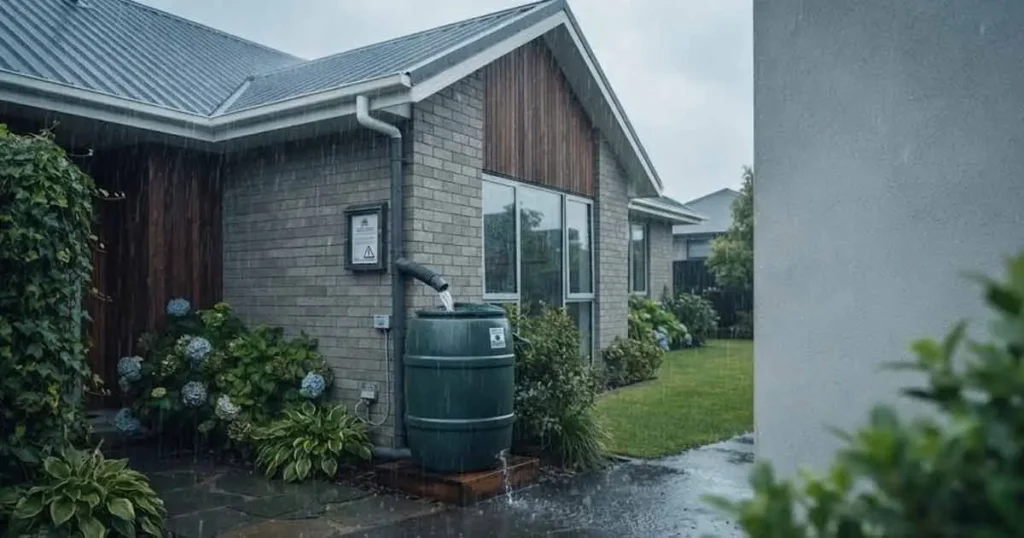

NO, it is NOT illegal to harvest rainwater in New York. There is no state legislation prohibiting residential rainwater harvesting, no limit on the amount of rain water that may be stored at a residence, and no permit requirement for a typical rain barrel located under a downspout. In New York, the doctrine of eastern riparian rights applies, which states that rainfall on private land is not considered a public water and does not need to be approved by the State. In addition to no ban, NYC and a few municipalities upstate have actively encouraged rain barrel programs in their stormwater management programs at various times. A rain barrel is as simple as a screened container that is attached to a downspout for most New Yorkers.
Key Takeaways
- Rainwater harvesting is legal at the State level in New York State.
- No volume limit and no permit required for a cistern or rain barrel located outdoors for irrigation use.
- There is no prior appropriation restriction in New York, which follows the doctrine of eastern riparian rights.
- The New York City Department of Environmental Protection has long endorsed rain barrel distribution programs to help cut stormwater runoff in the five boroughs of New York City.
- Systems that are larger and are used indoors for non-potable purposes are subject to the New York State Plumbing Code.
- Rainwater should not be used for human consumption, food or cooking without appropriate treatment (filtration and disinfection).
- There is no state incentive for rainwater harvesting in New York, although there are some utility and municipal rebate programs throughout the state.
- HOA rules and local zoning ordinances may add conditions in some communities, even where state law is entirely silent.
Is Rainwater Collection Legal in New York?
Yes. There are no restrictions or prohibitions in New York State on residential rainwater harvesting. A homeowner can place one rain barrel, multiple connected barrels or a larger outdoor cistern for garden and lawn irrigation without needing to obtain approval from any state agency. This is true throughout the entire geography of New York, from the heavily populated suburbs of Nassau and Westchester counties, to the Hudson Valley, the Finger Lakes, the Adirondacks and the rural areas of western New York near the Great Lakes.
The average annual precipitation for New York State varies from 40-50 inches across the state with the western portions of the state receiving significantly more precipitation because of the lake-effect precipitation from Lake Erie and Lake Ontario. The average 1,000 square foot roof can produce about 600 gallons of runoff for a one inch rainfall. In the older cities, such as New York City, where a combined sewer system is used, rooftop runoff is also discharged into the sewer system along with sanitary sewage. Those combined systems can back up into local waterways in many older northeastern cities during heavy rains, a long-standing water quality issue. The rain barrel can capture the rooftop runoff, thereby decreasing the amount of overflow that is added to the burden, and provide the homeowner with a free source of irrigation water in the summer when water is scarce.
This link is explicit in the City of New York’s Department of Environmental Protection. The agency has launched rain barrel giveaway and distribution initiatives at various locations to alleviate the amount of stormwater flowing into the combined sewer system. Similar programs have been available to municipalities and soil and water conservation districts in counties throughout Upstate New York.
What New York Law Says About Rainwater Collection
There is no specific rainwater harvesting law in New York similar to the laws found in Texas, Arizona and North Carolina. What New York has is a complete lack of prohibition, based on the long history of riparian rights in the state.
Under the reasonable use variant of riparian rights doctrine, New York water law is a system that prioritizes the reasonable use of water resources. As part of this, a landowner is entitled to use water that falls onto or flows over their land, and to do so without “unreasonable interference” from other riparian landowners. This is not the case if the rainwater from a private roof is used for non-interference purposes. It is considered to be a common use of private property and has been so interpreted by no state agency.
The law leaves no room for doubt, and New York is in the company of most states in the east and midwest which have no regulations on residential rainwater harvesting. The same riparian tradition and the same practical result prevails in Illinois, Missouri, Indiana, Ohio, Michigan, Tennessee, Georgia, North Carolina, Florida, and Virginia: a homeowner can install a rain barrel without a permit, notification, or volume limit at the state level.
The Department of Environmental Conservation in New York does not have a rule or guidance that limits residential rainwater collection. The state’s overall water policy framework, such as its combined sewer overflow reduction and harbor water quality improvement initiatives, does not consider the collection of rooftop rainwater to be a regulated activity, but rather a beneficial practice.
New York City: A Special Case Worth Noting
The residents of New York City are in a special situation. The city has one of the largest and most tightly regulated water supply systems in the world, with its water coming from upstate reservoirs in the Catskill, Delaware and Croton watersheds. No such system imposes any limitation on a citizen of a city to collect rain water from his own house.
The New York City Plumbing Code does apply to indoor non potable water reuse systems such as greywater and rainwater reuse for flushing toilets. The labeling, separation, and construction requirements of the NYC Plumbing Code for any NYC resident who wants to use rainwater captured for an indoor plumbing system for non-potable purposes.
No city permit, no DEP registration, and no notification to any agency is required for an outdoor rain barrel that is used only for watering garden and/or container plants that are under a downspout. This is exactly what New York City’s own environmental agency has been promoting with its distribution programs, which help to alleviate New York City’s combined sewer overflow issue.
Co-ops and condos are like HOAs, with their own rules, so check them out before putting any external system on a shared roof or common space. The overall situation for individual homeowners in the boroughs is unobstructed, especially those in detached homes in Queens, Staten Island, and parts of Brooklyn and the Bronx.
Larger and Indoor Systems When NY Rules Do Apply
The “permissive” approach to rain barrels is not a “no standards” approach to rainwater systems in New York. There are extra rules if the scale and intended use is different.
| System Type | Requirement in New York |
| Rain barrel under a downspout for outdoor irrigation | No permit required |
| Multiple linked rain barrels for outdoor irrigation | No permit required |
| Outdoor cistern used solely for irrigation | No permit required, regardless of size |
| System plumbed indoors for non-potable use (e.g., toilet flushing) | Must comply with the NY State Plumbing Code or NYC Plumbing Code |
| System intended to supply drinking water | Requires treatment and filtration to safe drinking water standards |
| Large commercial or agricultural systems | May require review by the NY Department of Environmental Conservation |
The New York State Plumbing Code (and NYC Plumbing Code for NYC residents) requires that non-potable rainwater systems be clearly marked, physically separated from potable water, and that there be no cross-connections. These are safety and construction standards. They are rules on how a system can be constructed, not whether it can exist.
If a rain collection system is large enough to significantly impact drainage or water availability downstream, it should be reviewed with the New York Department of Environmental Conservation prior to construction, especially for commercial or agricultural use.
HOA Rules and Local Ordinances in New York State
State law allows it, but this adds variables for some New York homeowners.
There are no specific laws in New York that guarantee a homeowner’s right to install a rainwater collection system if the homeowner’s HOA is objecting to it, whereas House Bill 991 in Illinois was passed in 2011 to create a formal pathway for the HOA to review installation of a rainwater collection system. A homeowners association or condominium board may, in New York, limit the size and/or location of visible rain barrels or set requirements for placement and screening, depending on the provisions of the association’s or board’s governing documents. Owners of homes in planned communities or buildings with boards should check their governing documents and, if required, make a written request before installing anything outdoors that is visible from the street.
Some New York communities have zoning codes that require outdoor structures or containers to meet requirements if they exceed a certain size. A typical 55-gallon rain barrel does not usually fall under these provisions, but a large above-ground cistern (with several hundred gallons of capacity) may in some jurisdictions. If a homeowner is considering larger systems, he should check with the local building or zoning department to see if it is necessary to obtain a permit.
Rain barrel programs have been implemented by several county soil and water conservation districts in New York as a subsidized program. At various times, Nassau, Suffolk, Monroe, Erie and other counties have provided rain barrel sales or giveaways to residential customers. Programs offered will vary depending on availability of funding and district priorities, so please check with the local soil and water conservation district or municipal water authority directly for current programs.
How New York Compares to Other States
New York is definitely in the “ok” category when it comes to residential rainwater collection. The table below is designed to give New York a perspective relative to the states that were researched most often on this topic.
| State | Legal Status | Volume Limit | Permit Required | Tax Incentive |
| New York | Legal | None | No | No statewide incentive |
| North Carolina | Legal, encouraged | None | No | No (SB 163 indoor standards) |
| Missouri | Legal | None | No | No |
| Illinois | Legal | None | No | No (HOA protection law) |
| Indiana | Legal | None | No | No (local rebates exist) |
| Ohio | Legal | None | No | No |
| Michigan | Legal | None | No | No |
| Georgia | Legal | None | No | No |
| Tennessee | Legal | None | No | No |
| Virginia | Legal, encouraged | None | No | Yes (tax credit) |
| California | Legal, encouraged | None | No | Yes (property tax exemption) |
| Texas | Legal, strongly encouraged | None | No | Yes (sales tax exemption) |
| Florida | Legal | None | No | No |
| Oregon | Legal (post-2009 reform) | None for rooftop | No | No |
| Arizona | Legal, encouraged | None | No | Yes (tax incentives) |
| Colorado | Legal with strict limits | 110 gallons | No (within limit) | No |
| Utah | Legal with limits | 2,500 gallons | Yes (over 100 gal.) | No |
| Nevada | Restricted | Water rights required | Yes | No |
Colorado, Utah and Nevada are more conservative than New York. It is generally similar to Illinois, Missouri, Indiana, Ohio, Michigan, and Georgia, which all have the eastern riparian tradition. It doesn’t currently have the tax benefits offered statewide by Texas, Arizona, Virginia and California, but there’s no state law that prevents a New York homeowner from getting a rain barrel.
The full US rainwater collection guide provides a state-by-state legal reference.
The persistence of the myth of illegal rainwater collection
Many New Yorkers who ask this question have heard or read about the fact that rainwater collection is illegal in many parts of the United States. That is a definite claim and there’s a definite correction that needs to be made.
The myth has two well documented events that gave rise to it. The first is that Colorado used to have a nearly complete prohibition on residential rainwater storage, which was in effect until 2009 when House Bill 1005 allowed for a limited exception for the first time. For decades Colorado was a true legal anomaly and that prohibition contributed to the general perception that water collection was largely forbidden in the West. The second case is a 2012 Oregon case in which a landowner was charged with collecting about 13 million gallons of rainwater in three large illegal rainwater reservoirs on his land. National media coverage suggested that it was home rain barrels, but the prosecution was for the unauthorized construction of large-scale water storage impoundments. Oregon then changed its rules to permit rainwater harvesting for rooftops without a permit.
Prior appropriation water law never applied to New York. The state’s eastern riparian tradition has long held that the use of water from rain on private lands is part of the ordinary use of the land. The issues that led to restrictions in the arid west have never applied to a state with an average of 40-50 inches of precipitation annually.
Safety tips for New Yorkers
Even if there is legal authorization to collect rainwater, the water collected may not be safe for all purposes. Collected rain water can be contaminated with bacteria, viruses, parasites, and chemicals that are present in the air and on roofing materials and gutters, according to the Centers for Disease Control and Prevention. Rooftop surfaces can also collect exhaust and other pollutants from road transport that are prevalent in urban areas like New York City.
In New York, collected rainwater may be used for the following:
- Lawn and garden irrigation
- Cleaning vehicles and outdoor equipment
- Filling the tank on the toilet (if system is installed indoors per code)
- Filling ornamental ponds (not for fish to be eaten)
Uses that require filtration and disinfection before they are safe:
- Drinking
- Cooking
- Brushing teeth
- Washing produce
Before installing a system in New York:
- Ensure that there is no specific ordinance in your municipality or borough regarding outdoor cisterns or containers larger than a specific size.
- For co-ops, condos and planned communities, check the governing documents and ask the board or HOA before putting any system on shared or external surfaces.
- Use a sealed barrel with a fine mesh inlet screen to stop mosquito breeding and to minimise debris contamination.
- Install the barrel so that the overflow drains away from the foundation of the building.
- To prevent organic debris and sediment from building up in the barrel, clean it and any connected gutters at least once a year.
- Please contact your county soil and water conservation district or local water utility to inquire if there is any rebate or distribution program for rain barrels currently in effect.
- If using a plumbed system, hire a licensed plumber who is knowledgeable about the requirements of the New York State or New York City Plumbing Code for non-potable water reuse.
Expert and Legal Perspectives
As water law experts always point out, it’s no surprise that New York’s stance on rainwater collection is the way it is, due to its legal history and geography. The state’s riparian rights doctrine has never recognized rainfall from rooftops as a regulated public water and the state legislature or any state agency has taken any action to change that.
The National Conference of State Legislatures has recorded that the majority of rainwater-related legislation enacted in the United States in the last 20 years has been aimed at eliminating barriers and promoting collection. The Empire State doesn’t have any restriction to remove, and that puts it in a comfortable majority.
Practical information for the installation of rain barrels and water conservation on residential properties throughout New York State is available from the Cornell Cooperative Extension, the university extension service in New York State. Rainwater harvesting is always presented as a positive and easy practice for homeowners in New York in its publications.
The Federal Energy Management Program identifies New York as a state where rainwater collection is allowed at the household scale without restriction, which is consistent with the state’s riparian rights tradition and the fact that there is no statute or administrative rule prohibiting rainwater collection.
Conclusion
There is no legal barrier to a homeowner wishing to harvest rainwater in New York State. There is no prohibition on the collection of rainwater for ordinary residential irrigation or other non-potable uses for outdoor purposes, and no volume limit or permit requirement. At various times, New York City’s own environmental protection agency has actively encouraged the practice as a means of reducing combined sewer overflow, one of the more positive signals of institutional support that any state’s citizens might reasonably hope for.
There are only a few situations that add additional steps: co-op or condominium boards, where the governing documents could impose conditions not covered by state law, and indoor plumbing of a non-potable rainwater system, which must meet the requirements of the New York State Plumbing Code or the New York City Plumbing Code for city dwellers. There is no prohibition on either of these. These are governance and safety issues that some homeowners may have to deal with depending on their living situation and system design.
The road to take for any resident of New York is simple. Verify local municipal regulations, review applicable building or HOA governing documents and select a barrel that is properly screened and sealed for outdoor use. If the system is for the indoor use, consult with a licensed plumber who is knowledgeable of the applicable code requirements. In addition to those measures, the law is in the homeowner’s favor.
The complete guide to rainwater collection laws in each state, including the most strict and even the states that provide active financial incentives, is most comprehensive guide on the subject available online in the US: Is It Illegal To.
Frequently Asked Questions
1. In New York State, is it legal to collect rainwater?
Yes. It is legal to collect rainwater in New York. There is no law prohibiting it, no limit on the amount of water a rain barrel or outdoor cistern can hold for a residential system, and no permit required for a typical rain barrel or outdoor cistern for irrigation. New York’s riparian rights doctrine allows the practice, as it considers rainfall on private land to be a part of the ordinary use of the land.
2. What is the maximum amount of rainwater that can be collected in New York?
In New York, a cistern or rain barrel for a typical home use is exempt from permit. Under the New York State or New York City Plumbing Code, the plumbing of a larger system indoors for non-potable water for applications like toilet flushing requires a permit and code compliance review.
3. How much rainwater can I collect in New York?
There is no volume cap for residential rainwater collection in New York statewide. This is different from some states that have limits on the amount of residential collection, such as Colorado at 110 gallons and Utah at 2,500 gallons.
4. How many other ways can I collect rainwater?
Yes. New York City has no ordinance prohibiting the collection of rainwater from a residential roof. The NYC Department of Environmental Protection has always encouraged this practice by distributing rain barrels. It is important for co-ops or condominiums to review building rules prior to installing any external system. For detached houses, individual owners can install a typical rainwater barrel without the city’s approval.
5. Does my NYC HOA/Co-op Board have the power to prevent me from installing a rain barrel?
Possibly depending on the governing documents of the community or building. Unlike Illinois which passed House Bill 991 to require a formal review process for a resident to install a rainwater collection system, there is no specific law in New York that mandates this. Anyone living in a managed community should check their governing documents and make a written request for the board to approve the installation of any visible system.
6. Is it safe to drink rainwater that I collect in New York?
Not without treatment. Rainwater that is collected should not be used for drinking, cooking, or preparing food without treatment by the Centers for Disease Control and Prevention. Rooftop surfaces can trap pollutants, especially in urban areas such as New York City, making treatment especially important. Harvested rainwater can be used for non-potable purposes, such as irrigation for lawns and gardens, vehicle washing, and other non-potable applications, as long as it is not used for drinking.
7. Is there any tax incentive available in NY for rainwater harvesting?
New York does not have a statewide tax credit or exemption for a rainwater harvesting system. In the past, some county soil and water conservation districts, such as Nassau, Suffolk, Monroe, Erie and Onondaga counties, have provided incentives for rain barrels. Residents should check with their local county conservation district or water utility to see what is available in their area.