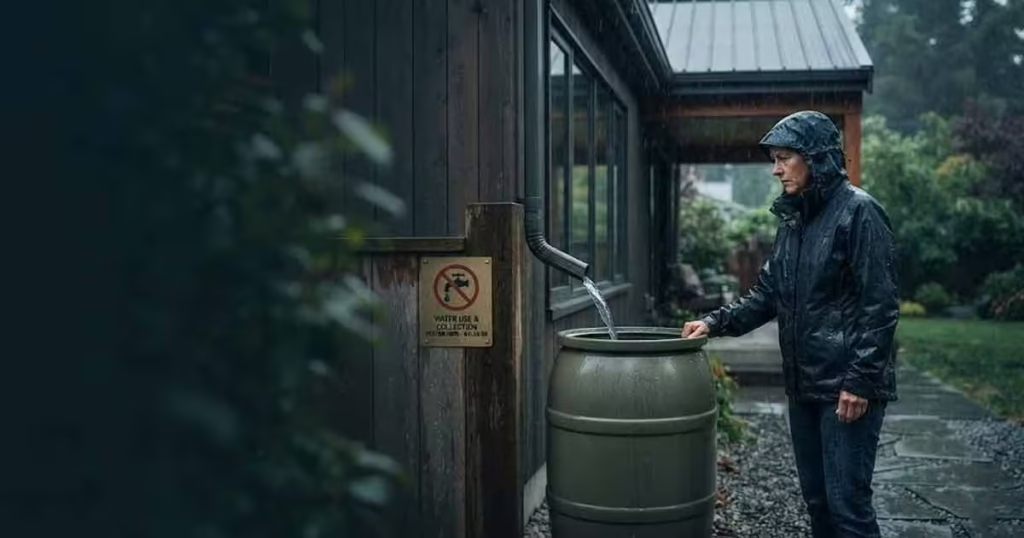

Nope, it’s not illegal to catch rainwater in North Carolina! The state does not have a residential rainwater harvesting ban, no limit on rainwater collection volume for a typical rain barrel mounted under a downspout and no permit requirement for the average homeowner’s rainwater collection system. North Carolina takes the lead on this issue as well: Senate Bill 163 of 2011 mandates that the North Carolina Building Code Council establish standards for the use of rainwater collected for non-potable purposes like irrigation and toilet flushing, and the state’s water conservation policy encourages rainwater collection. In most cases, a rain barrel needs only a screened container attached to a downspout for use by most NC residents.
Key Takeaways
- At the state level in North Carolina, it is legal to collect rain water.
- If it’s a residential rain barrel or outdoor cistern for irrigation, there is no volume limit and no permit is required.
- The NC Building Code Council was tasked with creating guidelines for non-potable rainwater use in the interior of buildings by Senate Bill 163 (2011).In fact, Senate Bill 163 (2011) gave the NC Building Code Council guidelines to create for non-potable rainwater use inside buildings.
- North Carolina has an eastern riparian rights doctrine, which does not impose any prior appropriation restrictions.
- Indoor systems for non-potable water use must meet the requirements of the North Carolina State Building Code and plumbing code requirements.
- Rainwater should not be used for drinking, cooking or food preparation until it has been filtered and disinfected.
- There is no statewide tax incentive for rainwater harvesting in North Carolina; however, there are periodic rebate programs offered by local utilities and municipalities.
- Even in communities where no restrictions are imposed by local ordinance, HOA rules may impose conditions.
Is it Legal to Collect Rainwater in North Carolina?
Yes. There are no North Carolina statutes that ban or limit residential rainwater harvesting. The homeowner can place one rain barrel, chain of connected rain barrels, or large outdoor cistern for garden and lawn irrigation without any state agency approval. This is true for all parts of the state, including urban areas like Charlotte, Raleigh and Durham, suburban areas of Wake County and Mecklenburg County, and rural counties throughout the Piedmont, Coastal Plain and western mountains.
The average annual precipitation in North Carolina is about 46 to 50 inches, depending on the region, and is one of the wettest states in the southeastern United States. The typical 1,000 square foot roof produces about 600 gallons of runoff per one inch of rain. In older cities in North Carolina that are equipped with combined or aged municipal stormwater systems, a large percentage of the rooftop runoff causes drainage and overflow pressures during peak storm events. That’s a small but important reduction in the load, and it provides the homeowner with a free, renewable supply of water for irrigation during the summer months when the water supply is in short supply.
Rainwater harvesting is a viable water conservation practice recognized by the North Carolina Department of Environmental Quality (DEQ) and the NC Cooperative Extension Service (NCCES), and both agencies have issued informative resources to homeowners who want to install rainwater collection systems.
What North Carolina Law Says About Rainwater Collection
What makes North Carolina unique, is that it has taken a proactive stance on rainwater reuse as opposed to a prohibitory stance like many states.
The North Carolina Building Code Council was tasked to adopt standards allowing collected rainwater to be used for non-potable indoor applications in Senate Bill 163 (2011) (informally referred to as the Reclaimed Water legislation). These include flushing toilets and urinals, cooling tower makeup water, and irrigation via a plumbed indoor irrigation system. This was an important policy move. Instead of leaving non-potable rainwater reuse as a mystery, North Carolina has taken steps to develop a standards-based approach that will enable it to be safely implemented.
Importantly, this legislation covers indoor plumbed systems. No building code standards, and no permit requirement apply to an outdoor rain barrel that is only used for garden and lawn irrigation. The legislative framework for indoor reuse is not an outdoor ban, it’s a facilitation.
The water law of North Carolina is based on riparian rights, which is common to the water law of the eastern states. Riparian rights give the landowner a reasonable right to use the water that falls on or flows across his land. The rainwater that falls on a private roof is part of the normal use of the property and does not constitute public water that needs to be allocated by the State. The same legal basis is in place for rainwater collection in all of the other states that share the eastern riparian tradition: Illinois, Missouri, Indiana, Ohio, Michigan, Tennessee, Georgia, and Virginia.
When NC Rules Do Apply: Larger and Indoor Systems
The open framework of rain barrels does not imply that all rainwater systems in North Carolina are completely unregulated. Depending on the scale and purpose, additional rules may be in effect.
| System Type | Requirement in North Carolina |
| Rain barrel under a downspout for outdoor irrigation | No permit required |
| Multiple linked rain barrels for outdoor irrigation | No permit required |
| Outdoor cistern used solely for irrigation | No permit required, regardless of size |
| System plumbed indoors for non-potable use (e.g., toilet flushing) | Must comply with NC Building Code rainwater reuse standards under SB 163 |
| System intended to supply drinking water | Requires treatment and filtration to safe drinking water standards |
| Large commercial or agricultural systems | May require review by the NC Department of Environmental Quality |
The North Carolina Building Code requirements for use of non-potable rainwater systems in buildings require that the systems be clearly labeled, physically separated from the potable water system, and constructed to avoid any cross-connections between the harvested water system and the potable water system. These are guidelines, not bans. They outline the way a system needs to be constructed, rather than whether it can be constructed.
Large-scale commercial or agricultural rainwater collection should be evaluated with the North Carolina Department of Environmental Quality prior to implementation, especially when a system is large enough to have a significant impact on shared drainage and/or downstream water supply.
HOA Rules and Local Ordinances in North Carolina
North Carolina state law is permissive, allowing rainwater collection, but there may be restrictions due to local rules for some homeowners.
Unlike Illinois, which passed House Bill 991 in 2011 to require a formal review process before limiting a homeowner’s rainwater collection system, there are no specific laws in North Carolina to this effect. A homeowners association in North Carolina may, depending on the language of its governing documents, prohibit the placement of rain barrels that are visible from the street or require rain barrels to be placed, screened or painted a certain color. Residential communities should check their covenants and architectural controls before installing any system. If a request is required, it should be made in writing to ensure that a record is made and to ensure that a formal response is made by the board.
Some cities in North Carolina have standing water and/or mosquito breeding control ordinances at the municipal level. These ordinances are not usually implicated by a properly sealed and screened rain barrel. It is the concern about unsealed containers of stagnant water that can serve as mosquito breeding sites, rather than a sealed container fed by a downspout. In almost all jurisdictions, there is a concern about the inlet screen on a barrel being too large.In nearly all jurisdictions, there is a concern that the inlet screen on a barrel is too large. If a homeowner in Charlotte, Raleigh or Asheville is interested in installing a larger above-ground cistern, they should check with the local planning department for any zoning or setback requirements.
Several North Carolina utilities and municipalities have rebate programs and subsidized sales events for rain barrels. The City of Durham, Orange Water and Sewer Authority, and other local utilities in the Piedmont and Triangle regions have in the past provided rebates or free rain barrels to residential customers. Programs are subject to change from year to year, so please contact the local water utility directly for the most up-to-date programs.
How North Carolina Compares to Other States
North Carolina is one of the more forward-looking states when it comes to rainwater collection, both because of its legal stance, which is permissive, and because it has legislation in place to encourage it, Senate Bill 163. The table below provides a sense of context for NC in comparison to the states that are most commonly studied on this topic.
| State | Legal Status | Volume Limit | Permit Required | Tax Incentive |
| North Carolina | Legal, encouraged | None | No | No statewide incentive |
| Missouri | Legal | None | No | No |
| Illinois | Legal | None | No | No (HOA protection law) |
| Indiana | Legal | None | No | No (local rebates exist) |
| Ohio | Legal | None | No | No |
| Michigan | Legal | None | No | No |
| Georgia | Legal | None | No | No |
| Tennessee | Legal | None | No | No |
| Virginia | Legal, encouraged | None | No | Yes (tax credit) |
| California | Legal, encouraged | None | No | Yes (property tax exemption) |
| Texas | Legal, strongly encouraged | None | No | Yes (sales tax exemption) |
| Florida | Legal | None | No | No |
| Oregon | Legal (post-2009 reform) | None for rooftop | No | No |
| Arizona | Legal, encouraged | None | No | Yes (tax incentives) |
| Colorado | Legal with strict limits | 110 gallons | No (within limit) | No |
| Utah | Legal with limits | 2,500 gallons | Yes (over 100 gal.) | No |
| Nevada | Restricted | Water rights required | Yes | No |
North Carolina is more liberal than Colorado, Utah and Nevada, and is generally similar to Illinois, Missouri, Indiana and Georgia. It’s a move ahead of many midwestern states in that it has created a standards pathway for indoor rainwater reuse, as opposed to simply permitting outdoor collection. It does not currently provide the state tax incentives as in Texas, Arizona, Virginia, and California, but the legislature’s intent is obviously to provide incentives.
The comprehensive US rainwater collection guide provides a state-by-state overview of the current state of rainwater collection laws.
Why the myth of illegal rainwater collection is still alive
This is a common misconception that many people in North Carolina have heard and it is illegal to collect rainwater in the majority of the United States. That’s a statement with a specific and verifiable source, and it deserves a clear response.
The myth is based on two well documented events. The first is Colorado’s near complete prohibition on the storage of rainwater for residential use, which was only recently lifted for the first time with House Bill 1005 in 2009. For decades, Colorado was a true outlier, and that prohibition added to the general perception that western water law had made it illegal to collect rainwater in general. The second incident occurred in 2012 in Oregon where a landowner was charged with taking about 13 million gallons of rainwater from three large reservoirs on his property. National media coverage of that case suggested that it was about rain barrels, but it was really about the illegal building of huge water storage reservoirs. Oregon later revised the rules to permit rainwater harvesting for roofing without a permit.
There is no prior appropriation water law in place in North Carolina and there are no significant limitations on residential rainwater collection. Restrictions in Colorado and Nevada were necessitated by arid-West concerns that are never been a problem in a state that gets nearly 50 inches of rain annually. NC’s eastern riparian tradition has always held that rain falling on private land is part and parcel of the ordinary use of the land.
Safety Guidance for North Carolina Residents
Rainwater harvesting does not imply that all rainwater collected is suitable for all purposes. The Centers for Disease Control and Prevention recommend that rainwater may be contaminated with bacteria, viruses, parasites and chemicals from roofing materials, gutters, and air pollution. Older structures or roofs may contain residue from lead-based paint, zinc from galvanized roofs, and particulate material that has settled from road traffic or industrial activities.
In North Carolina, collected rainwater can be used for some purposes, such as:
- Irrigation of lawns and gardens.
- Cleaning of vehicles and outdoor equipment.
- Watering of toilets (if built indoors based on NC Building Code requirements)
- Filling ornamental ponds (not for consumption of fish)
Those uses that must be filtered and disinfected before they are safe:
- Drinking
- Cooking
- Brushing teeth
- Washing produce
Before installing a system in North Carolina, consider the following:
- Ensure that your municipality does not have an ordinance regarding outdoor cisterns or standing water containers.
- In a planned community, check your homeowners association covenants and make sure to ask for any written architectural permission before putting up any system that will be visible for installation.
- To minimize debris contamination and mosquito breeding, select a barrel with a fine mesh inlet screen and a sealed lid.
- Arrange the barrel to allow overflow to be carried away from the foundation of the building.
- To remove organic debris and sediment, clean barrel and connected gutters at least once a year.
- Check with your local water company if there are any rain barrel rebate or subsidized sale programs in your area.
- When planning an indoor plumbed system, check with a licensed plumber who is knowledgeable about the requirements of the NC Building Code for rainwater reuse requirements that are outlined in SB 163.
North Carolina vs. Neighboring States
North Carolina is bordered by Georgia, Tennessee, and Virginia, all of which have riparian rights, and none of which have laws that restrict domestic rainwater harvesting.
There is no volume cap or permit requirement in Georgia, so it is legally similar to North Carolina for simple residential collection. Tennessee is also open. In one way, Virginia is more generous than North Carolina: It provides a state tax credit for rainwater harvesting equipment that North Carolina does not match.
The more significant comparison is with the states in the arid West. North Carolina’s 46 to 50 inches of rain annually is a whole different ball game when it comes to legal and practical considerations, compared to the 110 gallons per month that Colorado limits residents to and the need for water rights in Nevada before they can collect. The state is well endowed with precipitation and there is no legal or historical basis for limiting its use by residents.
Expert and Legal Perspectives
North Carolina’s 2011 law has consistently been cited by water policy experts as a state that is more progressive with regard to rainwater reuse. The legislature made it clear that the use of indoor rainwater is not a gray area and is a legitimate and encouraged use, not one that should be left unresolved, by assigning the Building Code Council to develop standards.
The National Conference of State Legislatures has documented that most of the rainwater harvesting legislation enacted across the United States in the last 20 years has been aimed at eliminating obstacles and promoting collection, not imposing new restrictions. North Carolina’s SB 163 is a clear example of such a bill.
Rain barrels are a recommended and encouraged homeowner landscaping tool for North Carolina homeowners, especially in communities with water demand stress during the summer months and stormwater infrastructure that can benefit from less rooftop runoff, as recommended in NC Cooperative Extension’s publications on sustainable home landscaping and water conservation.
North Carolina is considered a “permitted” state by the Federal Energy Management Program for household rainwater collection without restriction, as there is no state statute that prohibits it and there is active legislative encouragement via the 2011 bill.
Conclusion
A homeowner has no legal reason to not collect rainwater in North Carolina. Ordinary residential rainwater collection does not require permits, have a volume cap, or be prohibited by the state. The state has taken a step beyond most by mandating its Building Code Council to create guidelines for indoor non-potable rainwater reuse, placing it among the more progressive states in the Southeast on the topic.
There are only two situations that add additional considerations: HOA communities, where the legislature in NC has not provided a formal review process as is provided in Illinois; and indoor plumbing of a non-potable rainwater system, which must meet the NC Building Code standards set forth in Senate Bill 163. Neither of these is a prohibition.
The road to success for any North Carolina resident is simple. Check with local municipalities, read any HOA documents (if applicable), and select a barrel with a secure fit and screen. If it is an indoor system, contact a licensed plumber who is knowledgeable of the building code requirements. In addition to those measures, the law is definitely in favor of the homeowner.
The full guide at Is It Illegal To gives a comprehensive state-by-state reference for how rainwater collection laws vary throughout the country, including states that allow it, but impose restrictions, and states that prohibit it, as well as those that offer financial incentives for collecting rainwater.
Frequently Asked Questions
1. Can rainwater be collected in North Carolina?
Yes. In North Carolina, it is legal to collect rainwater. There is no law in the state that forbids it, no limit in the state on the volume of a cistern or rain barrel at a residence and no requirement in the state to obtain a permit for a cistern or rain barrel that is used for irrigation purposes and is of standard design. Senate Bill 163 (2011) also shows that the state actively promotes the use of rainwater, not just limits it.
2. What is the maximum amount of rainwater I can collect in NC without a permit?
In North Carolina, standard residential rain barrel or outdoor irrigation cistern does not require a permit. If you are plumbing a larger system indoors to provide non-potable water for a purpose other than drinking, for example, for flushing toilets, a permit and code compliance review will be required, as required by the standards adopted under Senate Bill 163.
3. How much rainwater can be collected in North Carolina?
There is no statewide limit on the amount of rainwater that can be collected for residential use in North Carolina. That’s different from some states which limit residential collections to 110 gallons, like Colorado, or 2,500 gallons, like Utah.
4. Will my HOA prohibit me from putting up a rain barrel in North Carolina?
Maybe, subject to the provisions of the community’s governing documents. North Carolina does not have a law mandating that HOAs perform a formal review before imposing restrictions on a homeowner’s rainwater collection system, unlike Illinois. North Carolina HOA members should check the covenants, and make a written request for the board to consider installing any system that is visible.
5. Can I drink rainwater I collect in North Carolina?
Not without treatment. The Centers for Disease Control and Prevention (CDC) states that rainwater should not be used for drinking, cooking or preparing food without filtration and disinfection. Harvested rainwater can be used for non-potable outdoor purposes, such as irrigating lawns and gardens, washing vehicles, and other uses.
6. Is there a tax break in North Carolina for collecting rain water?
NC does not have a rainwater harvesting tax credit or exemption. Some local utilities and municipalities, such as the City of Durham and the Orange Water and Sewer Authority, have provided discounted rain barrels or rebates in the past. Homeowners should check with their local water company to see if they have any current incentive programs.
7. What is the difference between North Carolina and other states such as Georgia, Virginia, and Tennessee?
All four states have riparian rights, and allow rainwater collection at the residence without a volume limit or a permit. Virginia is also unique in providing a state tax credit for rainwater harvesting equipment that North Carolina, Georgia and Tennessee do not match. In contrast to Georgia and Tennessee, North Carolina has enacted legislation that is actively establishing reuse guidelines for indoor facilities in 2011.
8. What is Senate Bill 163 and does it limit rain water collection in NC?
There is no restriction on rainwater collection under Senate Bill 163 passed in 2011. It instructed the North Carolina Building Code Council to establish codes that will permit collected rainwater to be safely used for non-potable, indoor purposes like irrigation systems and flushing toilets. It’s a facilitation law, not a restriction. It has no effect on the use of rain barrels for outdoor irrigation.