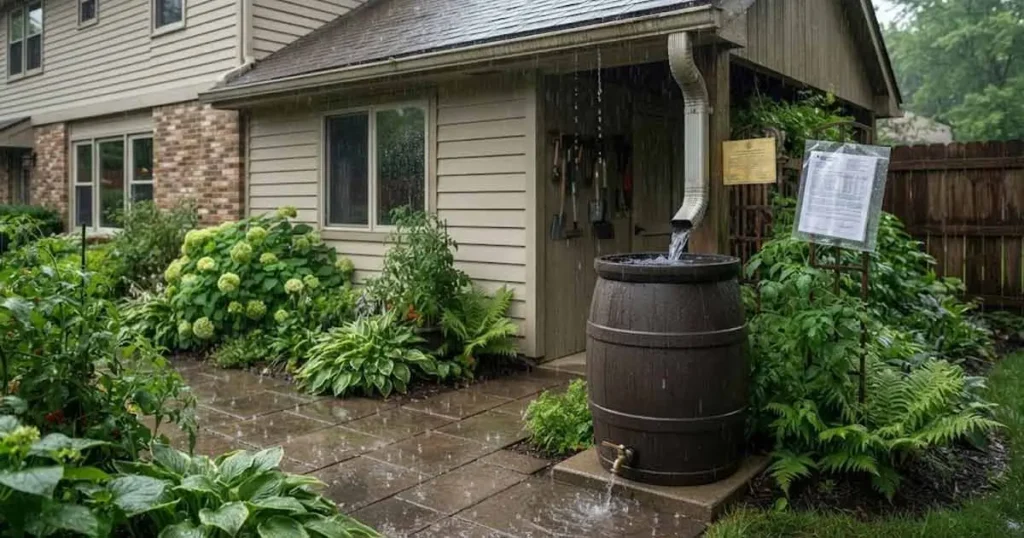

No, it’s not illegal to catch rainwater in Missouri. There is no state law prohibiting rainwater collection for residential use, no limit on the amount of water that can be collected, and no permit is required to use a typical rain barrel under a downspout. Under Missouri’s eastern riparian rights doctrine, water that falls on private property is considered the reasonable property of the land owner rather than a water resource that needs to be apportioned by the state. Most Missourians need only a screened barrel attached to a downspout for a rain barrel.
Key Takeaways
- Rainwater harvesting is perfectly legal in Missouri on the state level.
- No volume limit and no permit is required for a residential rain barrel or outdoor cistern used for irrigation.
- Missouri is subject to the riparian rights doctrine, which is shared by eastern and midwestern states, and thus does not have any prior appropriation restrictions.
- Indoor systems that are larger than those that are installed outdoors for non-potable purposes (e.g., toilet flushing) are subject to the Missouri Plumbing Code.
- Rainwater should not be consumed for drinking, cooking or food preparation unless it has been filtered and disinfected.
- Missouri does not have a statewide tax incentive for rainwater harvesting, although some local utilities have rebate programs.
- In some communities, even if the state law doesn’t specify, local rules and ordinances can impose additional conditions.
Is it Legal to Collect Rainwater in Missouri?
Yes. There are no Missouri statutes that prohibit or limit residential rainwater harvesting. A homeowner can place one rain barrel, a series of connected rain barrels, or an outdoor cistern that collects rainwater for irrigation of the garden and lawn without having to apply for approval from any state agency. It is true for urban residents in Kansas City and St. Louis, suburbanites in St. Louis County and Jackson County, as well as rural residents throughout the Ozarks and the Missouri River valley.
Missouri is averaging about 42 inches of precipitation a year, which is about the same amount as Indiana and Illinois. The typical 1000 square foot roof surface creates about 600 gallons of runoff for a one-inch rainfall. A large amount of that rooftop runoff in older cities in Missouri with combined sewer systems is conveyed directly to municipal sewer systems, and during periods of intense rainfall can cause combined sewer overflows. Even a small amount diverted into a rain barrel will ease that load, and will also provide the homeowner with an irrigation water source for use during the dry summer months when watering lawns and gardens is at its highest.
The Missouri Department of Natural Resources and the University of Missouri Extension have identified rainwater harvesting as a good water conservation practice and have developed some practical information for homeowners interested in installing a rainwater collection system.
Missouri Law on Rainwater Collection
There is no specific rainwater harvesting law in Missouri like there is in Texas or Arizona. What Missouri has is no prohibition, and a legal tradition of allowing rooftop rain to be part of the normal use of private property.
Missouri water law is based on a doctrine shared by most eastern and midwestern states known as riparian rights. Riparian rights give a landowner a reasonable right to use water that falls on or flows across his or her land. Rainwater collected on a private roof is not a public good that needs to be shared in a permitting program set up by the state. It is the same system that is in place in Illinois, Indiana, Ohio, Michigan, Tennessee, Georgia, Florida and Virginia, and it’s the basic reason all of these states are exempt from permitting a typical residential rain barrel.
There is no Missouri statute that specifically addresses rainwater harvesting and it is therefore not in a grey zone of legal uncertainty, but rather in a clear area of legal permission. No Missouri Department of Natural Resources rule or guidance has been adopted that limits residential collection at typical home size.
When Missouri Rules Do Apply: Larger and Indoor Systems
Rain barrels are not regulated in all of Missouri. Depending on the size and purpose of a system, there may be other rules.
| System Type | Requirement in Missouri |
| Rain barrel under a downspout for outdoor irrigation | No permit required |
| Multiple linked rain barrels for outdoor irrigation | No permit required |
| Outdoor cistern used solely for irrigation | No permit required, regardless of size |
| System plumbed indoors for non-potable use (e.g., toilet flushing) | Must comply with the Missouri Plumbing Code |
| System intended to supply drinking water | Requires treatment and filtration to safe drinking water standards |
| Large commercial or agricultural systems | May require review by the Missouri Department of Natural Resources |
The Missouri Plumbing Code requires that any rainwater system used indoors be clearly marked, physically separated from the potable water system and designed to prevent cross-contamination. These are building and safety regulations. They are used to describe the structure of a system rather than whether it can be constructed.
Missouri residents should consult the Missouri Department of Natural Resources for specific guidance on commercial and large-scale agricultural rainwater collection, especially when the proposed rainwater collection is of a size to potentially divert significant amounts of water from common drainage areas or impact downstream users in any practical way.
HOA Rules and Local Ordinances in Missouri
State law allows for this in Missouri, but there may be conditions for some homeowners imposed by local rules.
Missouri has not enacted any legislation to protect a homeowner’s right to install a rainwater collection system when the HOA is opposed. This means that a homeowners association in Missouri can, based on the provisions of its governing documents, limit the visible placement of rain barrels or require screening and placement. Property owners in planned communities should be sure to check their covenants and architectural guidelines before installing any system and, if required, request it formally on the HOA board in writing.
In the city, some cities in Missouri have laws concerning standing water and mosquito control. A rain barrel that is properly covered and screened is not a concern for these rules, as it is the presence of un-covered and stagnant water that will allow mosquitoes to breed. This concern can be addressed in almost any jurisdiction with a barrel that has a fine mesh inlet screen and a tightly-fitting lid. If you are thinking of installing a larger above ground cistern, residents of Kansas City, St. Louis, or Springfield should check with the local planning or public works department before attempting to do so.
A few local utilities and counties in Missouri have provided rain barrel programs and rebates. The City of Columbia and Mid-Missouri have long been engaged in encouraging stormwater management at the household level. Because rebates are offered year-to-year and by utility district, it’s best to contact your local water utility directly to find out what is currently available.
How Missouri Compares to Other States
Missouri is in the middle of the pack when it comes to permitting residential rainwater collection. Below is a table that compares Missouri with the states that are most often studied on this subject.
| State | Legal Status | Volume Limit | Permit Required | Tax Incentive |
| Missouri | Legal | None | No | No statewide incentive |
| Illinois | Legal | None | No | No (HOA protection law) |
| Indiana | Legal | None | No | No (local rebates exist) |
| Ohio | Legal | None | No | No |
| Michigan | Legal | None | No | No |
| Georgia | Legal | None | No | No |
| Tennessee | Legal | None | No | No |
| Virginia | Legal, encouraged | None | No | Yes (tax credit) |
| California | Legal, encouraged | None | No | Yes (property tax exemption) |
| Texas | Legal, strongly encouraged | None | No | Yes (sales tax exemption) |
| Florida | Legal | None | No | No |
| Oregon | Legal (post-2009 reform) | None for rooftop | No | No |
| Colorado | Legal with strict limits | 110 gallons | No (within limit) | No |
| Utah | Legal with limits | 2,500 gallons | Yes (over 100 gal.) | No |
| Nevada | Restricted | Water rights required | Yes | No |
| Arizona | Legal, encouraged | None | No | Yes (tax incentives) |
Missouri is more lax than Colorado, Utah and Nevada. It is generally similar to the eastern riparian tradition, which includes Illinois, Indiana, Ohio and Michigan, and has no volume caps. It does not provide the state-wide tax incentive that exists in Texas, Arizona, Virginia or California, but no state law will stop a Missouri homeowner from installing a rain barrel.
The full US rainwater collection guide details the current legal situation on rainwater collection in each of the fifty states.
The persistence of the myth of illegal rainwater collection
Many Missourians who look for answers to this question are doing so because they have heard the common misconception that it is illegal to collect rainwater in much of the United States. That is a claim with a definite and verifiable source.
The myth is created by two events. The first is Colorado’s previous near-complete prohibition on residential rainwater storage until 2009, when House Bill 1005 opened the door for some collection for the first time. Colorado had been an outlier for decades and the presence of that ban reinforced the general sense that western water law had rendered water collection generally illegal. The second case is from 2012 in Oregon, in which a land owner was charged with illegally harvesting some 13 million gallons of rainwater in three massive rainwater reservoirs on his land. That case got a lot of attention in the national press, and the message that was sent was it was a problem with home rain barrels, not with the illegal building of these large reservoirs. Later, Oregon amended its regulations to permit rainwater harvesting on rooftops without a permit.
There is no prior appropriation water law in effect in Missouri and there has never been a significant limitation on the collection of rainwater for residential use. Historically the legal issues that have been raised in the arid West have not been an issue here. Missouri’s Eastern riparian tradition holds that it has always been a part of the reasonable use of property to let the rain fall.
Safety tips for Missourians
Collecting rainwater under the legal framework does not imply that all the rainwater collected is suitable for all purposes. According to the Centers for Disease Control and Prevention, harvested rainwater could be contaminated with bacteria, viruses, parasites and chemical contaminants from roofing materials, gutters and airborne particulates. Roof surfaces, particularly on older buildings, may have residues of lead-based paints, residues of zinc from galvanized gutters, and atmospheric pollutants.
In Missouri, untreated collected rainwater can be used for:
- Watering lawn and gardens.
- Cleaning of vehicles and outdoor equipment.
- Avoid flushing toilets (where the system is installed inside the building per code)
- Filling ornamental ponds (not for fish to eat)
Uses which need filtering and disinfection before use:
- Drinking
- Cooking
- Brushing teeth
- Washing produce
Before installing in Missouri:
- Verify that there is no municipality ordinance regarding outdoor cisterns or standing water containers.
- If you reside in a planned community, check your homeowners association (HOA) covenants and make a written request for architectural approval before installing any visible system.
- To prevent mosquito breeding and debris contamination, use a barrel that has a tightly fitting lid and a fine mesh inlet screen.
- Place the barrel so that it does not run into the building foundation.
- Scrub barrel and gutters to eliminate organic debris at least once a year.
- Check with your local water utility to see if there is a rain barrel rebate or incentive program in your area.
Expert and Legal Perspectives
Water law experts repeatedly note that the state of the law on rainwater harvesting in the eastern and midwestern United States is quite different from the arid West. Colorado and Nevada have come to be restricted by the doctrine of prior appropriation, but Missouri and its nearby states have no such doctrine.
The National Conference of State Legislatures reports that in the last 20 years, most rainwater harvesting legislation in the United States has aimed at eliminating obstacles, rather than establishing new ones. States which have passed rainwater-specific legislation in recent years have tended to do so to clarify that collection is allowed, to provide tax incentive provisions or to establish construction guidelines for larger rainwater systems.
In publications regarding sustainable landscaping and stormwater management, the University of Missouri Extension consistently recommends rain barrels as a recommended practice for Missouri homeowners, especially in older urban areas that are connected to combined sewer systems where rooftop runoff can lead to combined sewer overflows during heavy rain.
The Federal Energy Management Program has an updated map of state rainwater harvesting policies in the United States. Since there is no state statute or administrative rule that prohibits residential collection in Missouri, the state is classified as a state where residential collection is allowed without restriction.
Missouri vs. Illinois: A Brief Comparison
Missouri and Illinois are adjacent states with rainwater collection laws that are quite similar. Both are based on riparian rights, both have no volume limits for residential collection, and neither requires a permit for a rain barrel or outdoor irrigation cistern.
The only practical difference is that Illinois enacted House Bill 991 in 2011 which explicitly provides for a formal review process for Illinois HOAs before they can limit a homeowner’s rainwater collection system. There is no similar law in Missouri. This means that Illinois homeowners have a clearer roadmap to navigate if they are opposed by an HOA than Missouri homeowners do at this time. The outcome of an HOA conflict involving a rain barrel in Missouri will largely hinge on the language of the community’s governing documents rather than any protection afforded by a state law.
See the Illinois rainwater collection guide for detailed information on the Illinois framework, including information on the HB 991 process.
Conclusion
There are no legal barriers to rainwater collection in Missouri. Ordinary residential rainwater collecting for irrigation or other non-potable uses outdoors is neither prohibited by state law nor limited by volume, nor does it require a permit. The State’s stance is influenced by its geographical and legal history. Under riparian rights principles, Missouri is a midwestern state that never considered rainfall on private property as a resource that must be authorized by the government to use.
The only variables that add any additional steps are local HOA covenants (which are not addressed at the state level in Missouri), and indoor plumbing of a non-potable rainwater system, which would have to meet the requirements of the Missouri Plumbing Code. None of these is an actual ban. These are issues that could be relevant for some homeowners, depending on their community and system design goals.
The road to be taken by any Missouri citizen is easy to follow. Always refer to local municipal regulations, read through HOA paperwork if applicable, and select an appropriately sealed and screened barrel. In addition to those measures, the law is squarely in the homeowner’s favor.
The complete state-by-state breakdown of rainwater collection laws is available in the US guide at Is It Illegal To
, and it gives a much wider perspective on the most restrictive states and those that actively encourage and incentivize rainwater collection at home.
Frequently Asked Questions
1. Can you collect rainwater in Missouri?
Yes. It is legal to collect rainwater in Missouri. There is no law that makes it illegal and no volume limit for residential systems and no permit requirement for a typical rain barrel or outdoor cistern to be used for irrigation.
2. How can I obtain a permit to collect rainwater in Missouri?
There is no requirement to obtain a permit for a standard residential rain barrel or outdoor irrigation cistern in Missouri. If you are installing a larger indoor system that will be used for non-potable water applications, like toilet flushing, a permit or code compliance review may be required.
3. What is the maximum amount of rain water that I can collect in Missouri?
There is no statewide limit on rainwater collection in Missouri. This is in contrast to Colorado that limits residential collection to 110 gallons and Utah that limits it to 2,500 gallons.
4. May my HOA prohibit me from putting in a rain barrel in Missouri?
Possibly per community’s governing documents. Unlike Illinois, there is no specific law in Missouri that mandates a formal review process for the installation of a rainwater collection system by a homeowner when a homeowner requests permission to install a rainwater collection system. Before installing any visible installation, members in Missouri should check their covenants and make a written request for a board decision.
5. Can I drink rainwater I collect in Missouri?
Not without treatment. The Centers for Disease Control and Prevention (CDC) advises against using collected rainwater for drinking, cooking, or preparing food without adequate filtration and disinfection. Harvested rainwater can be used for non-potable purposes, such as irrigation for lawns and gardens, vehicle washing and other purposes.
6. Does Missouri have any tax credit for rainwater harvesting?
There is no statewide tax credit or exemption for rainwater harvesting equipment in Missouri. There are some local utilities and municipal programs that provide periodic rebates. Historically, the City of Columbia and some Mid-Missouri utilities have embraced stormwater reduction efforts. Residents should check with their local water utility to find out if there are any incentives programs in effect.
7. What do you know about the state of Missouri compared to neighboring Illinois?
There are no caps on the size of rain barrels in either state and no permit requirements for rain barrels at the residential scale. The significant practical distinction is that Illinois enacted House Bill 991, which provides a homeowner with a specific procedural remedy to contest an HOA’s restrictions on rainwater systems. There is no Missouri equivalent statute, and the outcome of an HOA in Missouri is more dependent on the individual community’s governing documents.