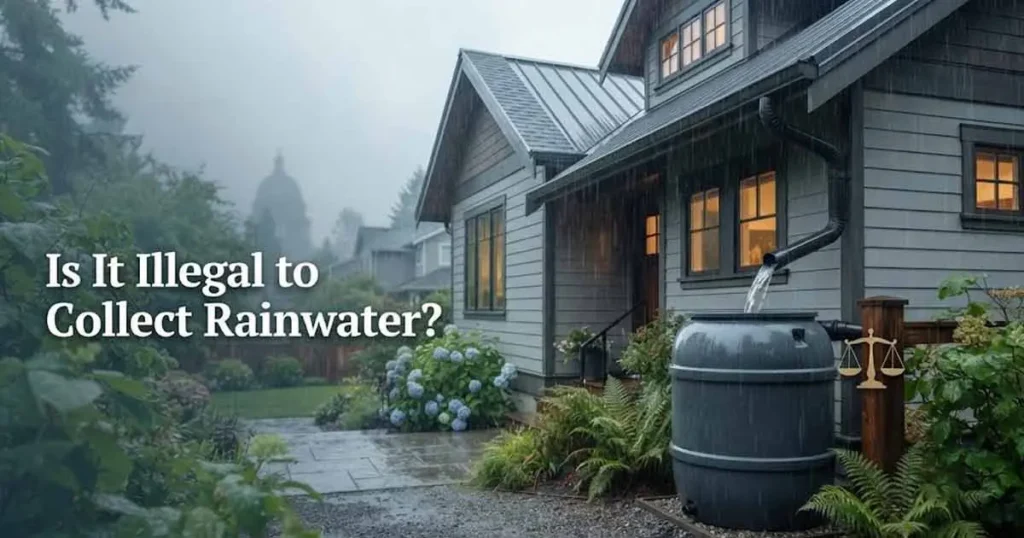

It is not illegal to collect rainwater in Illinois. No state legislation bans rainwater harvesting for residential use, no volume limits and no permit is required for a typical rain barrel attached to a downspout. In fact, Illinois took a further step in 2011 by passing House Bill 991, which modified the Illinois Homeowners Solar Rights Act to ensure a homeowner’s right to install a rainwater collection system even if an HOA tries to stop them. The simple components of a rain barrel are a screened container and a downspout and for most Illinois residents that is all that is needed.
Key Takeaways
- Rainwater harvesting is legal at the state level in Illinois.
- Residential rain barrels and outdoor cisterns (for irrigation) are not limited in volume and do not require a permit.
- Illinois House Bill 991 (2011) safeguards the rights of homeowners to install rainwater collection systems, and mandates that HOAs implement a formal energy policy before they can limit the installation of rainwater collection systems.
If a larger system is installed indoors for uses other than potable water systems (e.g., flushing toilets), it will be required to meet the requirements of the Illinois Plumbing Code.
- The rain water should not be used for drinking or cooking without proper treatment like filtration and disinfection.
- Illinois is in the eastern riparian rights doctrine, and therefore has no “prior appropriation” restrictions like those in Colorado and Utah.
Can You Legally Collect Rainwater in Illinois?
Yes. Rainwater collection is not regulated by any Illinois statute. The homeowner is permitted to place one rain barrel, a connected rain barrel system, or an outdoor cistern of larger size for garden and lawn irrigation without approval from any state agency. This is true in both urban and suburban communities (Cook County) and true in rural counties (central and southern Illinois).
The average annual precipitation in Illinois is about 38 inches. A typical roof area of 1,000 square feet will generate about 600 gallons of runoff for a one inch rain. Today, the majority of that water goes down the storm drains, leading to combined sewer overflows that have been a problem in older municipalities throughout Illinois. Even if only a small amount of the runoff is captured in a rain barrel, it can help alleviate the strain on municipal drainage systems and give the homeowner an inexpensive source of irrigation water in the summer.
Rainwater harvesting is recognized as a good water conservation practice by both the Illinois Environmental Protection Agency and the University of Illinois Extension and they have guidance for those who want to install a rainwater collection system.
Illinois Law on Rainwater Collection
Unlike Texas and Arizona, Illinois does not have a specific rainwater harvesting law. What it lacks is a prohibition, and a specific legal protection established by House Bill 991.
In 2011, House Bill 991 (2011) updated the Illinois Homeowners Solar Rights Act to specifically include rainwater collection. Prior to this law, a homeowners association could simply deny, without any procedure, a resident’s request to install a rain barrel or cistern. HB 991 changed that. Now it mandates any HOA that is asked by a homeowner to install a rainwater collection system to adopt an energy policy statement within 120 days. That policy should include a consideration of the acceptability of rainwater collection and, if it is acceptable, the location of the system on the property and the architectural requirements it has to meet. While not every HOA will approve every system, the law does not allow an HOA to simply refuse to approve a system or refuse without a formal review process.
Outside the HOA setting, Illinois water law is based on the riparian rights doctrine shared by the eastern states. A landowner has a reasonable right to use water that falls on or flows over his land under riparian rights. Rainwater that falls on a private roof will be considered a part of the normal use of that land, and not a shared public resource that is subject to a state permitting program. The most basic reason Illinois (as well as Indiana, Ohio, Michigan, Florida and most other eastern and midwestern states) do not require a permit for simple residential rainwater harvesting is that there are no risks associated with it.Simple residential rainwater harvesting does not involve any risk and that’s the basic reason why Illinois (and Indiana, Ohio, Michigan, Florida and most other eastern and midwestern states) do not require a permit for simple rainwater harvesting.
If Illinois Rules Do Apply: Larger and Indoor Systems
The rain barrel program is open, but that doesn’t mean that every rainwater system in Illinois is not regulated. Depending on the size and purpose of the system, other rules may be in effect.
| System Type | Requirement in Illinois |
| Rain barrel under a downspout for outdoor irrigation | No permit required |
| Multiple linked rain barrels for outdoor irrigation | No permit required |
| Outdoor cistern used solely for irrigation | No permit required, regardless of size |
| System plumbed indoors for non-potable use (e.g., toilet flushing) | Must comply with the Illinois Plumbing Code |
| System intended to supply drinking water | Requires treatment and filtration to safe drinking water standards |
| Large commercial or agricultural systems | May require review by the Illinois Department of Natural Resources depending on scale |
The Illinois Plumbing Code specifies that any rainwater system used indoors for purposes other than potable water must be labeled, physically separated from potable water, and designed to avoid cross-connections. The requirements are safety standards, not prohibitions. They describe the structure of a system, but not whether a system can exist.
One area where the Illinois Department of Natural Resources (IDNR) should provide specific guidance to Illinois residents before they proceed with commercial or large-scale agricultural rainwater collection is when the proposed system is large enough to divert significant amounts of water from shared drainage basins.
HOA Rules and Local Ordinances in Illinois
State law establishes the bottom line, but local regulations can complicate the situation for Illinois homeowners.
House Bill 991 established a procedure to navigate around the restrictions of an HOA, but it did not remove the restrictions. Even if an HOA has a 120-day policy review period, it may determine that visible rain barrels are not aesthetically acceptable for the community, or that it has particular requirements regarding rain barrel color, screening or placement. Owners of planned communities should consult their governing documents and make a written request to install any system before a formal review process is initiated, as required by law.
Some cities in Illinois have standing water and mosquito control ordinances at a municipal level. These ordinances are not usually involved with a sealed or screened rain barrel because mosquitoes do not breed in standing water, but rather in water that is stagnant and uncovered. In most jurisdictions, this is not a concern if a barrel equipped with a fine mesh screen is used over the inlet and a sealed lid is used. If you live in Chicago or a larger municipality, you may want to check with your city’s water management or public health department before installing larger cisterns.
A few counties in Illinois and utilities have acted ahead of time. Historically, the Metropolitan Water Reclamation District of Greater Chicago (MWDGCD), which provides stormwater services to Cook County and parts of neighboring counties, has also funded stormwater reduction projects, such as residential rain barrel programs. Rebates are available in some areas for some years and some areas for some utilities, so it is best to check directly with the local water provider to find out what rebates are available.
How Illinois compares to other states
Illinois is in the middle of the pack for states with no restrictions on residential rainwater collection. The table below helps to put Illinois in perspective with the states that are most often searched on this topic.
| State | Legal Status | Volume Limit | Permit Required | Tax Incentive |
| Illinois | Legal | None | No | No statewide incentive |
| California | Legal, encouraged | None | No | Yes (property tax exemption) |
| Texas | Legal, strongly encouraged | None | No | Yes (sales tax exemption) |
| Florida | Legal | None | No | No |
| Ohio | Legal | None | No | No |
| Indiana | Legal | None | No | No statewide (local rebates exist) |
| Michigan | Legal | None | No | No |
| Georgia | Legal | None | No | No |
| Oregon | Legal (post-2009 reform) | None for rooftop collection | No | No |
| Colorado | Legal with strict limits | 110 gallons | No (within limit) | No |
| Utah | Legal with limits | 2,500 gallons | Yes (over 100 gal.) | No |
| Nevada | Restricted | Water rights required | Yes | No |
Illinois is more liberal than Colorado, Utah and Nevada, and generally similar to Indiana, Ohio and Michigan. It currently does not provide the statewide tax incentives available in Texas and Arizona, and in Virginia, but the protections in HB 991 are one of the few states to have given specific legislative attention to the HOA barrier.
The full US rainwater collection guide provides detailed state-by-state information on the status of rain water collection laws in all fifty states.
Why the Myth of Illegal Rainwater Collection Persists
Many Illinoisans who ask this question are doing so because they have heard that it is illegal to collect rainwater in many parts of the United States. This statement has a clear source, and it needs to be rectified.
Two factors are responsible for the myth: the near complete prohibition on residential rainwater storage in Colorado (until 2009, when a limited exception was made in HB 1005); and a 2012 case in Oregon where a landowner was prosecuted for the unauthorized collection of 13 million gallons of rainwater in three large storage tanks. In that case, it was reported in the national media in such a way that it suggested that rainwater collection was considered widespread illegality. Actually, it was not about putting a rain barrel under a downspout, but about building illegal reservoirs on a large scale. Subsequent changes to Oregon’s permitting regulations have enabled the collection of rooftop rainwater without a permit.
In Illinois, the legal considerations that have been a factor in the arid west have never applied because there was never a “prior appropriation water law” in place. The state’s Eastern riparian tradition is that water that runs off any roof, regardless of ownership, has always been considered for use by the landowner.
Residential Safety and Information for Illinois residents
Collected rainwater is not necessarily safe for all uses, even if it is collected with legal permission. Harvested rainwater can be contaminated with bacteria, parasites, viruses, and chemicals that may be present in the air or on roofing materials or gutters. Residues from lead-based paint, zinc from galvanized gutters, and residues from nearby industrial activity are common sources of lead on roof surfaces.
The following are examples of acceptable uses for untreated collected rainwater in the State of Illinois:
- Watering lawns and gardens.
- Cleaning of outdoor equipment and vehicles
- Using the toilet system for flushing toilets (where system is installed indoors as per code)
- Filling of ornamental ponds (not for human consumption)
Uses that need filtration and disinfection to be safe:
- Drinking
- Cooking
- Brushing teeth
- Washing produce
Rainwater harvesting systems should be installed in compliance with the requirements of the plumbing code outlined above, and all pipes and fixtures connected to the rainwater system should be clearly labeled as “rainwater” by the homeowner.
Before installing in Illinois:
- Ensure that your municipality does not have any ordinance regarding outdoor cisterns or standing water.
- If you reside in a planned community, make a written request to your homeowners association to start the 120-day review period mandated by HB 991.
- To prevent mosquito breeding and reduce debris contamination, use a barrel that has a tightly-fitting lid and a fine-mesh inlet screen.
- Place the barrel so the overflow is away from the foundation.
- To prevent organic debris, clean barrel and connected gutters at least once a year.
- Check with your local utility to see if any rain barrel rebate or incentive program is available.
Also Read: Is It Illegal to Collect Rainwater in America
Avoiding the pitfalls of expert and legal perspectives
Water law experts continually emphasize that the legal environment for rainwater harvesting in the eastern U.S. is very different from that in the arid West. The doctrine of “prior appropriation” which historically was used to restrict rights in states such as Colorado and Nevada does not exist in Illinois or its neighboring states.
The National Conference of State Legislatures has recorded that in the United States, most rainwater harvesting legislation has been to ease restrictions, not impose them. States that have enacted rainwater specific legislation over the last 20 years have typically done so to clarify that collection is legal, to provide tax incentives, or to have construction standards for larger systems.
In its sustainable landscaping and stormwater management publications, the University of Illinois Extension always presents rain barrels as a recommended practice in the State of Illinois, especially in communities with combined sewer systems where rooftop runoff can cause combined sewer overflows in wet weather.
The Federal Energy Management Program has an up-to-date map of state rainwater harvesting policies in the U.S. Illinois falls into the “no restriction” category for collection at the residential level, which does not have any state statute prohibiting it.
Conclusion
A homeowner is not legally hindered in Illinois from installing a rain barrel or outdoor cistern. There is no state restriction on ordinary residential rainwater collection, no volume limit, and no permit is needed. The only time there are extra steps is when the system is installed in an HOA community (HB 991 establishes a formal review process) and indoor plumbing of a non-potable rainwater system (must meet the requirements of the Illinois Plumbing Code).
Water law is shaped by the geography and the state’s legal position. Under the principles of riparian rights, as an eastern state, Illinois has never considered rainfall that occurs on private property as property of another or as a resource that needs government permission to be used. Most other states, including California, Texas, Florida, Indiana, Ohio, Michigan, Georgia, Tennessee, Virginia, Arizona, and most others, have more lax systems.
The next step for any Illinois resident is easy – consult with local municipal regulations, read the documents from the homeowners’ association (if one exists) and select an appropriately screened barrel. In addition to those simple measures, the law is with the homeowner.
The complete national guide to rainwater collection laws at is it illegal to gives a state-by-state breakdown, including the most restrictive states and those that actively encourage rainwater collection.
Frequently Asked Questions
1. Can rainwater be collected in the state of Illinois?
Yes. It is legal to collect rainwater in Illinois. It is not banned by state law, there is no limit on the capacity of a cistern or rain barrel for residential use, and there is no requirement to obtain a permit for a cistern or rain barrel that is used for irrigation.
2. What is the maximum amount of rainwater that can be collected without a permit in Illinois?
The standard residential rain barrel or rainwater cistern does not need a permit in Illinois. If you are plumbing a larger system inside to provide non-potable water for non-potable purposes (such as flushing toilets), a permit and/or code compliance review may be required.
3. Is there anything my HOA can do to prevent me from installing a rain barrel in Illinois?
An HOA is not allowed to outright deny a request for rainwater collection. If an HOA is asked to do so, under Illinois House Bill 991 (2011), the HOA must adopt a formal energy policy statement within 120 days of the request, which must include a discussion of whether the system is allowed and what the architectural requirements are. The HOA can impose conditions, but it must also have a set process for reviewing the conditions, rather than an automatic denial.
4. How much rainwater can I collect in Illinois?
There is no statewide limit on the amount of rainwater that can be collected at a residence in No. Illinois. It is different from other states, such as Colorado, which limit residential collection to 110 gallons, and Utah, which limits it to 2,500 gallons.
5. May I use rainwater that I collect in Illinois?
Not without treatment. Collected rainwater should not be taken as drinking water, cooked or used in food preparation without filtration and disinfection, according to the Centers for Disease Control and Prevention. Harvested rainwater is suitable for non-potable applications such as irrigation, vehicle washing, and other uses.
6. Are there any incentives for rainwater harvesting in Illinois?
Unlike Texas, Arizona, and Virginia, there is no statewide tax credit or exemption for rainwater harvesting equipment in Illinois. Periodic rebates are available from some local utilities and municipal programs. Past efforts to reduce stormwater have been supported by the Metropolitan Water Reclamation District of Greater Chicago. Residents should check with their local water utility for any existing local incentives.