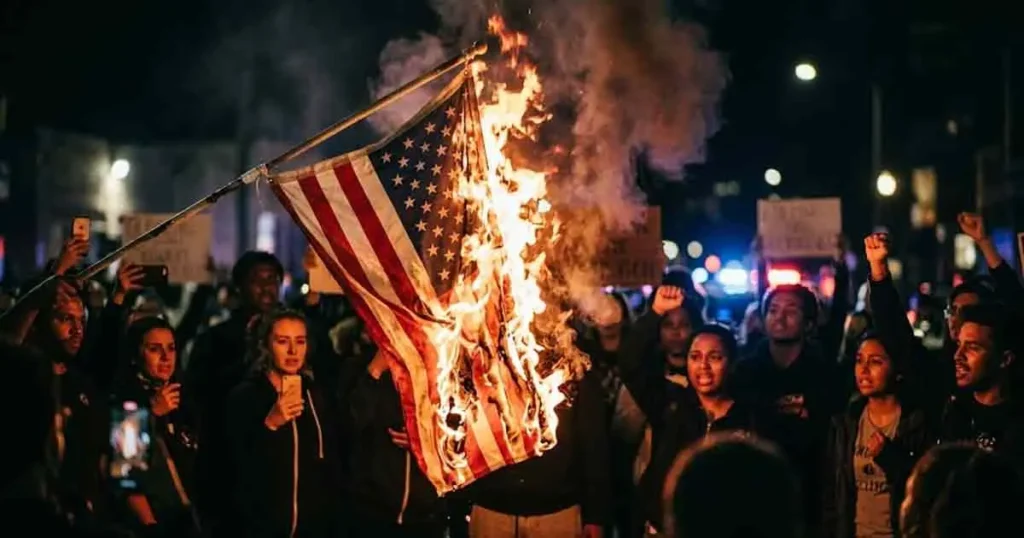

It is not illegal to burn the American flag in Texas for political reasons or to express a political opinion. A divided United States Supreme Court ruled in favor of protesters on June 21, 1989, in a First Amendment decision that allowed them to burn the American flag. In the hotly debated Texas v. Johnson case, the Court ruled 5-4 for Gregory Lee Johnson, who had set fire to the flag. That ruling was made on Texas soil, and Texas is the birthplace of the most significant legal precedent on flag burning in American history. The Texas Destruction of Flag law (Penal Code Section 42.11) has been declared unconstitutional and is no longer in effect. The constitutional protection is established law. That’s not to say that the political landscape around it hasn’t been settled, but in 2025, it was definitely a different political landscape – one that every Texan should know.
Key Takeaways
- The burning of the American Flag in Texas is not a crime in itself. In Texas v. Johnson (1989), the Supreme Court ruled that flag burning is a form of constitutionally protected symbolic speech under the First Amendment.
- The Texas Court of Criminal Appeals, the state’s highest court of criminal appeals, has ruled that Texas Penal Code Section 42.11, the Destruction of Flag law, is unconstitutional and therefore cannot be enforced.
- The Supreme Court ruled flag burning is protected by the First Amendment because it is expressive conduct. There is a fundamental principle of the First Amendment that the government can’t ban the expression of an idea just because society doesn’t like the idea or the expression.
- Why can’t it be illegal to burn the American flag? The Supreme Court has twice decided that flag burning is protected political speech (1989 and 1990). It is not to be criminalized as symbolic speech by any law, state or federal.
- Should the burning of the American flag in public be prohibited? Political expression of burning one’s own flag is protected. But fire safety requirements, burn bans and open fire ordinances may still apply, regardless of the type of burning.
- In August 2025, President Trump issued an executive order that ordered the Department of Justice to pursue some flag burning cases under existing content-neutral laws, including open burning and disorderly conduct laws. This order does not prohibit flag burning, but introduces a new enforcement element that all Texans should be aware of.
- It is not the First Amendment that protects burning someone else’s flag, it is the law that protects it as property destruction.
Under Texas law, no one is allowed to burn the American flag
The Texas Penal Code regulates the criminal laws in Texas. The Destruction of Flag law is found in Title 9, Chapter 42, Section 42.11 of the code, which deals with disorderly conduct and associated offenses.
A person commits an offense if the person intentionally or knowingly damages, defaces, mutilates or burns the flag of the United States or the State of Texas. The highest court of criminal appeals in Texas, however, ruled that the statute is unconstitutionally overbroad and thus unconstitutional under the First Amendment. Therefore, this law is unconstitutional and cannot be implemented.
The law is on the books. It is not enforced. The Texas Court of Criminal Appeals, the state’s highest court on criminal law, has ruled it unconstitutional. Under that statute, no Texas prosecutor will be able to successfully indict someone for burning a flag in the exercise of their political opinion.
Case that Started in Texas: Texas v. Johnson (1989)
The flag-burning case that gave rise to the entire national legal doctrine about flag burning stems from a case that started in Dallas, Texas. It is crucial to an understanding of why the law is structured as it is today.
In 1984, Gregory Lee Johnson set a flag on fire at the Republican National Convention in Dallas. In Texas, officials arrested Johnson and convicted him of breaking a Texas law that bans desecration of the flag. He was fined one year in prison and $2,000.
Johnson appealed the case, claiming that his actions constituted free speech protected by the First Amendment. His case was agreed to be heard by the Supreme Court. Most of the Court sided with Johnson and ruled that flag burning is a form of symbolic speech, protected by the First Amendment. Most said that the right to free speech covers what they regard as very offensive actions, but that society’s outrage does not mean that society’s free speech should be limited.
Justice William J. Brennan Jr. wrote for the majority that “If there is a principle underlying the First Amendment, it is that the government may not prohibit the expression of an idea because society finds the idea offensive or disagreeable. The Court held that Texas’s flag desecration law was a content-based restriction on expression and thus was unconstitutional.
The ruling invalidated flag desecration laws across the country. The ruling invalidated laws against desecrating the American flag, which at the time were enforced in 48 of the 50 states.
Why not make it illegal to burn the American flag?
One of the most common questions asked on this topic is: What is the direct constitutional answer?
The Supreme Court also ruled that the government does not have the power to limit speech for its content in general. This means that the government may not prevent anyone from saying something that most people find offensive. This is because the government cannot determine what ideas and information people can listen to.
Attorneys for free speech say the Supreme Court has had several decisions on flag burning, all of which have concluded that the right to burn a flag is protected by the First Amendment. David Cole, a professor at Georgetown Law who has defended flag burners in several landmark cases, said: “It can be used to wave it to show support for the government. It can be used to burn it to show opposition to the government.”
Congress tried to overturn the decision right after Texas v. Johnson. Congress challenged the decision later that year with the passing of the Flag Protection Act, which made flag desecration a federal offence. The constitutionality of the law was challenged in the Supreme Court which once again ruled that the burning of the flag was protected as free speech, in United States v. Eichman (1990), and that the Flag Protection Act violated the First Amendment.
Protection has been confirmed twice at the Supreme Court. As a matter of constitutional supremacy, no state law, Texas or otherwise, may abrogate it.
Is It Illegal to Burn the American Flag in Public?
This question is not as easily answered as the symbolic speech question, because there are other legal issues beyond the First Amendment involved in public burning.
It is constitutionally protected to burn an American flag as political protest. Whether it’s a fire pit or a campfire, there are rules that govern the lighting of any fire in public that are not based on the type of fuel being used.
State and local laws may also exist on open fires in general. When a burn ban is in effect at a state park or forest, it may create a fire risk to light the flag on fire. For instance, a fine of up to $5,000 and imprisonment of up to 6 months is the maximum penalty for violation of a fire restriction in a U.S. National Forest.
Texas has state-wide fire safety laws and burn bans are enforced in counties and cities throughout Texas on a regular basis, especially during droughts that are typical in Texas in the summer. If a person burns a flag in violation of a lawfully imposed burn ban, he or she may be prosecuted under the burn ban ordinance. The prosecution is not for flag burning. It’s for the fire ban.
The 2025 executive order focuses on this legal distinction
The 2025 Executive Order that Trump signed has something to say about the burning of the Texas flag.Trump’s Executive Order of 2025 has something to say about the burning of the Texas flag.
This is the biggest legal change on this issue in recent years and something that every Texas resident needs to know.
President Trump signed an executive order in August 2025, entitled Prosecuting Burning of the American Flag. The order outlines the meaning of the American flag and that its burning can lead to violence and riot. The order instructs the Attorney General to ensure that the Nation’s criminal and civil laws are enforced to the greatest extent possible against acts of American Flag desecration that are prohibited by content neutral and applicable laws, but not related to expression in a way consistent with the First Amendment.
The order does not introduce a new national ban on flag burning, but rather promotes the Attorney General’s prosecution of flag burners under existing laws, including those banning fires in fire safety zones. One such law – banning the lighting of a fire in a public park – resulted in the arrest of a man who lit an American flag across the street from the White House in protest against Trump.
While the order does not prohibit any flag burning, it does signal to federal officials that they should prioritize enforcement of otherwise neutral legislation and regulations about public fires and government property over enforcement of those laws and regulations against individuals who commit flag desecration. This preferential treatment is the equivalent of illegal discrimination of protected speech.
The bottom line for Texas people is this. It is constitutionally protected to burn a flag as a political protest. The federal government, however, has now told prosecutors to “examine all neutral laws that may be applicable to the particular facts of the flag burning case, such as Texas fire safety laws, burn ordinances, or disorderly conduct statutes. The protection of the First Amendment is in place. An aggressive enforcement environment has emerged.
What is prosecutable in Texas and what is not
It’s crucial for any Texas resident to know where the legal line is drawn.
What is protected:
- The burning of an American flag for political or symbolic purposes by the person who owns it.
- Burning a flag in an area and manner that does not conflict with fire safety laws
- The burning of the flag, which is not considered fighting words or incitement to imminent lawless action, is a form of political expression.
What still can be prosecuted:
- Burning a flag in contravention of a Texas burn ban or a fire safety ordinance
- Firing a flag on government land where fire is not allowed
- The destruction of any property other than that of the flag holder by burning a flag without permission,
- Taking a flag off someone’s flagpole and burning it, which could be considered theft or destruction of property. The owner may also bring an action for damages for the flag.
- If a flag is burned in a way that is fighting words or is designed to create an imminent lawless situation, it is not protected by the First Amendment, the Supreme Court has held.
Whether it is feasible to distinguish between flag burning in different ways and whether some flag burnings are considered “fighting words” and others “protected speech” remains to be determined. In 1989, Texas said that it was trying to keep the peace when it prosecuted Johnson, but the court considered the same set of circumstances and ruled that it was not at risk of peace being disturbed, because it was not at risk of people being offended.
The Political Controversy: Why the Debate Continues
The burning of the flag is a special part of American public discourse. The legal question is resolved. The political issue is not.
The decision was unpopular with the public and lawmakers, who saw flag burning as dead wrong, according to President George H. W. Bush. Congress has been considering the Flag Desecration Amendment, which would amend the U.S. Constitution to prohibit flag burning, several times in the years since the decision, but it has never managed to pass.
According to a report in 2023 by YouGov, 59 percent of the people said that they think flag burning is always unacceptable. The public is very and consistently against the act. The protection of the Supreme Court of it is also regular and consistent. The two have been sharing space in American public discourse for over 30 years.
Later, Trump requested the Supreme Court to re-think their flag burning decisions. In August 2025, President Trump signed an executive order that would allow the Department of Justice to prosecute some flag burning under federal law, even if it is protected by the First Amendment.In August 2025, President Trump signed an executive order to more aggressively enforce laws that prohibit the burning of items in public spaces, even if they are protected by the First Amendment.
The flag burning ban issue has never garnered the two-thirds majority of Congress. The latest passed the House of Representatives on June 22, 2005 and one vote short in the Senate on June 27, 2006. The Supreme Court’s decision in Texas v. Johnson continues to be the law unless a constitutional amendment is enacted.
The Texas v. Johnson case is situated in a specific legal context
The flag burning issue is a national one, and Texas has a long history of flag burning
| Legal Framework | Position | Authority |
| Texas Penal Code Section 42.11 | Unconstitutional and unenforceable | Texas Court of Criminal Appeals |
| First Amendment (U.S. Constitution) | Flag burning as symbolic speech is protected | U.S. Supreme Court, Texas v. Johnson (1989) |
| Flag Protection Act of 1989 | Struck down as unconstitutional | U.S. Supreme Court, U.S. v. Eichman (1990) |
| Flag Desecration Amendment | Never passed Congress | Failed by one Senate vote in 2006 |
| Trump Executive Order (August 2025) | Directs prosecution under neutral fire and safety laws | White House, August 2025 |
| Open burning and fire safety laws | Apply regardless of what is being burned | State and local authorities |
| Destruction of property laws | Apply to burning someone else’s flag | State criminal law |
There is a national picture that is consistent. In no state of the United States may flag burning be made a crime of political expression. What states and localities can do is to enact neutral laws on fire safety and public order for open burning, encompassing flag burning.
Also Read: Is It Illegal To
Expert and Legal Perspectives
In Texas v. Johnson, Justice Brennan, for the majority, said that “actions which inflict the most severe forms of offense upon society may be the most offensive to it” but that “the outcry of society is not enough to justify suppression of free speech. Over three decades after it was written, his majority opinion continues to be the prevailing opinion of constitutional law on the issue of flag burning.
In his concurring opinion, Justice Anthony Kennedy, who was part of the majority opinion in Texas v. Johnson, but found the decision “distasteful to him,” wrote: The flag is always the same in its expression of beliefs Americans hold: beliefs in law and peace, and that freedom which nourishes the human spirit. That’s poignant, but basic, that the flag is to protect those who say they hate it.
Texas Penal Code Section 42.11 has been ruled unconstitutional by the Texas Court of Criminal Appeals and is therefore not in effect, according to Attorney Paul Saputo, who has practiced in over fifty Texas state and federal courts and is an AV Preeminent Texas lawyer. The published analysis of the statute is one of the most accurate legal evaluations of the status of Texas’s flag destruction statute.
In response to the 2025 executive order, David Cole, a Georgetown Law professor and ACLU attorney who has represented flag burners in several high-profile cases, said the order would be Exhibit A for those prosecuted under content-neutral laws, explaining that the reason they were targeted was because they were burning a flag, not just burning something.
Conclusion
In Texas, burning the American flag is NOT a crime for political or symbolic purposes. The Texas Court of Criminal Appeals has ruled Texas Penal Code Section 42.11 unconstitutional and unable to be enforced. In 1984, flag burning was given First Amendment status as symbolic speech by the Supreme Court in Texas v. Johnson, which began in Dallas. The decision has been confirmed twice at the highest level of the judiciary and has been upheld over the last 30 years despite political attacks.
The environment in which enforcement is taking place has changed. In August of 2025, President Trump signed an Executive Order that instructs federal prosecutors to enforce flag burners under content-neutral laws such as fire safety ordinances, open burning ordinances, and disorderly conduct statutes. This leaves the constitutional protection intact for Texas residents, while the potential for prosecution by neutral laws has risen. A flag is not protected from burning charges if it is burned in violation of a Texas burn ban, on government property, or in situations that are “fighting words” or “inciting imminent lawless action.
See our complete coverage of the national legal situation at Is It Illegal to Burn the American Flag?
Frequently Asked Questions
1. Is it criminal to burn the American flag in Texas?
No, not for political or symbolic purposes. Section 42.11 of the Texas Penal Code is unconstitutional and unenforceable. The Supreme Court’s ruling in Texas v. Johnson (1989) protects flag burning as symbolic speech under the First Amendment.
2. Is it wrong to burn the American flag in public?
It is constitutionally protected to burn one’s own flag as political expression in public. Fires are subject to the same fire safety laws, burn bans and open fire ordinances, however, regardless of the type of fuel being burned. It is possible to be prosecuted for violating these neutral laws, not for the burning of the flag, but for the violation of fire safety laws.
3. Why is it that people are not allowed to burn the American flag?
The Supreme Court has decided two cases, Texas v. Johnson (1989) and United States v. Eichman (1990), that flag burning is protected political speech under the First Amendment. Most people don’t like this speech or expression, but the government may not ban it.
4. Does Trump’s executive order of 2025 make flag burning illegal in Texas?
No. The executive order does not outlaw flag burning. It directs the Department of Justice to prosecute flag burners under existing content-neutral laws such as fire safety ordinances and disorderly conduct statutes where those laws apply. The First Amendment protection of flag burning as symbolic speech is not affected.
5. In Texas, is it legal for me to burn someone else’s flag?
Yes. If a person burns a flag that is not his or her own, without permission, it is considered destruction of property in Texas. The First Amendment protection applies to your own property. When taking a flag and burning it, you are liable to being charged with theft and criminal mischief.
6. In Texas, has there ever been a time when burning a flag was legal?
Since the 1989 Supreme Court decision in Texas v. Johnson, the act has been constitutionally protected. Before that, there was an enforceable flag desecration law in Texas, and in 1984, Gregory Lee Johnson was convicted. This belief was later reversed, and the law was ruled unconstitutional.