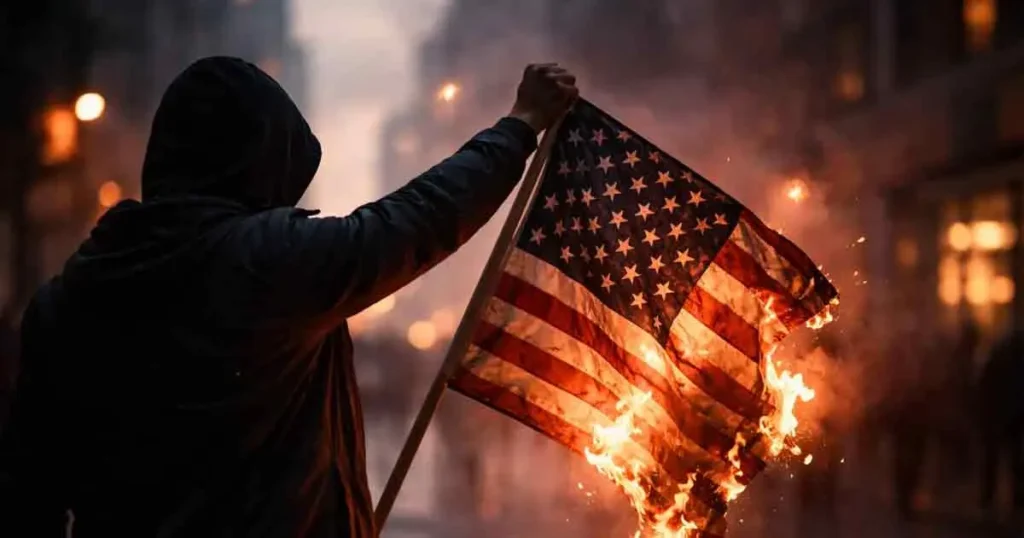

No, there is nothing illegal about burning the American flag in the United States as long as the act is done as a political expression. The U.S. Supreme Court has decided that flag burning is guaranteed under the first amendment as a symbolic speech. Nevertheless, there are still some situations when burning a flag can result in legal actions, i.e. when it is done in a manner that may threaten the population or breaks the local fire regulations.
Key Takeaways
- Burning of flags is usually lawful as a First Amendment-protected speech.
- This protection was provided by the landmark case Texas v. Johnson.
- Any efforts by the government to prohibit desecration of flags have been declared unconstitutional.
- There are still local laws that concern fire safety, disturbance of the people, or damage of property.
- The context is important, particularly when the act is associated with threats, violence, or personal property.
Knowing the Legal Position of Flag Burning
The constitutional provisions of the right to free expression are at the heart of the legality of burning the American flag. The First Amendment does not just protect verbal or written communications but also symbolic actions that can be used to deliver political messages.
Burning of flags has been a traditional way of protest especially at times of political instability. It has always been seen as expressive behavior by the courts and not a crime.
What is Symbolic Speech?
Symbolic speech is a type of speech that does not involve the use of words. This is also covered in U.S. law as:
- Protest by wearing armbands.
- Showing signs or symbols.
- Burning flags, and other objects, as a protest.
The Supreme Court has confirmed that such acts are under constitutional protection where they articulate a political opinion.
The Case Study: Texas v. Johnson
The contemporary legal standard is of Texas v. Johnson. Here, Gregory Lee Johnson was a political protestor who set an American flag ablaze at the 1984 Republican National Convention.
He was detained on a statute of Texas that forbade desecration of flags. However, the Supreme Court ruled in a 5–4 decision that:
- Burning of flags is expressive conduct.
- The government is not allowed to ban expression because it is offensive.
- The Texas law was a violation of the First Amendment.
The majority opinion by Justice William Brennan indicated that the government could not prohibit the expression of an idea just because society did not like it.
In United States v. Eichman, reinforcement was involved
Soon after the Texas v. Johnson ruling, Congress enacted the Flag Protection Act of 1989, in an effort to make flag desecration a federal offense.
This was contested in the case of United States v. Eichman, in which the Supreme Court once again decided that:
- The federal law prohibiting flag burning was not constitutional.
- Even controversial types of expression are safeguarded by the First Amendment.
This ruling solidified the fact that the symbolic protest using the flag cannot be prohibited simply because of the message.
In the case of Flag Burning May Still Be Illegal
The flag burning, though covered under the protection of speech, is not exempted to all the laws. Depending on the manner in which the act is executed, legal implications might be involved.
Cases in Which it may result in Charges
|
Situation |
Legal Risk |
|
Incineration of a flag in a limited space |
Breaking fire safety laws |
|
Causing property damage |
Destruction criminal charges |
| Endangering others |
Public safety violations |
|
Burning the flag of another |
Theft or vandalism offenses |
| Inciting unrest or violence |
Unruly behavior or instigation |
The main difference is that the government is unable to penalize the expression but can control the harmful behavior around it.
Constitutional vs. State Laws
Historically, many states in the U.S. had laws against flag desecration. But following decisions of the Supreme Court:
- These are very much unenforceable laws.
- Courts are required to bow to constitutional safeguards.
- Those who are prosecuted under such laws are usually found not guilty.
Practically, local authorities can still step in when the act poses a safety risk or disturbance to the people.
Popularity and Continuous Discussion
Even with the protection of the law, flag burning is a controversial thing. It has been indicated in surveys that a significant number of Americans would like laws prohibiting it, which represents a conflict between the popular will and the constitution.
Over the years, there have been attempts to change the Constitution to outlaw flag desecration but all have been unsuccessful.
This continuing controversy underscores one fundamental tenet of American law, namely the safeguarding of speech, even unpopular or offensive speech.
The First Amendment protects offensive expression because of the following reasons
The First Amendment is not only created to defend the ideas that are agreeable or generally accepted but also to defend dissent.
Courts have reiterated that:
- The right to criticize the government is a right of freedom of speech.
- Political meaning can be expressed through emotional or symbolic actions.
- Banning offensive speech poses a danger to wider censorship.
This principle guarantees that the voice of minorities and protest movements will be able to be heard without the interference of the government.
Real-Life Protest Case of Guarded Protest
The flag burning has been used in other forms of protests such as protesting against war, government and social injustice.
In both instances, the courts have dwelled on whether the act:
- Conveys a clear message.
- Does not result in illegal injury.
- Falls under the area of expressive conduct.
When such conditions are upheld, then the act is usually safeguarded by the constitutional law.
Also Read: Is It Illegal To
Conclusion
In the United States, the First Amendment allows the burning of the American flag as a political expression, which is legally safeguarded. This principle has been solidified by the decisions of the Supreme Court especially Texas v. Johnson and United States v. Eichman. Simultaneously, people have to obey the laws concerning safety, property, and the order.
It is important to know this difference. The legislation safeguards the right to share ideas, including controversial ones, but limits actions that harm. To get answers to delicate legal matters, the best guide is always a dependable and well-researched information.
Frequently Asked Questions
1. Is it a crime to burn the American flag?
No, it is not illegal if done as a form of political expression. Nevertheless, fire rules and safety should not be disregarded.
2. Can you be arrested for burning a flag?
The act can be violated in other ways, like by creating a fire hazard or property damage, which will result in arrest, but not the act of protest itself.
3. Is flag burning a free speech?
Yes. The Supreme Court has decided that it is a kind of symbolic speech which is safeguarded under the First Amendment.
4. Is it legal to prohibit flag burning by states?
No. State legislations prohibiting desecration of flags are invalid because of the decisions of the Supreme Court.
5. Can we burn the flag of another person?
Yes. That would be theft or vandalism which is not safeguarded under free speech.