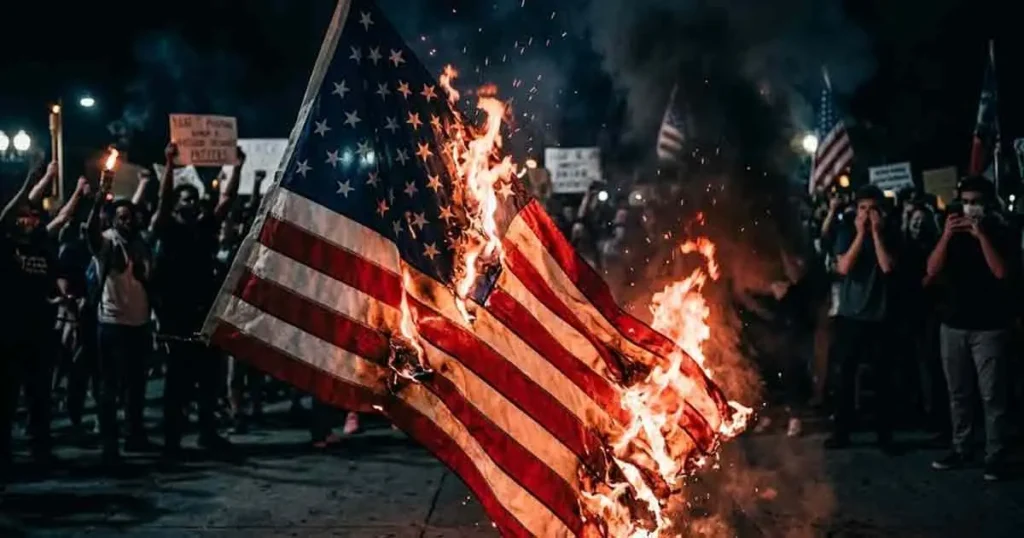

No, it’s not illegal to burn the American flag in the USA. Yes, it is legal to burn the American flag in the United States. The Supreme Court has decided flag burning is a form of symbolic speech protected by the First Amendment. In Texas v. Johnson (1989), the Court ruled that flag desecration is expressive conduct protected by the Constitution when it is done as a form of protest. That decision has never been overturned by any state law, federal statute or presidential executive order. For over 30 years, the legal question has been answered at the highest level. The political and enforcement landscape of that settled legal issue has changed in recent years, and especially in August 2025.
Key Takeaways
- It is not illegal to burn an American flag for political or symbolic purposes in America. The Supreme Court has decided that flag burning is a form of symbolic speech that is protected by the First Amendment.
- The Supreme Court has decided that burning the American flag is a mode of expression, and thus protected by the First Amendment in Texas v. Johnson. In a subsequent case, the Court determined in United States v. Eichman that a federal flag burning law was unconstitutional.
- In which States is it illegal to burn the American flag? None. In this Supreme Court ruling, the Court invalidated national flag desecration laws in 48 states. No state may ban flag burning as political speech.
- Now is it illegal to burn the American flag? No, even after the executive order by President Trump in August 2025. The order does not prohibit flag burning, but asks prosecutors to rely on neutral laws like fire safety ordinances against flag burners.
- Can you burn the American flag to protest? No, unless the act violates fire safety laws, is “fighting words” or incites imminent lawless action.
- It may be necessary to have time and place restrictions for starting a fire, and burning a flag at any time or place may not be allowed.
- It is not protected by the First Amendment to burn another flag, it is a crime of property destruction.
What the Law Says About Burning the American Flag
The laws of the United States that regulate flag burning fall under two Supreme Court rulings and the First Amendment of the U.S. Constitution.
The First Amendment to the U.S. Constitution guarantees freedom of expression, freedom of the press, the right to peaceably assemble, and the right to petition the government for a redress of grievances. The Supreme Court ruled that American citizens are not to be prevented from desecrating the flag.
The Supreme Court also ruled that the government is not allowed to censor speech in general. That means that the government may not prohibit the expression of an idea simply because most people think it is offensive. This is because the government has no authority to determine what ideas or information people are able to hear.
There is a federal flag desecration statute, 18 U.S. Code Section 700. Any person who willfully mutilates, defaces, physically defiles, burns, leaves on the ground or floor, or tramples upon any flag of the United States shall be punished by a fine imposed under this title or by imprisonment for not more than one year, or by both. This statute has been declared unconstitutional and unenforceable, however. It is not applicable to prosecute flag burning as political expression.
Which of the following states has laws prohibiting the burning of the American flag?
This is a very common question about this subject and the answer is the same in every state in the U.S.
This Supreme Court decision struck down national flag desecration laws in 48 states. Prior to Texas v. Johnson, there were numerous state flags laws prohibiting flag desecration. The 1989 ruling invalidated all of them, ruling that the flag’s use as political expression cannot be banned by any state government.
There is no state law that bans flag burning in itself as a political protest. This is the case in all states from Texas to Florida, California to New York, and everywhere in between. The constitutional protection is uniform throughout the country.
There is a completely different body of laws that govern open fires, public safety, and disorderly conduct that exist in the states, and that which is still legally valid. These laws are applicable to all burning, whatever it is burned, and flag burners can be sanctioned under the conditions of these laws.
Two Supreme Court Decisions That Settled the Question
Texas v. Johnson (1989)
The case that was pivotal was Texas v. Johnson, in which Gregory Lee Johnson burned an American flag during the 1984 Republican National Convention in Dallas in protest of the Reagan administration policies.
In June 1989, the Supreme Court ruled that the First Amendment applies to a wide range of expressive conduct, not just speech, and that flag-burning can be one of those forms of expression, as it was in Dallas.
Justice William Brennan delivered the opinion of the majority in Texas v. Johnson, saying that if there is a fundamental law behind the First Amendment it is that the government cannot prohibit the expression of an idea because society finds the idea offensive or disagreeable.
The decision was 5-4, but not along party lines. One of the other justices in the majority was conservative icon Antonin Scalia.
United States v. Eichman (1990)
In response to the Johnson ruling, Congress passed the Flag Protection Act of 1989, which was an attempt to establish a content neutral federal ban. Later, in the case of United States v. Eichman, the Court decided that a federal flag burning statute is unconstitutional.
Congress had attempted to pass a more content neutral law, but this law still restricted symbolic speech. Congress then attempted to make the act a crime by amending the Constitution, but the Supreme Court was unable to overturn that amendment. However, the Flag Desecration Amendment did not get the necessary two-thirds Congressional majority votes.
Two Supreme Court decisions. One legislative failure that was a federal issue. One unpassed constitutional amendment. The right to burn the flag as a symbol of political expression has been tried and proven at every level.
Should the burning of the American flag be illegal? The 2025 Executive Order
This is the most important recent development on this issue and the one that has caused the most public confusion as to the legal status of flag burning today.
On August 25, 2025, President Donald Trump signed an executive order calling for the Justice Department to pursue criminal charges against anyone who “desecrates the American flag,” such as by burning it, in direct defiance of a landmark Supreme Court decision that protected flag burning as a form of protected speech.
As Trump signed the order, he declared: “If you burn a flag, you get one year in jail; no early releases, no nothing. You get one year in jail, it goes on your record, and you will see flag burning stopping immediately.”
But the executive order does not and cannot ban flag burning. The government can’t prosecute protected expressive activity, even if many Americans, including the president, find it uniquely offensive and provocative, but people can be prosecuted for burning anything in a place they’re not allowed to set fires.
The executive order requires Attorney General Pam Bondi to prosecute anyone who burns or desecrates the American flag in ways that do not relate to expression, which are harmful under the First Amendment. This may include, but is not limited to, violent crimes, hate crimes, illegal discrimination against American citizens, or other violations of Americans’ civil rights, and crimes against property and the peace.
Attorneys doubted the order will pass constitutional muster. Flag burning is part of the First Amendment, said Robert Corn-Revere, chief counsel of the national free speech group, FIRE. The government can’t prosecute protected expressive activity, even if it is uniquely offensive and provocative to many Americans, including the President, who are not prohibited from doing so in the place where it is taking place.
The executive order is best seen as a political message, and an effort to establish precedents that could be litigated before a new Supreme Court. Does not alter the current legal protections for flag burning as symbolic speech.
Should the burning of the American Flag be considered legal or illegal when it is used for protest purposes?
The short answer is no, but there are some conditions.
Making a political statement by burning the U.S. flag is protected speech under the First Amendment.
Protest burning of flags is protected when:
- The flag that is being burned must be your flag.
- The burning should not be in violation of fire safety laws and/or burn bans where the burning takes place.
- The act shall not be fighting words towards a person or persons specified by name.
- The act shall not be intended to provoke imminent lawless action.
Just because flag burning is protected speech doesn’t mean it always is. States have authority to stop “imminent lawless action. The Court, however, clarified that it was not the same to offend observers as to promote lawlessness.
The distinction between protected protest and unprotected incitement is a factual one, based on the particular facts of each case. Many of the people who burn flags aren’t trying to incite violence,” said Brian Hauss, an attorney with the American Civil Liberties Union. If a person is burning a flag in protest, and if they are not saying to people to go out and commit violence, then the government can’t say, well, that might have the effect of causing violence to stir up, so let’s prosecute.
What is prosecutable, and what isn’t
It is important for all Americans to know exactly where the legal line is.
What is protected:
- The burning of the American flag for political or symbolic purposes.
- Burning a flag where and when it does not contravene fire safety regulations
- Burning the flag for political purposes, so long as it is not fighting words or inciting imminent lawless action.
What can still be prosecuted:
- Lighting a fire that is prohibited by a local fire safety ordinance or burn ban.Firing a flag when a burn ban or fire safety ordinance prohibits burning.
- The burning of a flag on government property where fire is not allowed.
- Taking a flag off someone’s flagpole and burning it, which could be considered theft or destruction of property. The owner could also file a civil claim to recover the cost of the flag.
- Burning a flag in a way that is likely to provoke imminent lawless action or is a fight word.
- Violating a fire restriction in a U.S. National Forest, which has a maximum penalty of up to 6 months imprisonment and a fine of up to $5,000.
The Proper Way to Retire an American Flag: An Important Distinction
This is a critical point that often is overlooked when talking about the legality of flag burning.
Burning the flag as a way to protest is protected speech, but the United States Flag Code provides that, “The flag shall be burned as a method of disposing of worn or damaged flags. When a flag is no longer suitable for display, it should be destroyed in a suitable and dignified way, preferably by burning, according to the Flag Code. It is not a protest burn and is a sign of respect for the flag as a symbol of the nation.
This is because the burning of flags is not illegal to use as a form of protest, but it is actually encouraged as the correct way to dispose of an old flag. The same act – burning the flag – has completely different meaning and legal context when it is used for different purposes. Respectful and encouraged ceremonial retirement burning. Politically sensitive, but protected, protest burning.
The Political Debate: Public Opinion vs. Constitutional Protection
The legal issue has been resolved. The question before the political class isn’t, and much of the confusion over the legality of flag burning stems from this.
According to a 2023 poll conducted by YouGov, 59 percent of respondents felt flag burning was always unacceptable. The public condemnation of the act is loud, solid and bipartisan. The Supreme Court’s protection of it is also uniform, and has been reaffirmed in two different rulings in over 30 years.
Congress has tried to change the Constitution to outlaw flag desecration as recently as 2006, by one vote in the Senate. The only way flag burning could be permanently banned in America is by the constitutional amendment process. The amendment has never been able to garner a 2/3 majority in both houses of Congress.
The Flag Burning Debate has changed over the years
The history of flag burning law in America is one of repeated efforts to make flag burning illegal, and repeated efforts by the courts to strike down those laws.
The first significant federal flag desecration law was enacted in 1968 during the Vietnam War. State laws that pre-date its existence in all but a few states. The Texas v. Johnson case struck down the state laws. The federal law was declared unconstitutional in the case of United States v. Eichman. The Flag Desecration Amendment was rejected several times in Congress. The 2025 executive order by President Trump is the latest in a series of efforts to identify a legal basis for prosecuting flag burning without directly attacking the Supreme Court’s landmark decision on the constitutionality of flag burning.
The Trump administration is not likely to be deterred by the fact that its efforts are likely to generate test cases; administration officials have been eager for the issue of flag burning to be before the justices again, hoping to get the court’s interpretation or invalidate its precedents.
It is uncertain whether the current Supreme Court would uphold or overturn Texas v. Johnson if the case were brought before them again. It is clear that today’s law is still the 1989 and 1990 decisions.
Expert and Legal Perspectives
The constitutional principle governing this issue was set forth by Justice William Brennan in his majority opinion in Texas v. Johnson. His assertion that the government cannot ban the expression of an idea just because society finds the idea offensive or disagreeable is the basis of First Amendment flag burning law.
It can be waved in support of the government, said David Cole, professor at Georgetown Law who has represented flag burners in several high-profile cases. It can be used to burn it as an expression of disapproval of the government. But most of all, the government is not allowed to dictate to us how to use symbols and speech. It is our job to decide those things.
Robert Corn-Revere, chief counsel of FIRE, a national free speech group, confirmed: Flag burning as a form of political protest is protected by the First Amendment. While people can be prosecuted for burning anything in a place they are not allowed to set fires, the government cannot prosecute protected expressive activity.
GS Hans, a Cornell University law professor who specializes in First Amendment issues, told the Associated Press in response to the 2025 executive order that the experts doubted it would hold up to constitutional challenges, and flag burning hasn’t posed a major public safety concern.
Also Read: Is It Illegal To
Conclusion
In America, it is not illegal to burn the American flag as a political or symbolic gesture. In Texas v. Johnson (1989) and United States v. Eichman (1990), the Supreme Court determined that flag burning is protected symbolic speech under the First Amendment. It cannot be outlawed by any state. It cannot be outlawed by any Federal law. No executive order can supersede the constitutional protection, unless the Supreme Court overturns its own precedent.
The key point that every American should grasp is that legal protection and legal risk are different concepts. Protest flag burning is protected by the First Amendment. All burning is covered by content neutral laws concerning open fires, public safety, and disorderly conduct, and the Trump administration’s August 2025 executive order has made it clear that federal prosecutors will enforce those laws against flag burners. Unauthorized burning of another flag is considered to be a property crime. The burning of a flag for the purpose of provoking imminent lawless action is not protected by the First Amendment.
The right to burn the flag is constitutionally guaranteed. In 2025, the actual application of that right has become more challenged than it has been since the original Texas v. Johnson decision. Each American that wishes to exercise and understand that right should have a clear understanding of the legal line.
For state-specific guidance, read our full coverage at Is It Illegal to Burn the American Flag in Texas?
Frequently Asked Questions
1. Is it illegal to burn the American flag in America?
No. In Texas v. Johnson (1989) and United States v. Eichman (1990), the Supreme Court ruled that flag burning for political or symbolic purposes is a First Amendment right. No individual state or federal law can prohibit it as a protest by itself.
2. What states is it illegal to burn the American flag in?
None. Texas v. Johnson was a case in which the Supreme Court ruled that flag desecration laws were unconstitutional, just as they were in 48 states at once. There is no state law in force banning flag burning for political purposes.
3. Has the executive order made it illegal to burn the American flag after 2025?
The August 2025 Executive Order by President Trump does not prohibit flag burning. It calls on prosecutors to apply existing content neutral laws, like fire safety ordinances and disorderly conduct laws, to flag burners where these laws apply. The protection of the First Amendment for flag burning as symbolic speech does not end.
4. Is it illegal to burn the American flag in protest?
No, if the act does not infringe on fire safety regulations, burn someone else’s property, be fighting words or be designed to incite imminent lawless action. It is constitutionally protected to burn one’s flag as political protest at a place where open burning is allowed.
5. Is Congress able to make flag burning illegal?
It can only be done through a constitutional amendment, which needs 2/3 of both houses of Congress and 3/4 of the states to pass. Several times, such an amendment has been introduced, but has never passed, most recently in 2006 when it lost one vote in the Senate.
6. Is it possible to tell the difference between ceremonial flag burning and protest flag burning?
Yes. Burning is the recommended method of retiring a flag that is worn or damaged, in accordance with the United States Flag Code. Ceremonial retirement burning is a way of showing respect for the flag as a national symbol and is not the same as protest burning. Both are within the law at this time.