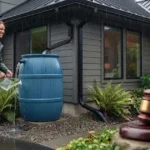
The collection of rainwater is legal in Michigan and there is no state law that prohibits it. A homeowner may install under a gutter downspout without any permits, registrations or state review whatsoever. The Michigan Department of Environment, Great Lakes, and Energy (EGLE) regulates water resources in general, and there is no statewide restriction on rainwater harvesting for personal outdoor water use. Rules only come into existence when a system is connected to a home or when a local ordinance applies.
Key Takeaways
- It is legal to collect rainwater in Michigan. There is no statewide law restricting rain barrels or residential harvesting.
- Michigan is a riparian rights state, meaning it considers reasonable water use on one’s own property to be different than the prior appropriation states in the western US.
- No permit is required for a simple rain barrel located under a downspout anywhere in the State of Michigan.
- The Michigan Plumbing Code governs collection surfaces, filtration and roof washers when a system is installed in a building or used for indoor applications.
- There is no statewide rain barrel incentive program, but some cities and counties provide rebates or instructions for installing rain barrels (part of Washtenaw County and part of Oakland County).
What is the reason that people believe it is illegal to collect rainwater in Michigan?
It’s not against the law and Michigan has never had a statewide rainwater ban. The notion that it may be illegal is generally a confusion with a few Western states that actually had laws that banned the practice, the most notable being Colorado, which had the only true statewide ban on residential rainwater collection in the country until 2016. The national coverage of that story, along with other stories about the tough waters permitting in Nevada and Utah, is generalized online as if it’s happening in all states, including Michigan, which has a completely different legal tradition.
Water rights doctrine is the reason for the differences between the two regions. Prior appropriation is a water allocation system in Colorado and most of the western United States that allocates water first to those who first appropriated it, and allows rain to be considered a portion of the water that should be allocated to the next user downstream. Michigan and most states east of the Mississippi take a different view, and have never required a state permit for a landowner’s reasonable use of water on his or her own property, even rain that falls on a roof.
How Michigan’s Water Law Differs From Western States
In Michigan, the riparian doctrine has historically provided all landowners adjacent to a water body with a reasonable use of the water, and there has been no analogous system to the western concept of distributing the rainfall to the downstream water rights holders. That’s why a Michigan homeowner installing a rain barrel has no similar legal question as a Colorado homeowner before 2016. The water was never consecrated by another person.
This is not to say that there is no regulation in Michigan. Michigan does not regulate the act of catching rain, but the systems used to store and use it, especially if it is connected to plumbing or is planned for use for anything other than outdoor irrigation.
Rules for Standard Rain Barrels in Michigan
The rules are simple for most homeowners.
- There is no permit required for a rain barrel that is connected to a roof downspout.
- The state does not have a limit on how much rainwater can be stored in a residence.
- Water collected can be used for irrigation of lawns and gardens.
- A sealed or screened barrel is usually required by local health and nuisance codes in order to prevent mosquito breeding.
One barrel or a couple of barrels hooked up to one another for a backyard irrigation system is not a regulated activity under Michigan law.
When Michigan Requires Permits or Code Compliance
Once a system is beyond an outdoor barrel, rules apply. The Michigan Plumbing Code has an appendix dedicated to rainwater collection systems that are connected to a building. This code allows rainwater to be collected from approved above-ground impervious roofing surfaces, but prohibits collection from parking areas or pedestrian surfaces unless the water is used exclusively for landscape irrigation. Systems designed to this standard also need a roof washer which will divert the initial flow of each rainwater event away from the storage tank to prevent debris and contaminants from entering the system.
| Situation | Requirement in Michigan |
| Rain barrel under a downspout for outdoor use | No permit needed |
| System plumbed into the home for non-potable indoor use | Must meet Michigan Plumbing Code appendix requirements |
| Collection from parking lots or walkways | Prohibited, except for landscape irrigation only |
| Drinking water use | Requires treatment and filtration to safe drinking water standards |
| Local ordinance in specific cities, including parts of Detroit | May add additional requirements beyond state code |
Unlike the Colorado rain barrel law, Michigan does not have a single statewide law governing rainwater harvesting. Rather, it incorporates these requirements into general plumbing and building codes, meaning the rules that apply are highly dependent on the construction and operation of a system, and not just its water storage capacity.
Local Rules and Incentives in Michigan
There is no statewide rebate or tax incentive program for rainwater harvesting in Michigan, although several local governments do offer rebates and/or tax incentives. Oakland County provides detailed information on rain barrel construction and placement as part of its stormwater management programs and Washtenaw County has provided credits for installing rain barrels or cisterns. There are some cities that have extra requirements that are added to state plumbing codes, such as Detroit. While state rules are consistent for barrel installations, homeowners should check with their city or county before undertaking anything more than a simple barrel installation as there are more variations in local rules than in state rules.
Also Read: Is It Illegal To
Michigan vs. Colorado: Why the Two Get Compared
The laws governing rainwater in Michigan and Colorado are in fact quite different, and are sometimes mentioned in the same breath online.
| Point of Comparison | Michigan | Colorado |
| Legal status | Legal statewide, no permit for basic barrels | Legal since 2016, but capped |
| Volume limit | None at the state level | 110 gallons, two barrels maximum |
| Legal basis | Riparian rights, reasonable use of rainfall | Narrow exemption from prior appropriation law |
| History | Never had a rainwater collection ban | Only state with a near-total ban before 2016 |
For all of Colorado’s regulations and the background on Colorado’s 2016 legal update, check out our Colorado rainwater collection guide.
How Michigan is doing compared to other states.How Michigan is doing relative to other states.
Michigan is one of the few states that have no limit on the amount of rainwater that can be collected for use at a residence. California, Texas, Florida, Ohio, Indiana, Tennessee, Virginia, Arizona and Oregon are all in this permissive category. See our US rainwater collection guide for the full state-by-state details, or check out the US rainwater collection guide, or review specific rules for California, Texas, Florida, Ohio, and Oregon.
Conclusion
The myth about rainwater collection is almost invariably a reference to headlines from very different states such as Colorado, and there is no statewide limit on collecting rainwater in Michigan. A basic rain barrel is permitted in all of Michigan. The rules that are in place are derived from the plumbing code, not a rainwater ban, and are in effect when a system is brought indoors or extended past the simple outdoor barrel. If you are thinking of installing a larger or plumbed-in system, you should consult the Michigan Plumbing Code and city or county ordinance before doing so. If you want an idea of how a truly “restrictive” state deals with the same question, check out our guide to rainwater collection.
Frequently Asked Questions
1. Is it illegal to collect rainwater in Michigan?
There is no state law in Michigan that limits rainwater collection. A simple rain barrel from a downspout does not require a permit anywhere in the state.
2. Why is it that it is illegal to collect rainwater in Colorado, but not Michigan?
Colorado has adopted the water law of prior appropriation, which historically allowed rainfall to be used with water rights that were downstream, and until 2016, there was almost no use allowed for rainwater. Today, there is a 110-gallon limit on rainwater use. The rights of riparians were never so limited as to prohibit the collection of rain water on one’s own property in Michigan.
3. What is the maximum height of a rain barrel in Michigan?
No. A typical rain barrel for outside watering does not require a state permit. Permits only apply if the system is connected to a building and/or is used indoors.
4. Is rainwater collection in Michigan allowed?
No, not for general use. The Michigan plumbing code does not allow water from parking lots or pedestrian areas to be collected unless it is to be used solely for landscape irrigation.
5. Does Michigan have any rain water harvesting rebates?
While there is no statewide rain barrel or cistern rebate program, some local governments such as portions of Washtenaw County have provided rain barrel and cistern installation credits. Please see your city or county for current programs.
6. Is Detroit’s rainwater collection rule different from the rest of Michigan?
Some cities in Michigan have extra local codes that are enforced in addition to the state plumbing code, such as Detroit. Residents of these zones should verify local regulations prior to putting any project other than a basic rain barrel in place.