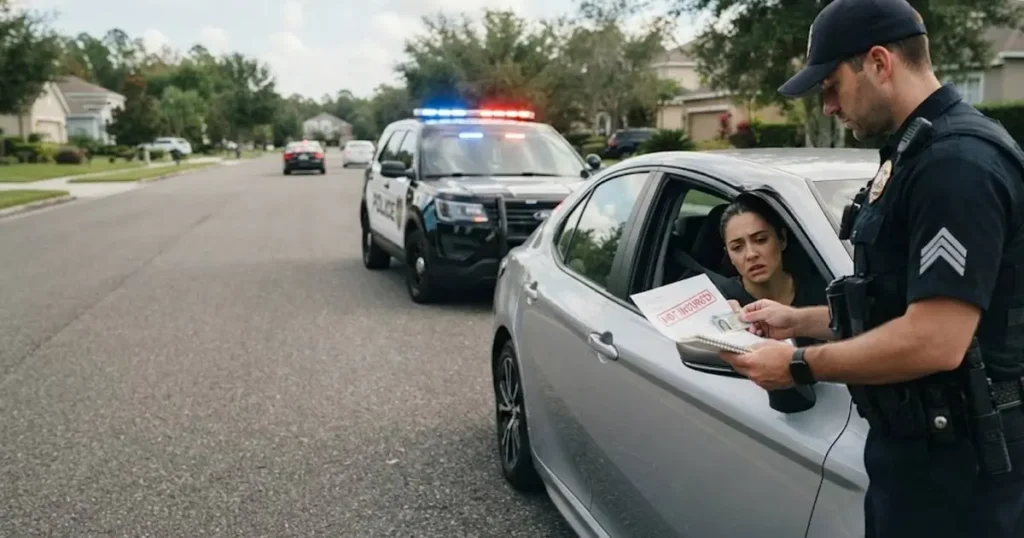

Yes, driving without insurance in California is indeed a crime. It is a traffic violation in California (VC 16028) to drive without insurance. This law mandates that you present proof of financial responsibility to a police officer if asked. It’s not just about self-protection. This is not a law that is designed to make you safe; it’s one that is designed to make it easier for others to be able to pay their medical bills if you get them hurt on the road. Beyond the general prohibition, it is crucial for every California driver to be aware of the actual laws, the drastically altered minimum coverage limits that went into effect on January 1, 2025, and the complete penalty structure for every phase of a violation.
Key Takeaways
- It is illegal to drive without insurance in California and can result in serious penalties and financial consequences.
- California Vehicle Code Section 16020 requires all drivers to have at least the minimum insurance coverage at all times.
- The new minimum liability limits are now 30/60/15 meaning $30,000 for bodily injury per person, $60,000 per accident and $15,000 for property damage.
- Driving without insurance is more of a regulatory violation than a crime and as such is an infraction, not a misdemeanor. First time offenders will be fined between $100 and $200. The total amount paid, including penalties and assessments, will be approximately $550 on a $100 charge. On a $200 fine, the total payment will be approximately $1,100.
- A second infraction carries a fine of $200-$500 and a penalty assessment of $520-$1,300. On a $500 fine, you could pay between $1,020 and $1,800.
- Under California Vehicle Code Section 16070, if a driver is reported for an accident and is unable to establish financial responsibility, their license will be suspended.
- The Low Cost Auto Insurance Program is a program in California that offers insurance at a reduced cost for those who are eligible and are not able to afford the cost of standard market coverage.
Under California law, driving without insurance is a crime
The California Vehicle Code requires all drivers and vehicle owners to establish proof of financial responsibility. This will likely be done through the purchase of auto liability insurance from the traditional insurance market for most private passenger vehicles. Financial responsibility must be carried on the vehicle at all times and must be produced upon request by law enforcement, upon renewal of the vehicle registration and in the event of a motor vehicle accident.
Drivers are also required to have proof of coverage on hand and show it if asked by law enforcement. This proof may come in the shape of a physical insurance card or a digital copy. If an individual is at fault and does not have insurance, they could be liable to legal repercussions and leave the victim without a guaranteed way to cover medical costs, vehicle damage and more.
Financial responsibility requirements may also be met by making a $75,000 cash deposit at the Department of Motor Vehicles or by the purchase of a surety bond for $75,000. These options are not as widely used as regular insurance, but are legally binding under California law.
What’s the penalty for driving without car insurance in California?
It is one of the most common queries regarding this subject and it needs a straightforward answer with legal accuracy.
Driving without insurance is more of a regulatory violation than a crime and as such is an infraction, not a misdemeanor. In order to be able to appear at court with proof of insurance, and have this charge dropped, you will have to show up with proof of insurance.
It’s important that it’s considered an infraction and not a misdemeanor. It means a first violation of California’s insurance law does not result in a criminal record, does not result in a direct criminal penalty for the violation, and is not a crime under the California Penal Code. The repercussions are, however, not to be taken lightly and can be significant in certain situations.
Most traffic offenses are infractions in California. This means that you should never face jail time for the offense, and should only be punished with a fine. If you keep doing the same things, if you don’t pay your fines, if you miss court dates, and other bad behavior, however, you may end up with a new charge, new fines, and have the possibility of being arrested.
The new insurance minimums for California 2025
It is important for California drivers to be aware of some changes in the requirements for auto insurance that took effect on January 1, 2025. Senate Bill 1107 contains new coverage changes statewide.
The state of California has established minimum liability insurance requirements that all drivers are required to have. These limits are also known as 30/60/15 and offer financial protection. These limits are effective as of January 2025 at $30,000 per person bodily injury, $60,000 per accident bodily injury and $15,000 property damage.
California’s previous minimums were set at 15/30/5 minimums, and these new minimums are a major increase. The higher insurance limits that come with the higher policy premiums could lead many drivers to seek out the lower-cost and lower-limit insurance option in California, which could force them out of the standard insurance market.
California’s Full Penalty Structure for Driving Without Insurance
The full penalty is important to understand because the base ticket is just one component of what California drivers pay.
First Offense
If the client commits this offense for the first time, the judge will sentence the client to pay a fine. The minimum fine is $100 and the maximum fine is $200. Penalties and assessments added to the fine. The total payment will be approximately $550 on a $100 fine. The total payment will be around $1,100 on a fine of $200.
The penalty assessment fees are $26 for each $10 of the overall fine. This multiplier is what results in the huge difference between the amount of the fine and what drivers pay at the courthouse window.
Second Offense
If the second offence is within three years of the first conviction, the fines are increased. The minimum fine that a judge can order is $200, plus penalties and assessments. The maximum fine that the judge can order is $500, which, if imposed, with penalties and assessments will make the total fine approximately $2,750.
The fines for the second violation range from $200 to $500, with penalties ranging from $520 to $1,300. On a $500 fine, you could pay between $1,020 and $1,800. That’s almost as much as the average annual cost of car insurance in California, which is $2,148.
Vehicle Impoundment
If you’re caught driving without car insurance, law enforcement can impound your vehicle. Impounded vehicle costs can be very high.
You might have your car towed and stored until you pay any towing or storage charges. These charges are added up daily and can amount to hundreds or thousands of dollars, depending on the length of time the vehicle stays in impound before the owner picks it up.
License Suspension
The state will impose the fine and also will suspend your driving privileges for 1 year, if you fail to present proof of car insurance after an accident. You may apply for reinstatement after being issued a driving privilege after 1 year provided you have proof of financial responsibility. If you are caught driving without insurance again in the event of an accident, your license will be suspended for up to 4 years.
The length of suspension is dependent upon the severity of the violation and driving history. It can be from 30 days to four years.
Why is it against the law in California to drive without car insurance?
The underlying rationale for California’s insurance requirement is not one of driver safety per se, but rather of financial protection for injured victims of the accident.
This law is meant to provide a way to help ensure that other people can receive their medical expenses if you injure them on the road, not to make them safe.
Driving without insurance is a serious crime in California, so it is imposed as a way to curb the number of uninsured drivers and make them abide by the law. Not having the proper insurance coverage could lead to fines, suspension of license and other penalties.
If an uninsured driver is at fault for an accident, persons who were damaged have a few options for obtaining recovery. If you have uninsured motorist coverage, the policy will cover the damages and injuries of an uninsured motorist or hit-and-run driver. Direct lawsuits are problematic in that many times, someone operating without insurance will not have the funds to pay off a judgment.
This enforcement rationale is an explicit statement of the social purpose of the law. The required insurance coverage is not to prevent accidents. It’s about making sure that a person who’s been injured in an accident has a means to get compensation when another person is responsible for the injury.
What If You Leave Your Insurance Card Behind?
If you can’t show proof of insurance that is acceptable to the state, then you may be fined a substantial amount of money, even if you’ve just forgotten to bring your insurance card with you. If it’s just a matter of forgetting proof of coverage, however, you can appeal for a reduced fine in court.
If a driver is insured when stopped, he or she can have the case dismissed for a nominal fee if he or she can provide proof of insurance at the time of the stop. Uninsured drivers at the time of the stop, but insured at the time of the hearing will be charged less fines and penalties.
If you were stopped without proof of insurance, but you had a policy at that time, then you must present proof of insurance in court or get the citation signed off at the DMV.
This distinction is important in reality. A driver who just didn’t remember to bring proof of insurance but was still insured is in a much better legal position than a driver who was not insured when the stop was made.
What Happens If You Cause An Accident Without Insurance In California?
Without car insurance in California, you may face a few repercussions when you are involved in a car accident. The state can revoke your driver’s license for one year if you don’t provide proof of car insurance after an accident. Plus, you will also have to pay a fine.
Accident victims must show financial responsibility to the DMV. California Vehicle Code Section 16070 requires that drivers be placed on notice to suspend their driver’s license after a reportable accident, making compliance to the accident regulations a de facto ‘financial responsibility’ investigation.
Even if you are not at fault for the accident, you can still receive a ticket for driving without insurance. This is a serious infraction and fines and penalties may be significant.
The most financial impact long term consequence of driving without insurance in California is civil liability exposure from causing an accident.
California’s Low Cost Auto Insurance Program
California has a special program that offers reduced auto insurance premiums to qualifying drivers. The Low Cost Auto Insurance Program was created in 1999 in California, and has a set of criteria which includes income restrictions, a clean driving record, and the fact that the car is worth $25,000 or less.
This program is tailored specifically to the most frequently cited California Driver’s No Insurance reason – cost. One of the primary reasons people decide not to have insurance is because they can’t afford it, according to surveys. The Low Cost Auto Insurance Program is designed to provide legal access to the minimum coverage for those who may feel excluded from the standard insurance marketplace.
What to do if you are ticketed for driving without insurance in California
In California, if a driver is cited for an insurance violation and believes it is a mistake, he or she has 30 days to appeal the judgment. Note that you won’t be able to bring in any new evidence or witnesses but can merely request that a higher court review the decision. If the court in appeal finds there was any mistake, then it can set aside the order.
Appeals must be filed within 30 days after the court’s decision on the Notice of Appeal (form CR-142) is filed by bringing or mailing it to the court of conviction. You can also fill out a Statement on Appeal within 20 days of filing the Notice of Appeal.
How California stands with other states
California’s driving without insurance penalties are unique in a few ways from those in Florida and Texas.
| Feature | California | Texas | Florida |
| First offense base fine | $100-$200 | $175-$350 | Varies by county |
| Total first offense cost with assessments | $550-$1,100 | $175-$350 plus surcharges | Varies |
| Second offense fine | $200-$500 | $350-$1,000 | Varies |
| License suspension | Yes (accident-related) | Yes | Yes |
| Criminal classification | Infraction (not misdemeanor) | Misdemeanor (third offense) | Civil violation |
| Minimum coverage requirement (2025) | 30/60/15 | 30/60/25 | 10/20/10 (PIP required) |
| Low-income insurance program | Yes (CLCA since 1999) | Limited | Limited |
California’s first offense infraction is less severe than Texas, as a third offense is considered a misdemeanor and could result in jail time. But the impact of a penalty assessment system in California can be four to five times the base fine, so the total cost of a first offense can be much higher than the fine itself.
Also Read: Is It Illegal To
Expert and Legal Perspectives
Curtis Legal Group states that drivers who are stopped and are unable to show proof of financial responsibility will be cited and will be required to pay fines and penalties, and that repeat offenders will pay higher fines and penalties and may have their vehicles impounded. If the driver can show that he or she was insured at the time of the stop, the case can be dismissed for a minor fee.
California has harsh penalties for drivers without insurance, according to Arash Law, a California personal injury firm, and those penalties don’t do much to assist the victim in obtaining a fair settlement for their losses. If you’re injured, it’s crucial to know your rights and options to hold negligent drivers accountable.
According to Greg Hill and Associates, Redondo Beach criminal defense and traffic attorneys, driving without car insurance in California is not a criminal offense, but rather a regulatory violation and is a violation, not a misdemeanor. Greg Hill and Associates offers this practical advice: When a driver shows up to court with proof of insurance, they have the best chance of having the charge dismissed.
Conclusion
Under Vehicle Code Section 16028, it is illegal not to have car insurance in California, and the penalties are enforced on all drivers on all public roads in the state. Senate Bill 1107 set the new minimums for coverage at 30/60/15, doubling the previous minimums in all areas.
California has a more complicated punishment structure than a fine. The base fine is $100 to $200 for a first offense, but an additional penalty added on top of that base fine often results in an actual cost of $550 to $1,100. If you commit a second offense in the same 3 year period, you can be penalized up to $1,800 to $2,750 in total fines. The first time a driver is involved in an uninsured accident, their license is suspended for a year and the second time, it is suspended for up to four years.
California’s citation classification for first violations does not result in a criminal record on the traffic citation and no jail time. But the risk of civil liability in an at-fault accident without insurance can be hundreds of thousands of dollars — more than the value of a few short years of coverage.
Since 1999, the Low Cost Auto Insurance Program (LCAIP) has offered a legal and affordable alternative to the standard market premiums for drivers who find themselves unable to afford these premiums. The best and safest option is to keep at least the state minimum coverage in place at all times and to keep proof of coverage in the car.
To find out about the national law on driving without insurance, check out Is It Illegal to Drive Without Insurance?
Frequently Asked Questions
1. Can you be arrested for driving without car insurance in California?
Yes. The California Vehicle Code Section 16028 prohibits operating without financial responsibility. All drivers are required to have a minimum liability insurance policy or an alternative, such as a $75,000 cash deposit or surety bond with the DMV.
2. How illegal is it to drive without insurance in California?
The first offense is not a misdemeanor, but an infraction, and no criminal record or jail time is attached to the citation itself. Fines and penalty assessments can be up to $1,100 for a first offence, and up to $2,750 for a second offence, however. If you are uninsured when you get in an accident, your license is suspended for 1 year and for repeat accidents up to 4 years.
3. What is the reason that driving without insurance is illegal in California?
California’s insurance law is enacted to make sure that the victim of an accident can get medical expenses and damages for property damage from the driver who caused the accident. The law is not so much about driver safety as it is about ensuring financial responsibility to other road users who may be injured.
4. What is the lowest amount of insurance that California requires in 2025?
California’s minimum coverage limits are 30/60/15 ($30,000 for bodily injury per person, $60,000 for bodily injury per accident, and $15,000 for property damage liability) as of January 1, 2025. These caps are double those of Senate Bill 1107, which set the limits at 15/30/5.
5. What does happen if you leave your insurance card at home in California?
If you were insured at the time of the stop, but just didn’t have proof, you can come to court with proof of insurance at that time. The court can cancel the ticket and only fine the driver an administrative service fee of $20, not the ticket.
6. Do the uninsured have an affordable insurance plan for California drivers?
Yes. The Low Cost Auto Insurance Program, created in 1999, offers drivers low-cost coverage for vehicles under $25,000 with a clean driving record and income limits who qualify.