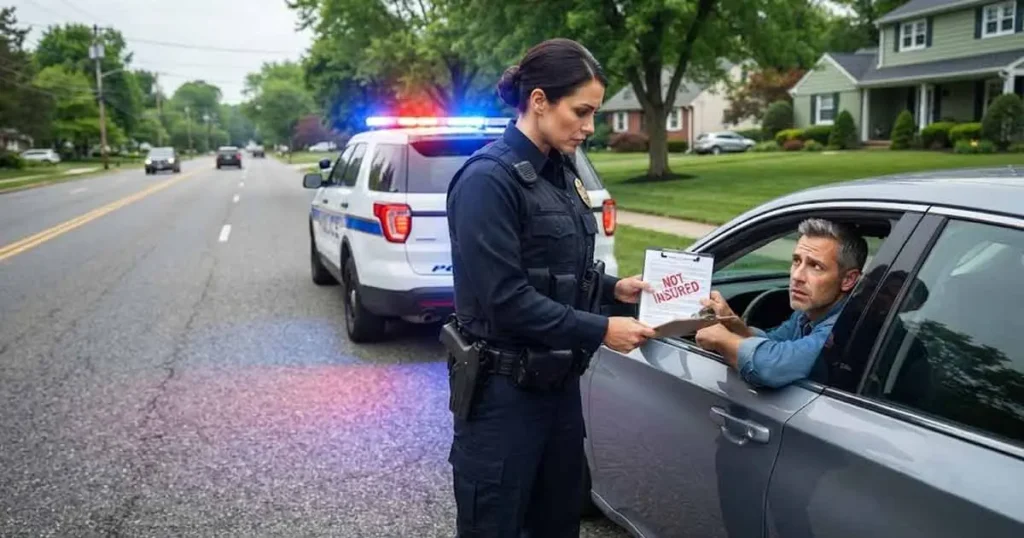

Yes, driving without insurance is illegal in nearly all states in the United States. All states require auto insurance for car registration or driving on the road except for New Hampshire. The consequences of driving without insurance can be very different, and can range from a simple warning to fines and even jail time. One of the most important legal obligations of any driver is to know your state’s laws and what the penalties are for driving without insurance.
Key Takeaways
- Nearly every U.S. state requires drivers to have car insurance. The only exception is New Hampshire, which does not require a traditional insurance policy, but does require financial responsibility.
- Drivers may drive without insurance in Virginia by paying an annual fee for uninsured motor vehicles, but it does not actually cover anything.
- Consequences of driving without insurance can be severe such as high fines, driver’s license suspension, vehicle registration suspension, vehicle impoundment, jail time, and even a requirement to file an SR-22 with the state Department of Motor Vehicles.
- Some states, such as California, have comparatively low fines for their first-time offenders, while others, such as New York, can charge much higher fines based on the number of offenses. Further, there are different states that have different methods of determining how the citation will affect the driver’s record, such as Texas, and other states that have monetary penalties as the primary focus.
- If you are the uninsured motorist in an at-fault accident, it’s a serious situation that will likely mean you are considered to be a high-risk driver to an insurance company, even if it is your first crash.
- A first offense is usually around $500 in fines for not having insurance in the state where you were caught.
- A lapse in car insurance coverage will also mean that you become a high-risk driver, making coverage more costly in the future.
The Legal Foundation: Financial Responsibility Laws
All states other than New Hampshire and Virginia consider driving without insurance to be a traffic offence, at the very least. Repeatedly is a misdemeanor in many states. The basis of the law is called financial responsibility law, which means that drivers are required to show that they have the ability to cover damages resulting from accidents.
Financial responsibility laws are in place in all states, so in states with no liability insurance requirement, you must be able to show that you have enough money to cover damages, medical bills and more if you cause an accident. Otherwise, you could be facing legal consequences such as a suspended driver’s license, car registration, and other legal consequences.
Unless you live in New Hampshire, you must have auto insurance on any vehicle registered in your name. Even if you do not own a car, but you drive one, you need insurance or be placed on the car owner’s insurance policy.
What Happens If You’re Stopped For Driving Without Insurance?
Without proof of insurance, you may be fined, have your driver’s license suspended or revoked, be issued a ticket, have your car impounded, lose your registration, go to jail, or be required to file an SR-22 form.
A driving without insurance citation carries the following penalties:
- Fines: They are subject to a fine of up to $5,000, depending upon the state and circumstances.
- License suspension: Most states will suspend your driving license if you are convicted of driving without insurance.
- Vehicle impoundment: Some states permit or mandate the impounding of an uninsured car by the police at the scene.
- SR-22 requirement: SR-22 is a certificate of financial responsibility issued by your insurance company to the state and it is usually required for a period of one to three years after you have been convicted of driving without insurance.
- According to November 2025 data from Quadrant Information Services, drivers who have been without coverage for one year will pay an average of $2,952 annually for full coverage and $900 annually for state minimum coverage. Compared to the average annual cost of car insurance for drivers with continuous insurance, that’s an increase of between 9 and 10 percent.
Is It Illegal to Drive Without Insurance in California?
In California, fines for a first offense range from $100 to $200, and penalty charges are usually four times the base fine, or $400 to $800 actual cost. Your car can also be impounded for as long as 30 days. A first offense will not result in a license suspension, but will result in a vehicle registration suspension. The minimum coverage in California is 15/30/5, or $15,000 bodily injury per person, $30,000 bodily injury per accident, and $5,000 property damage. The state has an electronic insurance verification system that automatically verifies coverage. California’s civil penalty provisions will result in a four-year license suspension if you are at fault in an accident without insurance.
In California, the traffic police can suspend your car registration if you don’t present your car insurance document. Fines are up to $100 for first offences, and up to $200 to $500 for repeated offences.
Can You Get in Trouble for Driving Without Car Insurance in Texas?
Insurance is a legal requirement in Texas for operating a vehicle without it, according to the Texas Transportation Code 601.191, is a criminal offense. This is a serious crime in Texas and sentences increase rapidly for multiple offenses. The fines for first offenders range from $175 to $350. A second offense in a 5-year period raises the cost to $350-$1,000. The third offense is considered a misdemeanor and carries fines up to $4,000 and up to 180 days in jail. Texas also has a Driver Responsibility Program surcharge of $250 for three years after a conviction. This brings your fine up to $750 in addition to the initial fine.
The minimum coverage requirements in Texas are 30/60/25, which means $30,000 in bodily injury coverage per person, $60,000 in bodily injury coverage per accident, and $25,000 in property damage coverage. In Texas, if you cause an accident without insurance, your license will be automatically suspended until you file an SR-22 and keep it in place for two years.
Is It Illegal to Drive Without Insurance in Florida?
Florida Statute 324.021 makes it illegal to drive without insurance in Florida. Florida has a no-fault insurance system, which presents special needs to the state.
Florida’s no-fault system requires that all drivers have Personal Injury Protection coverage, no matter who is at fault. Florida has minimum coverage requirements of $10,000 for PIP and $10,000 for property damage liability. In Florida, failing to meet these requirements will lead to license and registration suspension, reinstatement fees, and may require filing an SR-22 or FR-44.
Penalties by State: A National Overview
| State | First Offense Fine | License Suspension | Jail Time Possible |
| California | $100-$200 (plus assessments, total $400-$800) | Registration only (first offense) | No (first offense) |
| Texas | $175-$350 | Yes | No (first offense) |
| Florida | Varies | Yes | No (first offense) |
| New York | Up to $1,500 | Yes | Yes |
| Georgia | $200-$1,000 | Yes | Yes (up to 12 months) |
| Illinois | $500-$1,000 | Yes | No |
| Michigan | Up to $500 | Yes | Yes (up to 1 year) |
| Ohio | Up to $1,000 | Yes | No |
| Pennsylvania | $300 fine | Yes (3 months) | No |
| New Hampshire | No requirement | N/A | N/A |
Only State that doesn’t require insurance: New Hampshire
New Hampshire is the only state that has no requirement for car insurance coverage, unless a driver has just been in an accident or been involved in a serious moving violation.
In New Hampshire, where insurance isn’t required for the typical car, you have to be able to afford an at fault accident and have to deal with serious consequences if you don’t.
Virginia is also in a special place. Drivers in New Hampshire and Virginia can drive without insurance policies, but both states have strict financial responsibility requirements.
What are the consequences if you cause an accident with no insurance?
When you are involved in an auto accident without coverage, the repercussions could be even worse. All the penalties listed above will apply to you and you are more likely to have your license suspended and your vehicle impounded. You’ll most likely need to get your state’s department of motor vehicles to issue an SR-22 or FR-44 if you are involved in a serious accident and are not properly insured.
If you are driving without insurance and injure someone or damage someone’s property, you would be responsible for the costs. If you do not have insurance you could end up in a financial crisis due to the high cost of a car accident.
If you get into an at-fault accident and you do not have insurance, you will most likely be sued by the other driver’s insurance company for bodily injury or property damage, ranging from a few hundred bucks to hundreds of thousands of dollars, depending on the severity of the incident.
An SR-22 is a form that serves as proof of insurance
An SR-22 is not an insurance policy. A certificate issued by your insurance company that you meet the minimum coverage requirements is a certificate of insurance. An uninsured driving conviction usually means an SR-22 will be required in most states and the driver will need to keep the SR-22 for 1-3 years.
If you don’t have insurance or if your last car insurance policy ended, buy what is required by your state before you put your car back on the road. Keep a copy of your insurance certificate with your vehicle registration or with you on your cell phone. Some states will penalize drivers who drive without proof of insurance even if they have insurance coverage.
What is the impact on your insurance rates if you drive without insurance?
It can take years to impact a driver’s record and insurance rates if they are driving without insurance, and it can be challenging to get coverage in the future.
It may be more difficult and costly to obtain car insurance following a cancellation. If your policy was cancelled, particularly due to non-payment or risky activities, you could be charged more and have less choice.
The financial implications of driving without insurance extend beyond the fine and penalties:
- Increased insurance rates for 3-5 years following a driving without insurance infraction.
- Classification as a high-risk driver by most insurers
- Few insurance providers, may have to choose from non-standard high risk providers
- The annual SR-22 filing fee your insurance company charges for filing the document.
- The reinstatement fees for suspended licenses and registrations are:
Is it permissible to drive without insurance for just one day?
If you have a car parked or driving on public property, you can’t go without car insurance for any period of time. In just about every state, car insurance is required, even driving off a dealership’s lot without insurance is illegal.
Having a gap in your car insurance policy may mean your insurance rates increase as car insurance companies do not like seeing gaps in coverage. Your state’s DMV will also be notified of the lapse, and you will need to provide proof of insurance coverage to avoid penalties for operating a vehicle without insurance coverage.
Also Read: Is It Illegal To
Expert and Legal Perspectives
The insurance industry and consumer groups generally recommend a minimum of $100,000 of bodily injury protection per person and $300,000 per accident, since accidents may cost far more than the minimum limits mandated by most states.
If a driver does not have insurance, he or she will be personally responsible for any damage or injuries caused by an accident. This might result in out-of-pocket repair costs for another vehicle, medical bills for injured parties, and legal costs if the case goes to trial. The cost can be prohibitive, causing a lot of debt or bankruptcy.
Conclusion
In 49 of the 50 U.S. states, it is illegal to drive without insurance coverage, and New Hampshire is the only state that doesn’t require a traditional auto insurance policy, but even New Hampshire drivers must show financial responsibility. No matter where you live, driving without auto insurance or proof of financial responsibility is against the law.
Consequences for being caught are serious and can increase rapidly with repeated offences. California starts at $100 to $200 in base fines with quadrupled penalty assessments. Texas raises penalties for a first-time offense from $175 to jail time and fines of up to $4,000 for a third offense. The no-fault system in Florida has special coverage requirements and penalties for suspension.
In addition to the legal sanctions, driving without insurance can also have financial implications, such as increased insurance premiums, the need to obtain an SR-22, and personal liability for any accidents that occur.
The simplest and safest course of action is simple. At all times maintain the minimum coverage required by the state. Maintain a copy of your insurance in your car, both paper and electronic. If your policy expires, call your insurance company as soon as you can before you drive.
Frequently Asked Questions
1. What is the punishment for not having car insurance?
Yes, in 49 of the 50 states. New Hampshire is the only state that does not mandate an auto insurance policy, but drivers do need to show financial responsibility.
2. If you are caught driving without insurance, you will be fined.
Fines range from state to state but are usually in the $100 to $5,000 range, license suspension, vehicle impoundment and required SR-22 filing. In cases of repeat offenses, states such as Texas can also charge misdemeanors and jail time.
3. What will happen if you drive without insurance in California?
California first offense fines are $100 to $200, but in reality, the cost is about $400 to $800. Your car registration will be cancelled. The DMV will revoke your license for 4 years if you are driving without insurance and cause an accident.
4. What will happen to you if you drive without insurance in Texas?
The fine for first offenders is $175 to $350. A second offense reaches $350 to $1,000. The third infraction is a misdemeanor punishable by a fine of up to $4,000 and jail time of up to 180 days. Texas also imposes a Driver Responsibility Program surcharge of $250 for three years.
5. Will not having insurance impact your future insurance costs?
Yes, significantly. On average, you could be charged 9-10 percent more for coverage that lapses each year. You could be considered a high-risk motorist and be forced to obtain an SR-22 for one to three years, and the filing fee will be included in your annual premium cost.
6. If you don’t have the funds for car insurance, what should you do?
Check with your state’s insurance department for details on low-income assistance programs. Think about the minimum coverage instead of dropping coverage altogether. There are many insurers that provide payment plans. There are programs in some states that are created to help lower-income drivers pay for the minimum coverage requirements.