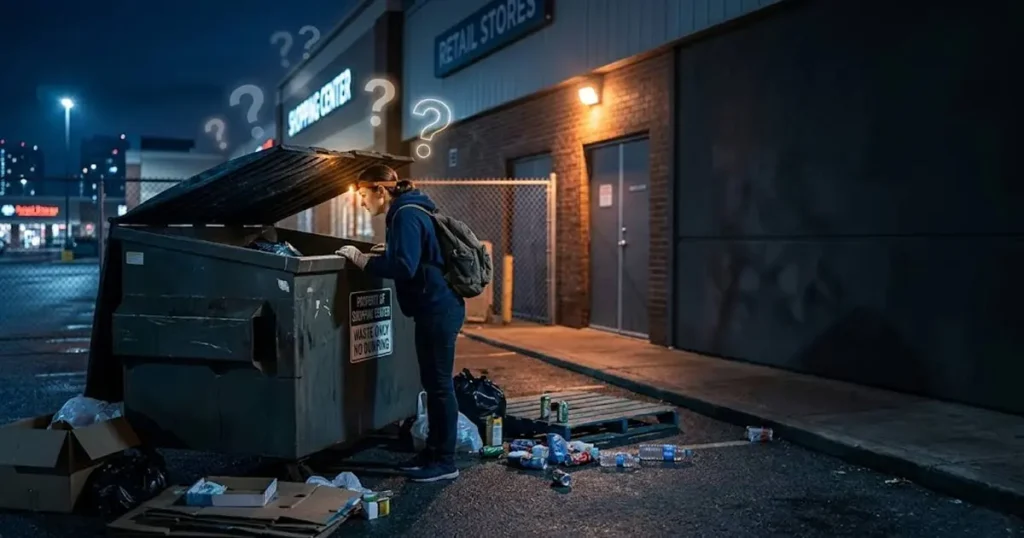

No, it is not illegal at the state level in Florida to dumpster dive. There is no Florida statute that specifically prohibits the practice. It’s not illegal to dive into a dumpster in Florida when considered in isolation. Florida law also adopts the basic rule of federal law set forth in California v. Greenwood (1988): “Trash collected by the public is abandoned property. But it is not as easy as it sounds to simply go through trash for discarded items in Florida, or in most other states. Legality is dependent on the site of diving and the objects being taken. Once the dumpster is on private property, trespass laws in Florida are enforced, and Miami-Dade County’s sanitation codes, as well as those of Orlando and Tampa, provide an additional layer of regulation for all Florida divers.
Key Takeaways
- There is no state law in Florida that prohibits dumpster diving. There is no Florida statute that specifically prohibits the practice.
- The principle in Florida is the same as the federal principle: Property that is left for the public to pick up is abandoned property under California v. Greenwood (1988).
- Florida Statute Section 810.09 makes it illegal to trespass on private property by dumpster diving. A criminal trespass is entering a store’s loading dock, parking lot or any property with No Trespassing signs.
- Miami-Dade County has passed codes that limit residents and business owners from taking materials out of their trash containers before they are picked up. Miami has a fine of up to $500 for any violations of access to commercial containers.
- Some cities have their own ordinance that can limit trash container access, such as Orlando and Tampa.
- Is it illegal to dumpster dive Sephora FL? The majority of Sephora stores are privately owned commercial property. If you trespass on their dumpster, you will be vulnerable to Florida Statute Section 810.09 misdemeanor trespass charges which are a second degree misdemeanor punishable by up to 60 days in jail and a $500 fine.
- In property injury cases, Florida uses a pure comparative fault system that means that if an authorized diver is at fault, he or she is still entitled to some compensation.
What Florida State Law Says About Dumpster Diving
There is no specific law in Florida that prohibits dumpster diving. The legality of diving, however, will vary based on where you dive and how you dive. Dumpster diving is sometimes prohibited by trespassing laws and local ordinances. By understanding these laws, you can prevent fines or arrests.
In Florida, the federal baseline is the Supreme Court’s decision in 1988 in California v. Greenwood, which held that discarded trash on public property is open to public access and therefore does not have an expectation of privacy. Florida expands on that foundation with certain laws that dictate when dumpster diving is prohibited.
There is no state legislation in Florida that prohibits or allows dumpster diving. The legality is determined by property rights and local ordinances. Florida Statute Section 810.09 is the most important statute for dumpster divers in Florida.
Florida Statute Section 810.09: The Primary Legal Risk
Trespass on property other than a structure or conveyance is regulated by Florida Statute Section 810.09. It is illegal to intentionally enter onto or remain on any property other than a structure or conveyance that is fenced or posted with No Trespassing signs or upon which the person is told to leave by the owner or an authorized agent.
No Trespassing is a criminal trespass in Florida under Florida Statute 810.09 when one enters a store’s loading dock, parking lot, or property with No Trespassing signs.
A violation of Florida Statute Section 810.09 is a second degree misdemeanor, punishable by up to 60 days in jail and a $500 fine for a first offense. Penalties can increase if trespass is on posted or fenced property or after being asked to leave.
Unmarked dumpsters behind strip malls, grocery stores and apartment complexes are the most hazardous, whether or not they have signage. In Florida, even a retail parking lot that doesn’t have a locked dumpster bin constitutes private property and owners can take legal action even if they don’t explicitly warn people in some cases.
City-by-City Florida Rules: Miami, Orlando, Tampa, Jacksonville, and Beyond
Miami-Dade County
The City of Miami-Dade has passed sanitation codes that prohibit emptying of residential or commercial trash bins prior to scheduled pick-up. The City of Miami has a fine of up to $500 for violations of commercial access to containers.
One of the most clearly defined commercial container access fines in the State of Florida is the fine for dumpster diving in Miami. The Miami-Dade approach is a result of the county’s proactive policies to protect waste management and recycling revenue by holding individuals accountable for illegally taking waste out of containers, whether public or private, regardless of the type of container or its location.
Orlando
Some cities, such as Orlando, have their own ordinance that can limit the availability of trash containers.
The city of Orlando has a municipal code on solid waste management that impacts the availability of access for commercial waste containers. The city’s strategy includes targeting commercial areas and disruption to scheduled pickups, as well as ordinances that may limit access to containers, even when the container is not in a commercial area.
Tampa
Tampa also has its own ordinance that could limit where and when trash containers can be accessed.
The City of Tampa’s municipal regulations contain provisions regarding solid waste management which may impact dumpster diving activity in the City’s commercial and mixed-use areas. Before diving, Tampa divers should make sure to check the city ordinance conditions that apply to their dive site.
Jacksonville
The Jacksonville city is the largest city in Florida in terms of area, and it does not have a specific dumpster diving ordinance but rather is enforced through Florida Statute Section 810.09. Under Florida state law, the commercial dumpster in Jacksonville that is on private property is exposed to the second degree misdemeanor.
Smaller Florida Cities and Rural Areas
There are some cities in Florida that have laws or ordinances that control or prohibit dumpster diving, even on public property. These laws are primarily in place to avoid health and safety concerns or to curb littering. Before diving into any dumpsters, it is always a good idea to check with local authorities or visit the city’s website to know the exact laws and rules before you dive into any dumpsters.
The most safe diving in Florida is curbside residential trash collection day. Given Florida’s tradition of active local solid waste regulation, each municipality will need to check its own ordinances before any dumpster diving activity can take place.
Is it illegal to Dumpster Dive at Sephora Florida?
Florida is one of the U.S. states with a large number of rich families and diving in dumpsters can be a rewarding adventure. Great places to dive in Florida include rich neighborhoods, shopping areas, beaches, garage sales and beauty stores.
In Florida, the majority of Sephora stores are in shopping centers on private commercial property. These dumpsters are usually located in commercial refuse sites that are considered private property under Florida Statute Section 810.09.
Some risks to Sephora dumpster diving in Florida are:
- A second degree misdemeanor with up to 60 days in jail and a $500 fine pursuant to Florida Statute Section 810.09.
- If the store is located in Miami-Dade, the county will impose an extra $500 fine for the commercial containers that were not accessed.The extra $500 fine is for commercial container access violations if the store is located in Miami-Dade County.
- A formal trespass warning which means any subsequent visit to the same property is a more serious criminal offence.
- In March 2025, Sephora officially announced its policy on dumpster diving, stating that such actions will not be tolerated.Sephora’s corporate stance on dumpster diving was confirmed in their Beauty Insider Community in March 2025, which stated that dumpster diving will not be tolerated.
Because the commercial property is private, Sephora management can give a trespass warning anytime, making all future visits a criminal trespass offense even if there are no visible No Trespassing signs at a specific Florida Sephora location.
The Four Core Legal Risks in Florida
There are four separate legal issues regarding dumpster diving in Florida.
1. The Florida Statute Section 810.09 defines criminal trespass
The biggest danger to most Florida dumpster divers. Second degree misdemeanor for unauthorized access to property, punishable by up to 60 days in jail and up to $500 fine. Escalation is the process that takes place when property is posted or fenced.
2. Municipal Ordinance Violations
In some Florida cities, the city ordinances and fines are more stringent than the state ordinances, including Miami-Dade County’s $500 fine structure, Orlando’s container access restrictions, and Tampa’s solid waste ordinances.
3. Disorderly Conduct
Although there may be no specific law against it, the police can issue tickets for “disorderly conduct” or “theft” charges. Florida’s disorderly conduct law may apply if dumpster diving activity is causing complaints, a public disturbance, or is being done in a manner that causes public alarm.
4. Theft Charges
Items that are actually thrown away in the dumpsters can be removed, provided there is no trespassing. If the owner of the property disputes abandonment of any items, however, theft charges can also come into play in addition to the trespass exposure.
The rules of what you can and can’t do legally in Florida
Generally permissible in Florida:
- Dumping on public property in municipalities without an ordinance against dumpster diving
- This is the safest diving in Florida, and the most effective way to retrieve discarded items from the trash at the curbside of a residential neighborhood on the day for public collection.
- Dumpster diving on private property with clear written permission from the landowner.
- Entry to publicly accessible waste containers where there is no signage or enclosure for restricted access
The following is generally prohibited in Florida:
- Entering or using any dumpster on private property without the owner’s consent.
- The use of commercial containers in Miami-Dade County without the proper permits from the county’s sanitation codes.
- Orlando or Tampa commercial areas may have ordinances that restrict access to dumpsters.
- After a formal trespass warning, continuing to use a dumpster is considered a trespass.
- Taking out personal papers, medicine or identification from any dumpster
- Leaving trash behind after dumpster diving, a violation of Florida littering law
Comparing Florida to other states
In Florida, there is no statewide prohibition on smoking, the cities with the largest populations have active bans, and civil cases in Florida follow the “pure comparative fault” rule.Florida is in a unique position among states because of the absence of any statewide smoking ban, the presence of active bans in its major metropolitan areas, and the fact that civil cases in Florida are governed by the “pure comparative fault” rule.
| State | State Law | Key Local Rules | Civil Liability Standard |
| Florida | No statewide ban; Section 810.09 second-degree misdemeanor trespass | Miami-Dade $500 fines; Orlando and Tampa ordinances | Pure comparative fault |
| Iowa | No statewide ban; Iowa Code 716.7 trespass | No confirmed city-specific bans in major cities | Modified comparative fault |
| Tennessee | No statewide ban; TCA 39-14-405 Class C misdemeanor | Nashville and Knoxville commercial restrictions | Modified comparative fault |
| Indiana | No statewide ban; IC 35-43-2-2 Class A misdemeanor | Indianapolis minimal; Fort Wayne recycling restrictions | Modified comparative fault |
| California | No statewide ban; Section 602 trespass | LA and SD scavenging ordinances; SF recycling restrictions | Pure comparative fault |
| Alabama | No statewide ban; trespass fines up to $500 | Birmingham and Montgomery commercial restrictions | Contributory negligence |
| Texas | No statewide ban; Section 9.41 force justification | Austin and San Antonio scavenging restrictions | Modified comparative fault |
| Oklahoma | No statewide ban | Oklahoma City Section 38-702 misdemeanor ban | Modified comparative fault |
| Illinois | No statewide ban; prohibits open waste scavenging | Wood River 2025 ban; Belleville $400 license | Modified comparative fault |
| North Carolina | No statewide ban | Local ordinances vary | Contributory negligence |
| Pennsylvania | No statewide ban | Lancaster ordinance; Philadelphia regulations | Modified comparative fault |
Florida’s pure comparative fault standard for civil cases is shared with California and makes it one of the more favorable states for recovering damages for injuries, as opposed to the contributory negligence systems in Alabama and North Carolina. One of the most specifically written municipal dumpster diving fines in the state series is Miami-Dade’s $500 structure for commercial container access.
Some dangers unique to Florida Dumpster Diving
Florida dumpster divers aren’t only worried about legal hazards. There are unique safety concerns with Florida’s climate and commercial activities.
- Tropical climate: Florida’s climate is hot and humid year round, even in the winter months, causing decomposition inside enclosed commercial dumpsters and posing a bacterial risk inside containers.
- Sharp objects: Commercial dumpsters contain a lot of broken glass, metal objects and industrial waste.
- Chemical exposure: Retail and industrial dumpsters in Florida may have chemicals used for cleaning, marine chemicals, or chemicals used in agriculture.
- Wildlife: Florida’s warm climate can allow insects, cockroaches and in outdoor or semi-rural settings, snakes and other wildlife to live in dumpsters.
- Florida night diving: Florida is a popular destination for night dumpster divers, but night diving in Florida is a popular sport and law enforcement target.
Also Read: Is It Illegal To
Expert and Legal Perspectives
A nationally known legal reference source, World Law Digest, has verified that Florida does not have a specific law against dumpster diving, and that the legality of dumpster diving is dependent upon where you dive and how you dive. Their analysis states that dumpster diving on private property without permission is illegal in Florida and trespassing and public property dumpsters are generally available, depending on local ordinances.
According to Legal Analysis resource, LegallyExplained, which published detailed research into dumpster diving in Florida in April 2026, there is no Florida statute prohibiting dumpster diving and it is not illegal at the state level in Florida. Their analysis points out that some municipalities, including Miami-Dade County, have a sanitation ordinance prohibiting dumping items before they are picked up on the designated collection day and that the most secure diving in Florida is curbside residential trash on the designated collection day.
According to LawAgent, which is a legal guidance resource updated in November 2025, the legality of dumpster diving in Florida depends on the circumstances, such as location and intent, trespassing ordinances often determine what is allowed, and even if there is no explicit prohibition, law enforcement may issue citations for any suspicion of disorderly conduct or theft. They have performed an analysis of the $500 fine structure in Miami, which gives the most specific documented municipal penalty information available for dumpster diving in Florida.
Conclusion
The state of Florida does not make dumpster diving illegal. There is no Florida law barring the practice and California v. Greenwood, decided by the U.S. Supreme Court in 1988, sets the federal floor for dumpster diving on public property across the state. The safest dumpster diving in Florida is curbside residential trash on the public pick-up day, where the California v. Greenwood framework is most applicable and where there are no complications of private property or municipal ordinance.
The trespass system of Florida and the current municipal regulatory environment are things that every Florida diver should be aware of. Unauthorized private property access is a second-degree misdemeanor under Florida Statute Section 810.09 with a possible jail sentence of 60 days and a fine of up to $500. Miami-Dade County has its own $500 commercial container access violation fines. Both Orlando and Tampa have ordinances that limit access to containers in commercial areas. Even if a sign is put on a dumpster, it poses the greatest legal risk in Florida behind strip malls, grocery stores and apartment complexes.
In Florida, the safest way to dumpster dive is to only dumpster on the public collection day on curbside residential trash, and always check your local city’s code before dumpster diving in any city and make sure you are granted specific permission by the property owner before dumpstering in commercial dumpsters.
To see the national legal aspect of dumpster diving, check out Is It Illegal to Dumpster Dive?
Frequently Asked Questions
1. What are the consequences of dumpster diving in FL?
Not on the State level. There is no specific Florida law banning dumpster diving. Generally, it is legal on public property after the California v. Greenwood case. Miami-Dade County, however, has its own fines of $500 for violations of private property access for commercial containers, and Florida Statute Section 810.09 classifies unauthorized access to private property as a second degree misdemeanor.
2. Can I dumpster dive in Miami, Florida?
Sanitation codes have been adopted in Miami-Dade County that limit the removal of items from residential or commercial waste containers prior to scheduled pick-up. Miami fines up to $500 for violations of access to commercial containers. The county restrictions make Miami one of the most heavily regulated dumpster diving areas in the state of Florida.
3. Is dumpster diving legal in Orlando, FL?
There are also ordinances in Orlando that could limit your access to trash containers. Orlando divers should check the current provisions of city ordinance before diving. The best way in Orlando and everywhere in Florida is to put trash out for collection on the designated day.
4. Can you dumpster dive at Sephora, Florida?
The majority of Sephora stores in Florida are on private commercial land. Unauthorized entry into their dumpsters is a second degree misdemeanor pursuant to Florida Statute Section 810.09. Miami-Dade sites have extra county-level fine exposure. In March 2025, Sephora’s corporate policy was confirmed, stating that dumpster diving is not allowed in Sephora stores.
5. In Florida, the penalty for dumpster diving on private property is?
Florida Statute Section 810.09 is a second degree misdemeanor punishable by up to 60 days in jail and a fine of up to $500. In addition, Miami-Dade County has a commercial container access ordinance that imposes a $500 exposure. A formal trespass warning makes any future return to the same property a more serious crime.
6. How to dumpster dive legally in Florida?
The FLORIDA SAFEST DIVE is curbside residential trash collection day. Only dumpsters on true public property (no fencing, gates or No Trespassing signs). Be sure to review your local municipality’s code before proceeding. Always ask permission to enter any commercial dumpster. If told to evacuate by property owners or law enforcement, evacuate without delay, no arguments.