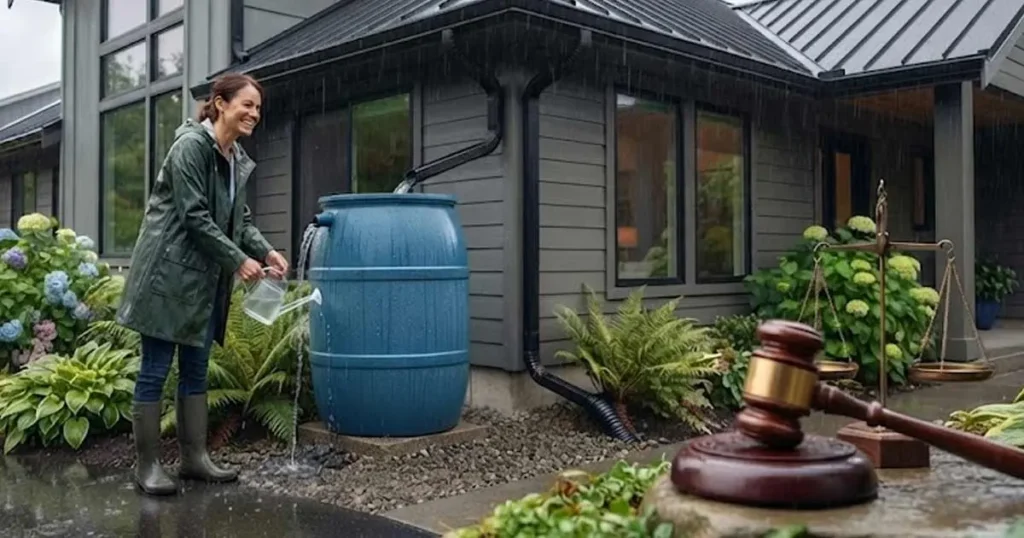

Rainwater collection is legal in Oregon, and one of the more liberal states in the country. Oregon law follows the principle that it’s not water that falls on a roof that’s connected to the regulated water system; it’s water that flows over the edge, which is not subject to the water rights permit process at all. Standard rain barrels and small cisterns can be installed by a homeowner without a permit, registration, or paperwork, under a downspout.
Key Takeaways
- It’s legal to collect rainwater in Oregon. Rooftop rainwater may be collected in a cistern or barrel to use for non-potable purposes without a permit.
- The Oregon Revised Statutes (ORS) 537.141 explicitly exempts rooftop rainwater from the water rights permit system.
- Belief that it is illegal to collect rainwater in Oregon is a myth, borrowed from headlines about Colorado, which did have a rainwater collection ban until 2016.
- Exceptions are made when a system becomes large enough to be considered as a main water source, or when rainwater is conveyed into the building.
- Unlike states that have traditionally prohibited rainwater harvesting, Oregon actively promotes it as a stormwater management option.
Why Do People Think It’s Illegal to Collect Rainwater in Oregon?
It is not illegal or ever was illegal for the common use of the average home. The myth continues because it is borrowed from another state’s history. The only true statewide ban on residential rainwater collection in the country was in Colorado, which was frequently repeated in national news coverage as if it was applicable in all the western United States, Oregon included, until 2016. A 2015 news report on the issue, which directly addressed the rumor, stated that it was “folklore,” and noted that exceptions have always been made for regular Oregonians who catch rain in a barrel, bucket, or tub.
Oregon’s underlying water law is also confusing because it appears to be restrictive on the surface. Oregon, like Colorado, is a doctrine of prior appropriation, meaning that surface water and groundwater is considered a public resource and must be obtained by permit. The difference is what is considered as regulated water in the first place. Oregon’s statute excludes rainwater from the regulated system, as it is never part of that system. Until 2016, Colorado had a permit system in place for rainwater too.The actual restriction was Colorado’s permit system for rainwater, before 2016.
The Oregon Rainwater Law in Practice
Rooftop rainwater harvesting is included in the list of exempt uses under Oregon Revised Statute (ORS) 537.141. There are two exemptions.
- The water shall be precipitation; that is, rain or snow, and not water diverted from a stream, pond or ground water source.
- It must be diverted from the ground and generally collected from an artificial impervious surface, such as a roof top.
This type of rainwater harvesting system does not require a water right according to the Oregon State University Extension guidance, provided that the water does not come into contact with soil between the roof and the storage tank. Water that is allowed to pool on the ground and is subsequently collected is considered surface water and is subject to the normal permit system.
The following are the rules for Standard Rain Barrels and Small Systems:
Oregon’s rainwater law is easy for the vast majority of homeowners.
- Rooftop collection does not need an OWDO permit.
- Rain barrels have no state mandated volume limit for homes.
- Irrigation may be done outdoors (without extra approval) with water.
- The exemption is extended to residential and commercial properties.
No state review is required for a single 55-gallon rain barrel connected to a downspout or for two or three barrels connected together. The Oregon Department of Consumer and Business Services (CBS) is an active publisher of guidance that encourages the practice as a method to reduce stormwater runoff and alleviate the burden on municipal drainage systems, especially in urban flood-prone areas.
When Oregon Does Require a Permit
The Oregon exemption for water rights applies to the water, not the plumbing or construction to store and transport it. Permits are relevant in a few particular scenarios.
| Situation | Permit Likely Required |
| Simple rain barrel under a downspout | No |
| Small cistern used only for outdoor irrigation | No water right, but local building rules may apply to large tanks |
| Indoor use, such as toilet flushing | Yes, plumbing and backflow prevention required |
| Drinking water use | Yes, full treatment to safe drinking water standards plus permits |
| Very large cistern systems approaching commercial scale | Water right review by the Oregon Water Resources Department |
The use of it indoors is legal but it is not considered as a mere barrel out of doors. In addition to standard plumbing and electrical permits from local building officials, any system connected to a home’s water lines should have code-compliant backflow prevention to ensure that the rainwater is not contaminated by the home’s water supply. On top of that, systems designed to provide drinking water should comply with all safe drinking water treatment requirements. Even though small residential systems do not require review by the Oregon Water Resources Department, large systems that could plausibly impact streamflow or existing water rights holders will require review.
Why Oregon and Colorado get confused
Online, Oregon and Colorado are frequently paired together, but in reality the two states have near-opposite rainwater laws.
| Point of Comparison | Oregon | Colorado |
| Legal status | Legal, no permit for rooftop collection | Legal since 2016, but capped |
| Volume limit | None for residential use | 110 gallons, two barrels maximum |
| Legal basis | Rooftop water treated as exempt from the permit system | Narrow exemption carved out of prior appropriation law |
| History | Never had a residential rainwater ban | Only state with a near-total ban before 2016 |
Both states have the same water doctrine: prior appropriation, the doctrine that is the root of the issue, which is why they are grouped together in casual conversation. The actual result is quite different, though. See our Colorado rainwater collection guide for a more detailed explanation of Colorado’s rules and the changes in law for 2016.
Also Read: Is It Illegal To
Oregon’s performance compared to other states
Oregon is one of the few states that do not impose volume limits on rainwater harvesting for residential use. California, Texas, Florida, Ohio, Indiana, Tennessee, Virginia, Arizona and Michigan all fit into this unburdened category, with a few, such as Arizona and Texas, taking it further and providing tax breaks for it. See our detailed US rainwater collection guide for the whole story on rainwater collection by state, or read the state-specific rules for California, Texas, Florida, and Ohio.
Conclusion
Oregon is one of the easier states to collect rainwater in the country. While there has been a persistent online myth that the state doesn’t allow rain barrels, the truth is that any ordinary homeowner can install a rain barrel without a permit, no cap and no paperwork. Only comes into the picture for indoor plumbing, large scale systems or anything close to commercial use. Residents who are considering something other than a basic barrel installation should verify requirements with their local building officials prior to installation. Compare how this is done in a neighboring western state in our rainwater collection guide.
Frequently Asked Questions
1. In Oregon, is it against the law to collect rainwater?
No, it’s legal to collect rainwater in Oregon. Oregon Revised Statute 537.141 exempts rain water from the Oregon Water Rights permit system for rooftop systems, which includes a typical rain barrel or small cistern.
2. Why is it that it is illegal to collect rain water in Colorado, but not in Oregon?
Colorado has also lifted the ban on collection, though a 2016 law limits collection to 110 gallons per day, according to the state.Colorado also no longer has a ban on collection, although a 2016 law caps collection at 110 gallons per day, according to the state. Oregon, however, never capped rooftop rainwater, as it is not subject to the permit system at all, but is treated as exempt to it.
3. Where can I get a permit for a rain barrel in Oregon?
No. In Oregon, standard rain barrels and small cisterns for outdoor irrigation do not need a water right, registration or state permit.
4. Is it legal to use collected rainwater for indoor use in Oregon?
Yes, but if it is used indoors, like to flush the toilet, it must be a code-compliant system and be permitted by the plumbing and electrical codes. The use of drinking water demands full treatment to safe drinking water standards.
5. What is the maximum amount of rainwater I can collect in Oregon?
There is no state mandate for the volume of residential collection. Limits are only applicable to very large systems that may be a primary water source and may impact other water rights holders.
6. So where did the myth about the illegality of rainwater collection in Oregon come from?
Its spread was mostly driven by national media coverage of Colorado’s water restrictions on rainfall, which were in effect until 2016, and the fact that both states have a similar water law framework based on the prior appropriation doctrine.