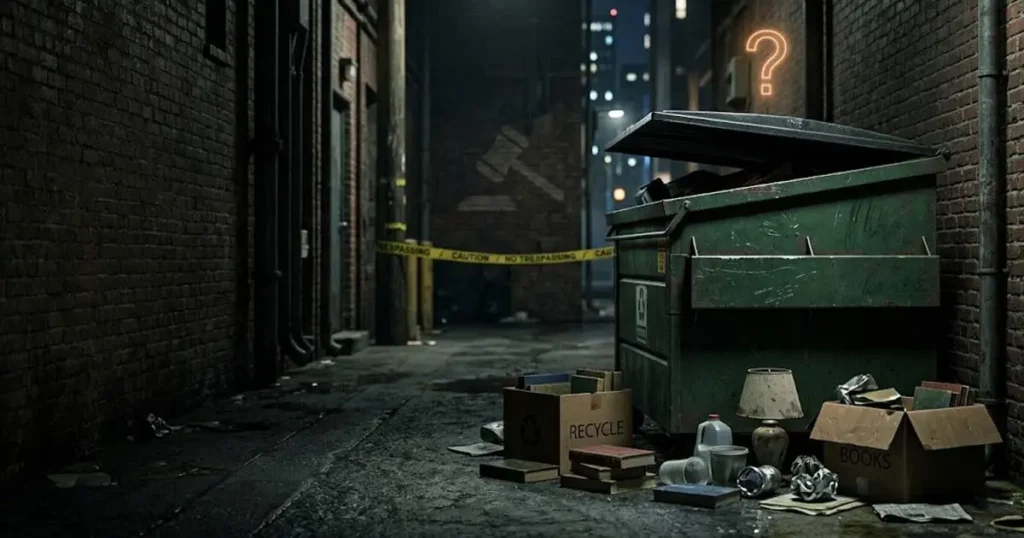

No, it’s not a state law in Missouri to explicitly prohibit dumpster diving. Dumpster diving in Missouri is not technically illegal, but the legality depends upon the property rights, local ordinances and where and how you obtain the dumpster. While it is generally legal to dumpster dive in Missouri, the legality of dumpster diving depends on the circumstances and local regulations. The most critical legal distinction any Missouri dumpster diver can make is the public vs. private property issue. Every access to private property is considered trespassing under Missouri’s trespassing law (Statute 569.140), and there are additional rules for major cities in Missouri such as Kansas City, St. Louis, Springfield, Columbia and Joplin that all divers should check before diving.
Key Takeaways
- Dumpingster diving in Missouri is legal when the dumpster is located in an area open to the public and not secured or posted with No Trespassing signs. Most cities will not stop you if you are not creating a mess or disturbing anyone and the trash is left on a public sidewalk, curbside or alley.
- If the dumpster is on private property, diving could be considered trespassing, which can cause six months in jail and a fine of up to $500 according to Missouri’s laws under Statute 569.140.
- The state of Missouri does not have a statewide law against dumpster diving, but there may be local laws or rules in certain cities such as Springfield, Kansas City, St. Louis, and Columbia.
- Diving is not prohibited at St. Louis unless a No Trespassing sign is displayed or the dumpster is on private land. Waste management regulations can be in place for cities, such as Joplin.
- When the dumpster is locked or fenced, it may be considered a forcible entry and a crime of breaking and entering may be charged.
- Can you dumpster dive at Sephora in Missouri? The majority of Sephora stores are in private commercial space. If you trespass on their dumpster, you may face Missouri trespassing charges that carry up to six months imprisonment and $500 fine.
- Some neighborhoods even have Homeowners Association policies that prohibit dumpster diving activity.
Here’s what Missouri State law says about dumpster diving
There are no specific laws or regulations that individuals should know about with regards to dumpster diving in Missouri, but there are some conditions and restrictions. One of the main issues with dumpster diving is trespassing on private property. Missouri law is quite strict that no one can enter into another’s property without permission. So it is important to realize that it is illegal to enter private property without the owner’s permission to obtain dumpsters.
In Missouri, the federal baseline is the Supreme Court’s 1988 decision in California v. Greenwood, which held that discarded garbage in public areas is not subject to the Fourth Amendment’s protection of privacy.
In the 1988 case of California v. Greenwood, the Supreme Court decided that it is OK to search through trash in a public place, provided that it does not interfere with city, county, or state laws and the contents are not within the private property line.
To understand the legality of dumpster diving, it is important to be familiar with the concept of property ownership and abandonment. After the item is tossed and put in a dumpster, it is normally presumed to be abandoned property. But the overall rule of abandonment does not apply to dumpsters that are on private commercial or residential property.
Missouri Statute 569.140 is the Primary Legal Risk
Dumping trash in a dumpster isn’t specifically outlawed in Missouri. However, this activity can lead to certain legal implications if certain boundaries are crossed. For instance, if the dumpster is on private property, diving could be considered as trespassing, which can cause six months in jail and a fine of up to $500 according to Missouri’s laws under Statute 569.140.
Trespassing: If the dumpster is on private property, such as behind a store, apartment complex or in a gated area, you may be facing trespassing charges. It is illegal to trespass on private property, even if it is done to observe garbage being thrown away.
Breaking and Entering: If the dumpster is locked or fenced off, then forcing your way in may result in charges of breaking and entering.
Under Missouri law, this is one of the most layered statutory exposures due to trespass under Statute 569.140 and the potential for break and enter charges for forced entry into locked or fenced enclosures. If a diver walks over a No Trespassing sign, he/she will be exposed to the standard trespass exposure. If a diver climbs a fence or breaks a lock to enter the same dumpster, he or she will be charged with a completely different and more serious offense.
City by City Missouri Rules: Kansas City, St. Louis, Springfield, Columbia and Joplin
Kansas City
Dumpster diving in Missouri – particularly in the Kansas City area – is not prohibited, but it does have restrictions. Public dumpsters may be used freely but unauthorized diving into private dumpsters is trespassing and may result in criminal charges.
There is also privacy in Missouri. A homeowner or property manager would expect that their trash area would be their own. When someone accesses it without authorization, they might feel their privacy has been breached, particularly when it is designated as a private zone or is locked off. Apartment complexes may, for example, have signs posted that say dumpsters are only for residents and that violators may be prosecuted.
St. Louis
Diving is permitted in St. Louis unless there is a No Trespassing sign up or the dumpster is on private property. At the municipal level, St. Louis is generally more tolerant, relying on the state’s general trespass statute for the most part, rather than having specific scavenging ordinances.
Joplin
Some cities, such as Joplin, may have waste management regulations. An understanding of the local laws and ordinance in towns and municipalities throughout Southwest Missouri is critical, because local laws may prohibit dumpster diving. Joplin’s enforcement of waste management rules is typical of the pattern of municipal oversight that is found throughout Southwest Missouri, and is more stringent than the state’s general rules.
Springfield and Columbia
Local laws or rules may exist in individual cities, such as Kansas City, St. Louis, Springfield and Columbia. No current sources fully confirmed Springfield and Columbia provisions for individual ordinance verification before any dumpster diving activity, so specific provisions were not confirmed in detail in both cities.
Is Dumpingster Diving at Sephora in Missouri Illegal?
It’s easy to end up in trouble with the law by dumpster diving behind a store, restaurant, or office building. The majority of these areas are private land. It’s dangerous and may be illegal without permission.
Typically, Sephora stores in Missouri can be found in shopping centres or commercial strips on private property. The dumpsters used at these sites are usually located in commercial refuse collection zones, which are usually private lands under Missouri’s trespass doctrine.
If you are in a fenced area or near a locked bin and a police officer sees you, he or she is entitled to ask you to leave or impose a fine for trespassing even if the business doesn’t care. Always look for dumpsters that are in public, not locked, and have no warning signs.
As far as the risks go, there are some specific dangers to Sephora dumpster diving in Missouri:
- Missouri Statute 569.140 provides for trespassing penalties of up to six months in jail and $500 fine.
- If the dumpster enclosure is locked or fenced, and it is necessary to break into gain access, charges for breaking and entering will apply.
- Depending on the Kansas City store location, it’s a violation of municipal ordinance in Kansas City, St. Louis, Springfield, Columbia or Joplin.
- As revealed in its Beauty Insider Community in March 2025, Sephora has a corporate policy prohibiting dumpster diving.
An important legal consideration for Missouri is privacy expectations
The Fourth Amendment of the U.S. Constitution is concerned with the reasonable expectation of privacy. In Missouri, for instance, if a dumpster is in a place that is not open to the public, the owner may have a reasonable expectation of privacy. If this is the case, it may also be a violation of privacy rights if someone accesses the dumpster without permission, in addition to trespassing.
This privacy dimension is one that is unique to Missouri and is more than trespass based. A homeowner or property manager can expect privacy in their trash area. If a person searches it without permission, he or she might feel that his or her privacy is being invaded, particularly if the space is designated as private or is locked off. This is because a Missouri real estate owner can make a privacy claim even if there is no signage stating No Trespassing, as long as the waste area is separated by structure from public access.
What’s legal and what’s not in Missouri
Generally allowed in Missouri:
- Dumpster diving if the dumpster is in a public place where there is no sign of No Trespassing and is not locked, like a public sidewalk, curbside, or alley
- Pick-up of litter from curbside waste collection on public land
- Dumpster diving on private property with written permission from the owner.
- Private property diving in St. Louis where there is no signage or private property status
In general, it is illegal to:
- Accessing dumpsters on private property, like behind a store, apartment complex, or inside a gated area, without permission
- Attempting to break into or enter a locked or fenced dumpster that may result in charges of breaking and entering.
- Breaking the rules of the HOA which explicitly prohibit dumpster diving in residential areas
- Staying on the premises of a dumpster after being told to leave by the property owners, management or law enforcement.
- Making a mess or disturbance, which may lead to littering or disorderly conduct fines
How Missouri is alike and different from other states
Missouri has no statewide statute, a specific statutory exposure for dual trespass and breaking and entering, and is actively enforced at the city level, making it a unique state.
| State | State Law | Key Local Rules | Max Trespass Penalty |
| Missouri | No statewide ban; Statute 569.140 trespass | Kansas City, St. Louis, Springfield, Columbia, Joplin local rules | Up to 6 months jail and $500 fine |
| Michigan | No statewide ban; trespass statute applies broadly | Detroit $500 fine ban; Warren junk peddler license; Ann Arbor outright ban | Up to $500 fine plus possible prison |
| Florida | No statewide ban; Section 810.09 trespass | Miami-Dade $500 fines; Orlando and Tampa ordinances | Up to 60 days jail and $500 fine |
| Iowa | No statewide ban; Iowa Code 716.7 trespass | No confirmed city-specific bans in major cities | Varies by degree |
| Tennessee | No statewide ban; TCA 39-14-405 trespass | Nashville and Knoxville commercial restrictions | Up to 30 days jail and $50 fine |
| Indiana | No statewide ban; IC 35-43-2-2 Class A misdemeanor | Indianapolis minimal; Fort Wayne recycling restrictions | Up to 1 year jail and $5,000 fine |
| California | No statewide ban; Section 602 trespass | LA and SD scavenging ordinances; SF recycling restrictions | Up to 6 months jail and $1,000 fine |
| Alabama | No statewide ban; trespass fines up to $500 | Birmingham and Montgomery commercial restrictions | Up to 3 months jail and $500 fine |
| Texas | No statewide ban; Section 9.41 force justification | Austin and San Antonio scavenging restrictions | Up to 180 days jail and $2,000 fine |
| Oklahoma | No statewide ban | Oklahoma City Section 38-702 misdemeanor ban | Up to 6 months jail per Section 38-702 |
| Illinois | No statewide ban; prohibits open waste scavenging | Wood River 2025 ban; Belleville $400 license | Varies by municipality |
Missouri’s six months maximum jail time for Statute 569.140, plus the separate charge of breaking and entering for forced entry into locked enclosures, makes it one of the more complex series of laws in this state for dumpster diving violations.
Here are some practical tips for legal dumpster diving in Missouri
Respect local laws, signs and people’s space at all times. The best way to avoid fines or legal troubles when dumpster diving in Missouri is to stay informed and cautious.
Be sure to review local ordinances and request permission where necessary to prevent legal issues.
Practical guidance that is specific to the State of Missouri:
- Please verify with your local municipality before doing so, particularly in Kansas City, St. Louis, Springfield, Columbia and Joplin.
- Check to see if the dumpster is actually located on public property like a curbside, sidewalk or alley.
- Avoid forcing entry into a locked or fenced dumpster, as it creates the opportunity for two exposures to breaking and entering.
- Check if there are any HOA policies if diving in a residential area
- Respect the cleanliness of any area, do not litter or cause disorder, or incur littering/disorder fines
Also Read: Is It Illegal To
Expert and Legal Perspectives
A criminal defense attorney who has practiced for more than 10 years says there would be no problems particular to dumpster diving. The legal definition of “discard” is that it means the person has lost all legal interest in the item. Trespassing is the main concern. If you are on someone else’s property, they have the right to prevent you from being there. This means that if there is a sign, you could likely be cited.
Law enforcement generally doesn’t spend much time dealing with a person dumpster diving, for a number of reasons. Someone would have to do this several times to get into any trouble with the law.
According to the website Scrape Dude (which provides dumpster diving tips in several states), Missouri does not specifically prohibit dumpster diving, but trespassing is illegal, and respecting local rules and regulations is a must when searching for items.
Reliable Rolloffs, a waste management firm based in Missouri, urges business owners and side hustlers to take the law into consideration when dumpster diving, such as private property rights, reasonable expectation of privacy, and current state law and local ordinances.
Conclusion
There is no state law against dumpster diving in Missouri. There is no specific Missouri law against dumpster diving, and the Supreme Court’s 1988 decision in California v. Greenwood establishes the federal bottom line that allows dumpster diving on public property throughout the state. Diving is allowed in St. Louis as long as a No Trespassing sign is not posted or the dumpster is clearly on private property.
Every Missouri diver should be aware of Missouri’s double legal exposure model. Trespassing is a criminal offense in Missouri, punishable by up to six months in jail and a $500 fine (Missouri Statute 569.140). If you break into a fenced or locked dumpster, it’s a new breaking and entering charge. In some neighborhoods, HOA policies limit the practice, and each of the cities of Kansas City, St. Louis, Springfield, Columbia and Joplin has its own local rules that add to the state rules.
The safest way to dumpster dive in Missouri is to only go to dumpsters in truly public spaces like curbsides, sidewalks, alleys, and before accessing a commercial dumpster, check your municipality’s code and ask for specific permission from the property owner before you go to a dumpster that is locked, fenced or posted with No Trespassing signs.
To learn more about dumpster diving laws, check out Is It Illegal to Dumpster Dive?
Frequently Asked Questions
1. Can you get in trouble for dumpster diving in Missouri?
Not at the state level. There is no Missouri law against dumpster diving. Generally, the use of a cell phone on public property like curbsides, sidewalks, and alleys is legal, based on the California v. Greenwood precedent. But, under Missouri Statute 569.140, trespassing on private property is a crime punishable by up to six months jail time and a $500 fine.
2. Is dumpster diving legal in Kansas City, Missouri?
Yes, with limits. It is legal to dive in public dumpsters in Kansas City, but illegal to do so without permission on private property and may result in criminal charges. Many apartment complexes in Kansas City have signs that prohibit dumpster access to anyone but their residents.
3. In Missouri, what is the punishment for dumpster diving on private land?
Missouri Statute 569.140 imposes a fine of up to $500 and up to six months jail time for trespassing. If the dumpster is locked or fenced and you break in, you will be charged with breaking and entering, and will have to pay an extra fine.
4. Is it illegal to dumpster dive at Sephora in Missouri?
The majority of Sephora stores in Missouri are on private commercial property. Anyone who comes onto their dumpsters without permission is trespassing under Missouri Statute 569.140. In March 2025, it was confirmed that dumpster diving is not allowed in Sephora’s stores under the company’s policy.
5. Can you dumpster dive in St. Louis?
Diving is permitted in St. Louis, unless there is a No Trespassing sign or the dumpster is on private property. This permits St. Louis to be one of the more liberal cities in Missouri for the activity of dumpster diving on public property, as long as there is no signage or private property restriction.
6. How do you legally dumpster dive in Missouri?
Only access dumpsters in public places (not locked or No Trespassing) at curbsides, sidewalks, alleys, etc. Please review your local city code in Kansas City, St. Louis, Springfield, Columbia and Joplin before you start. Do not forcibly enter a locked or fenced enclosure. Ask the property owner for explicit permission to use any commercial dumpster.