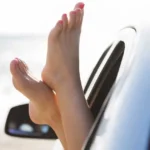

No, driving with bare feet is not illegal in Georgia. In Georgia, there is no state law that would not allow an individual to drive a passenger car with bare feet. The myth that it is against the law is a myth and you cannot be ticketed merely because of failing to wear shoes behind the wheel. There is no statute in the Official Code of Georgia Annotated that mandates footwear among drivers of such vehicles and as such, the act itself is not a citable offense. Georgia, however, has a significant exception that all drivers and riders in the state must be aware of: state law specifically forbids barefoot riding of motorcycles, making Georgia, along with Alabama, one of only two states to have a particular statutory limitation on what motorcyclists can wear.
Key Takeaways
- In Georgia, it is not illegal to drive a car or truck with bare feet. There is no footwear requirement in the Official Code of Georgia Annotated when it comes to standard vehicle drivers.
- There is no clause in the Official Code of Georgia Annotated, Title 40 on motor vehicles, which requires footwear on normal vehicle operators.
- Georgia has a special distinction with Alabama: the state law obligates motorcycle riders to wear shoes.
- The only exemption is motorcyclists, who are required to wear shoes under O.C.G.A. Section 40-6-311(e).
- You cannot be quoted as driving a car bare-foot. A barefoot driver alone does not provide a legal ground to issue a ticket by any Georgia officer.
- Georgia uses a modified comparative negligence. When barefoot driving is a cause of an accident and your contribution to the accident is more than 50 percent, you can get nothing at all.
- Barefoot driving can also influence insurance claims without issuing a citation.
What the Georgia Law says about Barefoot Driving
The traffic laws of Georgia are regulated by Title 40 of the Official Code of Georgia Annotated, which is among the most comprehensive traffic laws in the Southeast. That code does not say anything at all on the issue of driver footwear in passenger cars.
Georgia Department of Driver Services driver manual does not mention any shoe requirement, but concentrates on seatbelts, signals, and sobriety.
Although it is widely known that it is illegal to drive without shoes, Georgia does not have such a law. Unless driving barefoot interferes with your driving skills, you are safe.
None of the states in the United States has a law that specifically prohibits drivers to drive a car with bare feet. Georgia stands at the same level as the national standard of passenger vehicles. The legislation is concerned with how the driver behaves and how he or she controls the vehicle rather than what the driver prefers to put on his or her feet.
The Motorcycle Barefoot Law in Georgia: What the Law States
This is the legal difference which separates Georgia and most of the rest of the states and one that every motorcyclist should be well informed about.
O.C.G.A. Section 40-6-311(e) requires motorcyclists to wear shoes.
In Georgia, it is not permissible to ride a motorcycle without shoes and the law is quite clear on the matter.
Georgia is one of the only two states in the country that has an express statutory footwear requirement of motorcycle riders. Alabama has garnered more national attention regarding its prohibition, but Georgia has a similar law under O.C.G.A. Section 40-6-311(e) with the same legal effect. We can refer directly to a motorcyclist in Georgia who has stopped without shoes, whereas we can not refer to a car driver who has stopped under any statute to barefoot driving.
The rationale of this law is the specific weakness of motorcycle riders. Motorcyclists are exposed to all the road conditions unlike drivers of enclosed vehicles. Their feet are directly touching the environment and in case of any collision or skid, bare feet are at risk of direct contact with the road surface, debris and vehicle parts. The legislature concluded that this risk deserves certain legal protection.
Is it Legal to Be Pulled Over or Ticketed in Barefoot Driving in Georgia?
No, to car and truck drivers. Even in the case of a passenger vehicle, a Georgia police officer has no legal grounds to issue a citation to barefoot driving.
The police may impose a reckless driving charge on you in case they establish that your barefoot driving was the cause of a crash. You may also get a ticket on distracted driving, should you be attempting to find a lost shoe or otherwise distracted due to being barefoot.
In case being barefoot is a factor in unsafe driving or a collision, you might be punished by wider traffic regulations. Imagine a case in which you are driving with your feet unshod and your foot slips off the brake leading to a fender-bender. In Georgia, an officer might cite you on grounds of not exercising due care or reckless driving in case the officer feels that you were not in full control of the vehicle. You could mention that you did not have shoes, which could be considered a contributing factor.
Potential charges that might be as a result of unsafe driving due to barefoot include:
- Reckless driving
- Lack of due care.
- Footwear retrieval is a cause of distracted driving.
- Loss of control of vehicle.
In both instances, the unsafe act is the subject of the charge, and it is not the lack of shoes as such.
The impact of Barefoot Driving on Liability in Georgia
Georgia uses a modified comparative negligence in civil cases. This is the legal fact that has the most practical implication on Georgia drivers who are involved in accidents.
Georgia has a modified comparative negligence system. Such rules limit the compensation of an injury victim who contributes to his or her accident. Being caught driving without shoes may make an insurance company or jury believe that you are at least partially to blame in your accident. A particular insurance company may argue that you lost control of your car since you were not driving with the right footwear.
Georgia has a critical threshold of 50 percent. A driver who is found to have caused an accident 50 percent or more is not allowed to receive any compensation at all.
Avoiding civil litigation by driving with bare feet. In some situations, a court may hold you negligent because you are driving without shoes. In case this oversight resulted in an accident that led to the injuries of someone, you can be held responsible and be liable to compensate the victim.
This implies that although there is no risk of citation when driving barefoot in a passenger car, it may be a crucial point in establishing the civil liability following an accident. A carrier able to demonstrate that bare feet had a role in slowing the brakes or pedal slip has a basis to place a larger proportion of blame on the barefoot driver, which directly impacts their entitlement to damages.
The impact of Barefoot Driving on Insurance Claims in Georgia
Outside the courtroom, the issue of barefoot driving may make the claims management of Georgia insurance companies more complicated, even when there was no citation.
There are no instances of shoeless driving insurance denials. Emphasis is on action. But the actual situation is more subtle. The insurers will investigate the conditions under which each accident occurred, and any fact that can be described as part of unsafe vehicle operation will be used as evidence to decrease or challenge a claim.
It is a mere method of remaining safe and not getting less compensation in a car accident claim. Having a pair of flat driving shoes in the car nullifies this argument all together and does not cost anybody anything to practice as a habit.
Comparison of Georgia with other states
Georgia is the same as Alabama in its prohibition of motorcycle barefoot, and both states are unique in that regard compared to the rest of the country. In the case of car drivers, Georgia is on par with the national standard.
| State | Barefoot Car Driving | Barefoot Motorcycle Riding | Negligence Standard |
| Georgia | Legal | Illegal (O.C.G.A. Section 40-6-311(e)) | Modified comparative (50% bar) |
| Alabama | Legal | Illegal (Code 32-5A-245b) | Contributory (full bar) |
| North Carolina | Legal | Legal | Contributory (full bar) |
| Tennessee | Legal | Legal | Comparative (local ordinances may apply) |
| California | Legal | Legal | Pure comparative |
| Ohio | Legal | Legal | Modified comparative (51% bar) |
| Oklahoma | Legal | Legal | Modified comparative (51% bar) |
| Texas | Legal | Legal | Modified comparative |
| Florida | Legal | Legal | Pure comparative |
| Michigan | Legal | Legal | Modified comparative |
Georgia has a 50 percent fault standard, which is slightly higher than the 51 percent standard in Ohio and Oklahoma. A Georgia motorist who is found to have been precisely 50 percent at fault in an accident forfeits all claims to recovery, but in Ohio or Oklahoma the same result would still allow some compensation.
Also Read: Is It Illegal to Drive Barefoot
Is Driving with Barefoot safe? An Honest Assessment
Car drivers have their legal question resolved. The safety issue should be given an individual and sincere analysis, especially to the Georgia drivers who have to experience various conditions between the crowded urban freeways of Atlanta and the rural country roads and the highways of the coastline.
Potential Advantages
Certain drivers and safety observers observe that bare feet might be of real sensory advantage under some circumstances.
The advocates of driving barefoot argue that it gives the driver greater control over the pedals since they can feel the exact action of the pedal. They are also able to see objects on the pedals that may cause difficulty in driving such as small rocks, pebbles or even water.
Genuine Risks
- Sweaty or damp feet lessen the grip on the pedals and risk slipping at the most important time.
- Bare feet do not offer any defense to floor debris or harm during a collision.
- The longer drives are more fatigating without the support of a shoe.
- Consistency of the reaction might be different because of unequal foot-to-pedal contact during long journeys.
In Cases Where Bare Feet May Be the Wiser
Some people wear high heels instead of bare feet because they think that it is unsafe to drive with high heels. Safety experts have always found some kinds of footwear to be more hazardous than none at all, especially flip-flops, which may slip off or get trapped under pedals.
The general consensus on the safety of footwear can be seen in the footwear risk comparison below:
| Footwear Type | Pedal Control | Risk Level |
| Barefoot | Moderate | Medium |
| Flat sneakers | High | Low |
| Flip-flops | Low | High |
| High heels | Very low | Very high |
| Heavy boots | Low-Moderate | Medium-High |
| Sandals | Low | High |
The general advice of legal and safety experts is to wear flat, closed-toe shoes with a thin, stiff sole. These offer optimum pedal sensitivity and minimal civil liability.
When Driving Barefoot is Best in Georgia
Some of the driving conditions in Georgia render barefoot driving an especially poor practice choice, even where it is legal:
- Summer heat: Georgia heat is very intense and the floor of the vehicle gets very hot thus contacting metal pedals and floor with bare feet is uncomfortable and distracting.
- Wet weather: Rain and humidity on foot surfaces can significantly increase the risk of pedal slip.
- Atlanta freeway driving: The high-speed, high-density traffic requires immediate and steady response of the pedals with no allowance to slip.
- Long-distance driving: There is a cumulative foot fatigue that occurs without shoe support.
- Rural roads: Unpredictable conditions and fluctuating surfaces demand good and stable pedal control.
The climate of Georgia, hot and humid summers and wet winters provide an all-year-round climate where the quality of foot-to-pedal contact is significant. The extra risk of wet, sandy feet upon returning to a vehicle is created by beach and lake visits, which are common during the warmer months in Georgia.
Professional and Legal views
Adam Hasner an Atlanta-based personal injury lawyer with Hasner Law PC confirms that there is no legal issue with the barefoot driving as the car drivers of Georgia, but states explicitly that the liability in the civil sense is a reality. His guidance published points out that a court may conclude that a driver was negligent in barefoot driving under specific conditions and that the negligence, when it is connected to the injuries of a person, can lead to the liability of damages.
Hawk Law Group, a personal injury law firm in Georgia, recommends that since Georgia has a modified comparative negligence system, any element that might be described as contributing to unsafe car operation is worth getting rid of. They advise their clients in a simple way, legal is not risk-free, and unwarranted liability considerations must be avoided at all costs.
Ride Safe Georgia, a government-approved road safety organization, states that in Georgia no law exists to ban barefoot car driving, although motorcyclists are clearly mandated by O.C.G.A. Section 40-6-311(e) to wear shoes. Their advice is identical to the two-part legal fact that pertains in Alabama: legal on cars, illegal on motorcycles.
Also Read: Is It Illegal To
Conclusion
Car and truck drivers are allowed to drive with bare feet in Georgia. The Official Code of Georgia Annotated has no shoe requirement regarding passenger vehicle operators, the Georgia DDS driver manual does not mention shoes, and no officer can legally cite a driver because he or she is driving barefoot. All other states in the country share this stand on standard passenger cars.
Georgia does have a major legal difference, which drivers and riders should be aware of. Riding a motorcycle barefoot is specifically forbidden by O.C.G.A. Section 40-6-311(e), and Georgia is among only two states with this particular statutory ban. All motorcyclists in Georgia must be well informed of this rule.
The more significant issue to car drivers is the altered comparative negligence standard in Georgia. In the event that driving without shoes was found to be the cause of an accident, your right to compensation can be diminished or completely taken away in case your fault is found to be 50 percent or more. The most sensible and legally viable strategy is to always have a good pair of flat, closed-toe driving shoes in the car.
Frequently Asked Questions
1. Is driving with bare feet in Georgia illegal?
No, not to car or truck drivers. There is no law in the Official Code of Georgia Annotated that does not allow driving with bare feet in passenger vehicles. You cannot be quoted to it alone.
2. Can you ride a motorcycle in Georgia with bare feet?
Yes. In Georgia, the O.C.G.A. Section 40-6-311(e) clearly stipulates that motorcyclists have to wear shoes when operating or riding a motorcycle. Georgia and Alabama are the only two states that have this particular statutory prohibition.
3. Does a Georgia police officer have the power to ticket me because I was driving with my feet in the air in a car?
Not to drive barefoot. A car driver cannot be cited by an officer on the ground of not having footwear. Unsafe driving behavior must also be observed or the fact that barefoot driving contributed to an accident must be done before a citation can be made.
4. What is the impact of the modified comparative negligence rule in Georgia on barefoot drivers?
In the modified comparative negligence standard in Georgia, the apportionment of fault is on a proportional basis. In case it is determined that barefoot driving was a cause of an accident and your overall fault is 50 percent or more, you are not allowed to recover any compensation whatsoever.
5. Is barefoot driving admissible against me in Georgia by my insurance company?
Yes, potentially. It can be increased by insurers as a contributory element in establishing fault or in lowering the payout of a claim, especially when the issue of pedal control or reaction time is in question following an accident.
6. In Georgia, is it safer to drive with bare feet than in flip-flops?
In many cases, yes. Flip-flops may fall or get stuck between pedals and this poses a more immediate threat than bare feet in most situations. Sneakers with a firm sole and flat, closed-toe sneakers are the safest in general.