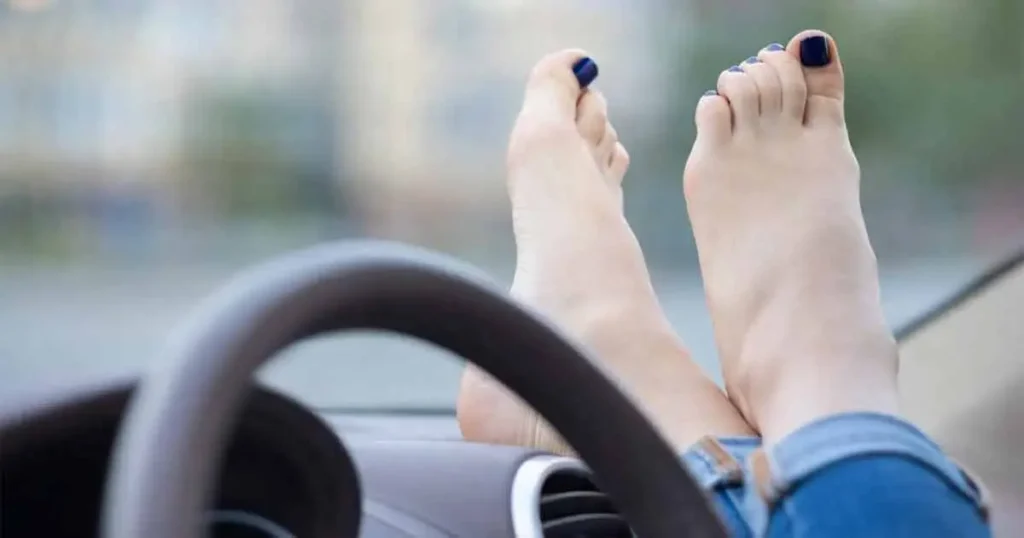

No, there is no law against driving with bare feet in Alabama as long as you are driving a car, truck or enclosed passenger vehicle. No particular law outlaws driving without shoes provided you are driving an automobile. But in one thing Alabama is different than all other states in the country. Only Alabama has a law expressly prohibiting driving a motorcycle barefoot, in Section 32-5A-245(b) of the Code of Alabama.The law is lenient to car drivers. It is not the case with motorcyclists. It is critical that all drivers and riders in the state understand that difference.
Key Takeaways
- In Alabama, it is not illegal to drive a car or truck with bare feet. It is not forbidden by any state law against passenger vehicle drivers.
- Alabama has a special claim to fame among all 50 states: it is the only state where it is a state offense to ride or operate a motorcycle with bare feet.
- The Alabama Code 32-5A-245(b) provides that it is unlawful to ride or operate a motorcycle or motor-driven cycle without shoes.
- In Alabama, you cannot be ticketed just because you were driving a car without shoes.
- The system of contributory negligence is applicable in Alabama. In case it is established that barefoot driving has led to an accident, it can entirely deny you the right to compensation.
- Even in cases where no ticket is given, barefoot driving may influence insurance claims.
What Alabama Law Says About Barefoot Driving
The traffic regulations in Alabama are one of the most comprehensive in the South, addressing such issues as speed limits and DUI limits, seatbelts and helmets. The state code is silent on the issue of driving barefoot in passenger cars. There is no stipulation that a car driver should wear any type of footwear.
In Alabama it is legal to drive a motor vehicle with bare feet. It is however illegal to ride a motorcycle on bare feet.
In Alabama, the driver is allowed to operate a motor vehicle with bare feet, with the exception of motorcycle drivers and riders.
The uniqueness of Alabama in the national context is this two-part legal reality, legal with cars and illegal with motorcycles. All other states either allow barefoot riding of motorcycles or just do not mention it. The state of Alabama has a definite statutory prohibition supported by a certain code section.
The Alabama Motorcycle Barefoot Law: What the Statute Says
This is the greatest legal difference in Alabama and one that motorcyclists should have a clear understanding of.
Alabama Code Section 32-5A-245(b) makes it a crime to ride or drive a motorcycle or motor-driven cycle without shoes. This does not apply to cars, trucks or enclosed vehicles but on a motorbike, it is against the state law to ride with bare feet.
Not wearing shoes while driving a motorcycle is a general offense in Alabama with a ten dollar fee, according to the state’s Supreme Court. The penalty itself is small, yet the infraction is real and in the books. An example of a motorcyclist with no shoes can be given directly, but not a car driver.
The rationale of this law is simple. The riders of the motorcycle are exposed to the road conditions fully. They have their feet in touch with the environment. Bare feet are exposed to immediate danger of road surface, debris, and vehicle parts in a collision or even a minor skid. The legislature decided that this risk justified a certain legal condition, which no other state has been able to match on the case of normal motorcycles.
Is it possible to get a ticket on driving with bare feet in Alabama?
In the case of car and truck drivers, no. In Alabama, a police officer has no legal authority to cite barefoot driving in a passenger vehicle in and of itself.
Although you will not be ticketed just because you were driving with your bare feet, other problems may come up as a result of your barefoot driving resulting to unsafe conditions or accident. In case an officer believes that your driving is unsafe, or erratic, and you happen to be bare-footed during that time, he or she might imply that you were unsafe because you were bare-footed. This could result in references or greater police questioning.
The misdemeanors that may result due to unsafe barefoot driving are:
- Careless driving
- Reckless driving
- Loss of control of a vehicle.
In both instances, the ticket is given to the observed behavior, but not the lack of shoes. The bare feet are legally relevant only in the case of unsafe vehicle operation.
Contributory Negligence Rule in Alabama: A Critical Legal Risk
Alabama is among the few states which continue to use the doctrine of pure contributory negligence in civil cases. This regulation has far reaching consequences on barefoot drivers in accidents.
In contributory negligence states, such as Alabama, Maryland, North Carolina, and Virginia, and the District of Columbia, you will not get any compensation in case you are found to have been at least partially negligent in an accident.
This is one of the most stringent standards of liability in the country. Majority of states employ comparative negligence system, which limits recovery to a claimant in proportion to their fault. Alabama does not. Any portion of fault that is attributed to you even one percent will wipe out your right to recover damages altogether.
Driving barefoot may lead to inconveniences in case of an accident. Although you cannot be given a ticket as a result of being barefooted, the other party may argue that you did not wear shoes hence the accident. When your case is in court, an insurance company or the other party may claim that you were negligent in driving barefoot. In case a court determines that you are negligent, you might be liable to pay damages in case of an accident, although barefoot driving may not have been illegal per se.
The practical implication is obvious. In Alabama, even the most seemingly insignificant detail, such as shoes, can be the determining factor in whether or not you can claim damages after a serious accident.
The impact of Barefoot Driving on Alabama Insurance Claims
Outside the courtroom, driving barefoot may influence the way your insurance company will manage a claim.
Although driving with bare feet is not illegal, it may have some legal consequences. In case of any accident and it is found that driving with bare feet was a contributing factor to the accident, then you might be blamed. The insurance companies could argue that you were driving with bare feet and this is why they can lower your claim.
With the finest auto insurance cover, your insurer may refuse to pay your claim because of your bare feet when the accident occurred.
Insurance adjusters are trained to find any contributing factor that alters or diminishes liability. Although illegal, barefoot driving provides them with a ready case in any accident where pedal control is in question. Having a pair of flat driving shoes in the car does not cost anybody anything, and eliminates this argument completely.
Alabama vs. the Other States
The legal status of Alabama is unique mainly due to its motorcycle law. In the case of car drivers, it is in line with the rest of the country.
| Tennessee | Legal | Legal | Local municipal ordinances may apply |
| North Carolina | Legal | Legal | Contributory negligence adds civil risk |
| Texas | Legal | Legal | No footwear statute in Transportation Code |
| Florida | Legal | Legal | Unsafe driving citations possible |
| Michigan | Legal | Legal | State Police confirm no restriction |
| California | Legal | Legal | Liability implications in accidents |
| Ohio | Legal | Legal | Recommends shoes but does not mandate them |
| Oklahoma | Legal | Legal | Behavior-based enforcement only |
Alabama is the only state that does not allow motorcycle riders to ride with bare feet, whereas the other states either do not forbid it at all or can only regard it as an aggravating circumstance when it comes to reckless driving.
Barefoot Driving, Is It Safe? An Honest Assessment
The question of the law and the question of safety are distinct issues. Alabama permits barefoot car driving. The decision to make is a wise one depending on the circumstances and the driver.
Potential Risks
- Wet or sweaty feet decrease pedal grip and risk of slipping.
- The use of bare feet will not protect during a collision where a foot injury is a risk factor.
- When driving long distances, the fatigue is more severe and without the support of a shoe.
- Variable foot-to-pedal contact may decrease reaction consistency.
In the absence of good footwear, feet might slide off the pedals or they might be injured in case of an accident. When wet or sweaty, bare feet may easily slip off the pedals and this may cause loss of control of the vehicle.
In Cases When Bare Feet Are Better
Safety experts often indicate that some shoes are more hazardous than no shoes.
Some types of shoes could get stuck and cause a motor vehicle accident. Bulky shoes make it difficult to properly control the gas pedal, brake pedal, and clutch. There are cases where driving without shoes may be a better option than wearing dangerous shoes.
The overall safety consensus is reflected in the footwear risk comparison below:
| Footwear Type | Pedal Control | Risk Level |
| Barefoot | Moderate | Medium |
| Flat sneakers | High | Low |
| Flip-flops | Low | High |
| High heels | Very low | Very high |
| Heavy boots | Low-Moderate | Medium-High |
| Sandals | Low | High |
The uniform advice of legal and safety experts is flat, closed-toe, with a thin, hard sole. These have the highest levels of pedal sensitivity and minimum legal exposure.
When Barefoot Driving Is Best in Alabama
Although some countries allow it, some driving circumstances increase the real danger of barefoot driving:
- Wet weather: Rain or moisture on the foot surface causes a high level of pedal slip.
- Heavy traffic: Accurate and fast braking requires constant pedal grip.
- Long distance driving: Over time, foot fatigue is worsened by lack of shoe support.
- Night driving: There is less room to spare to braking reaction due to diminished visibility.
- New cars: Pedal height and distance differ and demand more attention of the feet.
An efficient routine is to have a pair of flat driving shoes in the car at all times. This is a mere step that eradicates the safety issue and any liability claim that an insurer may make.
Expert and Legal Viewpoints
According to Jaffe, Hanle, Whisonant and Knight, P.C., a criminal defense and civil litigation firm based in Birmingham, Alabama may legally permit car drivers to drive barefoot, but the contributory negligence doctrine of the state makes any circumstance that may be described as negligent nullify. Their advice is similar: have sensible shoes at hand and do not give any reasons to blame.
The Alabama personal injury firm, Hodge Copeland, P.C. confirms that insurance companies are on the move to popularize the barefoot driving as a factor in accident claims. Their recommendation to the clients is to record all situations and seek the services of a lawyer before uttering anything concerning footwear after an accident.
FindLaw, a nationally recognized source of law, states that no federal or state law in the United States outlaws barefoot driving in a passenger car and that any citation based on that alone can be contested in court. The motorcycle law in Alabama is the only statutory exception that is clear in the nation.
Also Read: Is It Illegal to
Conclusion
In Alabama, car and truck drivers are allowed to drive with bare feet. The Alabama Code does not forbid it, and no officer can give a citation related to footwear in a passenger vehicle. Alabama, however, has a special status in the American traffic law: it is the only state that explicitly prohibits barefoot riding on motorcycles, pursuant to Alabama Code Section 32-5A-245(b). All motorcyclists in the state ought to know this rule.
To car drivers, the more significant legal issue is the contributory negligence doctrine of Alabama. By that criterion, a simple finding of fault related to barefoot driving can remove the right to compensation of a driver altogether. Legal permissibility, coupled with the civil liability risk, implies that, although it is legal to drive barefoot, it presents a real exposure in Alabama that drivers should be keen to take into consideration.
The easiest and most legally acceptable thing to do is to have a good pair of flat, closed-toe driving shoes in the car. It is free and eliminates all the complexities that barefoot driving can bring.
Frequently Asked Questions
1. Can you be arrested in Alabama because you were driving without shoes?
No, not to car or truck drivers. There is no law in Alabama against driving barefooted in passenger cars. You cannot be quoted on it singly.
2. Is it a crime to ride a motorcycle with bare feet in Alabama?
Yes. The Alabama Code, Section 32-5A-245(b) clearly forbids the operation or riding of a motorcycle or a motor-driven cycle without shoes. This particular statutory prohibition is unique to Alabama, and not found anywhere else in the country.
3. Does a car driver in Alabama have a right to be ticketed because he is driving with his feet in the air?
Not to drive barefoot. There is no legal ground that an officer can use to stop a car driver on the ground of not having shoes. It is possible to cite only in the case of unsafe driving behavior.
4. What is the impact of Alabama contributory negligence rule on barefoot drivers?
Significantly. Alabama is among very few states that continue to use pure contributory negligence. Provided that barefoot driving can be proved to have been one of the causes of an accident, even in part, it can prevent you to get any compensation at all, no matter how much responsibility the other party has.
5. Does my insurance company have a barefoot driving case against me in Alabama?
Yes, potentially. It can be increased by the insurers as one of the factors in the fault determination or diminishing or denying a claim, especially in states such as Alabama where contributory negligence is applicable.
6. Is it safer to drive barefooted than in flip-flops?
In many cases, yes. The flip-flops are often considered more dangerous than bare feet due to their ability to slip or get stuck under the pedals. The safest overall are flat, closed-toe sneakers.