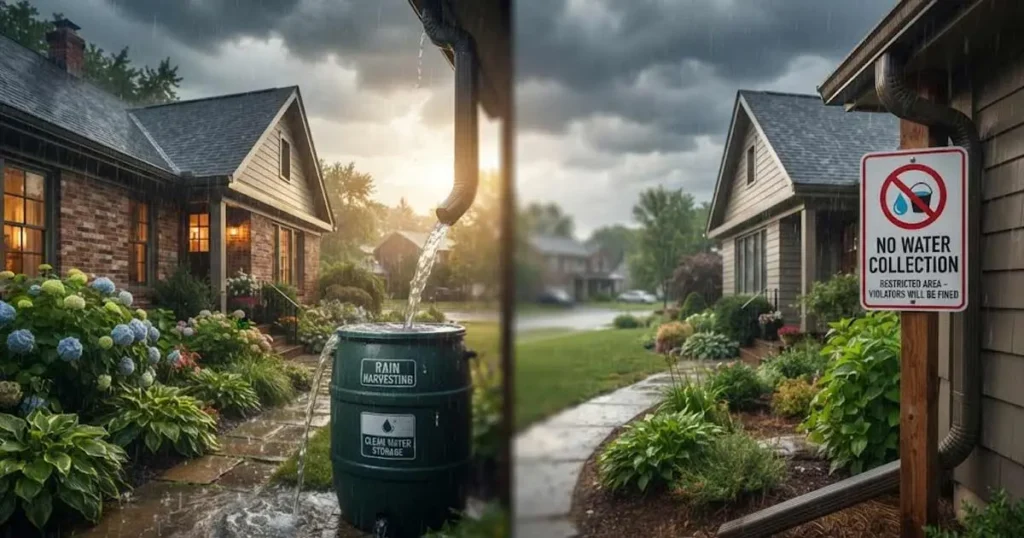

It is not illegal to collect rainwater in Florida. There are no state laws prohibiting rainwater harvesting in Florida, so residents can collect rainwater at any time and in any manner. Rainwater collection is one of the most liberal states in the country, with no restrictions in Florida state law. Florida is unique because its permissiveness is supported by the real climate advantage. Florida has 54 inches of average annual rainfall, and the legal framework eliminates any administrative obstacle that may deter rainwater collection.
Key Takeaways
- Rainwater harvesting is legal in Florida. There are no permit or registration requirements for residential rainwater collection systems in Florida, and no state-level restrictions on rainwater collection.
- Residential rainwater harvesting is not regulated at the State level in Florida. As many barrels or cisterns as possible can be installed.
- The 2017 Florida Building Code (Chapter 29) regulates Nonpotable Rainwater Collection and Distribution Systems, with the intent to establish technical requirements for the design and installation of such systems.
- Several local municipalities in Florida, such as Manatee County, Orlando and Tampa Bay area utilities, offer rainwater collection rebates.
- St. Petersburg offers a $50 rebate for installing a rain barrel. Orlando has a rainwater collection equipment rebate program.
- Florida averages about 54 inches of rain per year, making it one of the most productive states for rainwater harvesting in the country. That’s about 34,300 gallons per year currently flowing into storm drains on a typical 1,200 square foot roof with 85 percent collection efficiency.
- There are some uses of stored water that are regulated in Florida. Health codes apply if you plan to treat and use collected rainwater for drinking. These rules are intended to promote water quality, not to limit water collection.
What Florida Law Says About Collecting Rainwater
Florida promotes rainwater harvesting, but with regulation to prevent impacts to natural water systems. Homeowners are permitted to harvest rainwater with approved systems, under the state law.
Florida is a doctrine-based state, with riparian water rights doctrine applying to Florida.Florida is a doctrine based state, and the riparian water rights doctrine applies to Florida. This system is typical of the eastern states, and it is quite distinct from the previous doctrine of “prior appropriation” that was adopted in western states such as Colorado and Utah and which had the effect of limiting rainwater collection to preserve the rights of those who live downstream.
The State of Florida provides tax incentives and rebate programs for rainwater collection and several municipalities, including Manatee County, offer programs to help reduce costs. Nonpotable Rainwater Collection and Distribution Systems are covered in Chapter 29 of the 2017 Florida Building Code.
The riparian rights doctrine does not allow you to take water that falls on your land and prevent it from reaching those downstream who have a prior right to use the water. This legal framework eliminates the underlying tension that leads to restrictions in western states, and eliminates the need for Florida to impose restrictions on residential collection volumes, or require permits for typical residential systems.
Florida Building Code Chapter 29: Technical Standards for System Installation
There are no legal limitations on rainwater collection in Florida, but systems that are designed to be connected to plumbing for use indoors must meet technical standards of the building code.
Systems should be designed and installed according to plumbing codes and any storage tanks should be covered to prevent mosquito breeding and contamination. Rainwater harvesting is legal in Florida, but it is important to make sure that you meet the rules that govern the use of rainwater.
Nonpotable Rainwater Collection and Distribution Systems is covered in Chapter 29 of the 2017 Florida Building Code. This is not a collection limit. A technical standard for indoor distribution that ensures that the components of the system are designed to be safe and constructed to meet the requirements of the system where it is used for irrigation supply, toilet flushing or other uses of rainwater indoors.
The building code framework in Florida has several key system requirements, such as:
- Rainwater should be collected in a separate cistern or tank, either above or below ground, for the purpose of rainwater harvesting.
- The tank should be of a non-toxic material and should not be used for any other type of liquid storage.
- Properly cover and seal the tank so that animals cannot access it and so that it cannot evaporate and so that mosquitoes cannot breed in it.
- Non potable water lines and potable water supply lines should be identified with a label.
Can Collected Rainwater be Drinking Water in Florida?
One of the most critical and important practical issues for Florida homeowners is how Florida compares to other states in terms of permitting.The answer to one of the most important and practical questions for Florida homeowners is that Florida is more permissive than most states.
There are no state laws in Florida to prohibit residents from harvesting rainwater at any time or in any way. When the water is used for private purposes only, it can be used for potable purposes.
Florida has some restrictions on the use of stored water. If you are going to treat and use rainwater for drinking, health codes apply. These rules are designed to assure water quality and not to limit the collection.
In this series, Florida is more lenient than most states with respect to potable use of collected rainwater. Most other states and California restrict the use of collected rainwater to non-potable uses without treatment. The state of Florida does not have that restriction, but health codes still apply when collected water is used for drinking or cooking purposes.
The Rainfall Advantage of Florida: Collection Makes Practical Sense
The average annual rainfall in Florida is approximately 54 inches. That is about 34,300 gallons per year currently flowing into your storm drain on a typical 1200 sq. ft. roof with 85% efficiency.
This amount of rainfall has drastically changed the situation for Florida compared to the western states where collection has always been limited. In arid states such as Colorado and Utah, the caps were placed due to the fact that each bit of rain was of importance to the downstream water rights holders. With all the rain Florida receives, residential collection is a very small percentage of the water available and does not have any significant impact on downstream water availability.
The more rainfall a state receives, the less restrictions it has, for example Florida, and the more drought prone a state is, the more it is encouraged to collect rainwater, for example, California. The climate in Florida is ideal for the practical and legal viability of rainwater harvesting.
Local Incentives and Rebate Programs Throughout Florida
The State of Florida does not provide direct state-wide financial incentives for rainwater collection, but local municipalities have established their own financial incentives for homeowners who install rainwater collection systems that meet their requirements.
Installing a rain barrel at Petersburg is rewarded with a $50 rebate.
Orlando has a rainwater collection equipment rebate program. The program is designed in accordance to the city’s water conservation goals and offers a tangible financial reward to homeowners to decrease their reliance on city water by using rainwater.
In addition to the water conservation strategy, Manatee County has rebate programs for rainwater collection equipment.
The Florida Water Star program provides water-efficient landscaping practices and irrigation systems programs and rebates in some counties. The Florida Friendly Landscaping program offers homeowners and businesses information and resources about water efficient landscaping practices, such as rain barrels and cisterns.
Please consult your local county extension office or water utility for current incentive programs in your area; programs and rebate amounts are subject to change and some municipalities may have developed new programs since this article was last updated.
Mosquito Control: A Florida-specific Practical Concern
A practical concern that is unique in Florida is the issue of rainwater collection, which is not as critical in cooler or drier states.
The tank should be covered and sealed so that it is inaccessible to animals, does not evaporate, and does not allow mosquitoes to breed.
Mosquitoes are one of the most active in the state of Florida, and stagnant water in containers that are not properly sealed can serve as a breeding ground for Aedes and Culex mosquito species that transmit diseases such as West Nile virus, Eastern equine encephalitis, and dengue fever. Florida county mosquito control programs proactively check for standing water complaints and rain barrels or cisterns that are not properly covered may lead to complaints and visits by county officials.
This is not a legal restriction on rainwater collection. The need for covered, properly sealed collection containers is a very real issue in Florida, as in many other states. Securing and covering rain barrels and cisterns tightly and securely is a public health duty as well as a way to prevent mosquito breeding issues.
Florida HOA and Local Ordinance considerations
Despite the relaxed state laws in Florida, local governments and homeowners associations may have more stringent requirements.
Double-check all county and local laws and remember to be aware of HOAs. As long as you do that, there’s much to be liked about Florida for rainwater collection.
Texas has an explicit statute (Texas Property Code Section 202.007) that explicitly bans HOAs from banning rainwater harvesting systems, but Florida does not. This implies that a Florida HOA may legally restrict rain barrels or cisterns that are visible from the street, via the governing documents.
Homeowners in planned communities should check their covenants, conditions and restrictions before installing any rainwater collection system in Florida. If the HOA documents do not specifically mention rainwater collection, consult with HOA management prior to installation to prevent conflicts regarding placement, visibility or system design.
How Florida does compared to other states
There are no state-level limits on residential rainwater harvesting in Florida. Install as many barrels or cisterns as you can on your property; no permit or registration is needed.
| State | Legal Status | Volume Limit | Tax or Financial Incentive | HOA Protection | Key Law |
| Florida | Legal and encouraged | None | Local rebates (no state incentive) | No specific statute | Riparian rights; Florida Building Code Ch. 29 |
| Texas | Legal and strongly encouraged | None | Yes (state sales tax exemption) | Yes (Property Code 202.007) | HB 3391, Tax Code 151.355 |
| California | Legal and encouraged | None | Yes (property tax exemption) | No specific statute | Rainwater Capture Act 2012 |
| Arizona | Legal and encouraged | None | Yes | No | Tax incentives |
| Virginia | Legal and encouraged | None | Yes (tax credit) | No | State encouragement |
| Tennessee | Legal | None | No | No | SB 2417/HB 1850 |
| Michigan | Legal | None | No | No | No restrictions |
| Indiana | Legal | None | No | No | No restrictions |
| Ohio | Legal | None | No | No | No restrictions |
| Colorado | Legal with restriction | 110 gallons | No | N/A | HB 16-1005 |
| Utah | Legal with restriction | 2,500 gallons | No | N/A | Registration required |
With no restrictions on use and a surplus of rainfall, Florida is one of the most practically friendly states in the nation for rainwater collection, along with Texas and California, where local rebates are available.
Practical Steps for Florida Homeowners
When installing any rainwater collection system in Florida, the following practical steps will assure full compliance and maximum benefit:
- Check with your local county to see if there are any other requirements besides the state requirements
- If you live in a planned community, review your governing documents because Florida doesn’t have the same explicit protection of HOAs that Texas does.
- Call your local water company or county extension office to find out what rebates are on offer in your area.
- Make sure all cisterns and rain barrels are covered and secured to prevent mosquito breeding, in line with Florida’s public health issues.
- If your system will be connected to indoor plumbing for use for non-potable purposes like toilet flushing, be sure that it is designed in accordance with Chapter 29 of the Florida Building Code.
- If you plan to use the water you collect for drinking or cooking, make sure that the system design includes appropriate filtering and treatment in accordance with Florida health codes.
- See the Florida Friendly Landscaping program resources for ideas on incorporating rainwater collection as part of a water-efficient landscaping plan.
Also Read: Is It Illegal To
Expert and Legal Perspectives from the field of education
There are no state laws in No. Florida that prohibit rainwater harvesting, so it is generally legal for residents to harvest rainwater anytime and in any way that they would. Florida is an excellent state for rainwater harvesting due to the absence of state-level regulations, the scarcity of regulations that would hinder system installation and use, and its warm, rainy weather.
Collecting rainwater in Florida is legal with some restrictions to protect water resources and property rights. In Florida, it is legal to collect rainwater. Rainwater can be collected from the roof of your house or home for your own use. There are some rules, however, that must be followed to ensure the protection of water quality and rights.
Florida promotes rainwater harvesting while controlling it to prevent adverse effects on natural water systems. Rainwater collection is permitted under the state law for use by homeowners.
Conclusion
It is legal to collect rainwater in Florida. Residential rainwater harvesting is not regulated at the state level in Florida. As many barrels or cisterns as possible can be installed on your property and no permits or registrations are required. The riparian water rights doctrine does not exist in Florida, eliminating the legal conflict that restricts water collection in western states, and Florida receives 54 inches of average rainfall per year, which makes residential collection almost productive at other states’ level.
The reality is, what Florida homeowners should know is the practical aspect of it that goes beyond just the legalities. Systems that are connected to indoor plumbing should be in compliance with Chapter 29 of the Florida Building Code. Collected water for drinking or cooking should be treated according to Florida health codes. In Florida, where the weather is warm and humid, cisterns and rain barrels need to be sealed off to stop mosquito breeding. While Florida does not have an explicit protection statute for HOAs like Texas, HOA governing documents can limit visible collection systems.
There are rebate programs in the Tampa Bay area, Manatee County, St. Petersburg, and Orlando that offer financial assistance for eligible installations. Please check with your local water utility or county extension office to find out what programs are available in your particular municipality before installation.
To read the national legislation on rainwater collection, check out Is It Illegal to Collect Rainwater?
Frequently Asked Questions
1. In Florida, is it legal to harvest rainwater?
There are no state-wide regulations in the state of Florida prohibiting rain water harvesting, so it is generally legal to harvest rainwater at any time and any manner.
2. In Florida, is a permit required to collect rainwater?
There is no permit or registration required for typical residential collection systems. Systems connected to the indoor plumbing should meet the technical standards in chapter 29 of the Florida Building Code for Nonpotable Rainwater Collection and Distribution Systems.
3. What is the maximum amount of rainwater that can be collected?
Florida has more relaxed potable use regulations than most states. If water is only for private use, then it may be used for potable water. But Florida health codes mandate that treated rainwater must be used for potable purposes before it can be collected.
4. Do you receive rebates for rainwater collection in Florida?
St. Petersburg will provide a $50 rebate for rain barrels. There are also rebate programs in Orlando and Manatee Counties. Contact your local county extension office or water utility to find out what programs are available in your area.
5. May a Florida HOA ban rainwater collection?
Potentially yes. Unlike Texas, there is no statute in Florida prohibiting HOAs from regulating rainwater harvesting systems. Check your HOA governing documents prior to installation.
6. What is the reason for the lack of restrictions on rainwater collection in Florida?
The water rights doctrine in Florida is riparian, meaning that water usage is tied to land ownership, and that downstream water rights are not protected as in western states under the doctrine of prior appropriation. However, Florida receives a lot of rain each year (54 inches) and the water collected by residents is not significant to the overall water cycle.