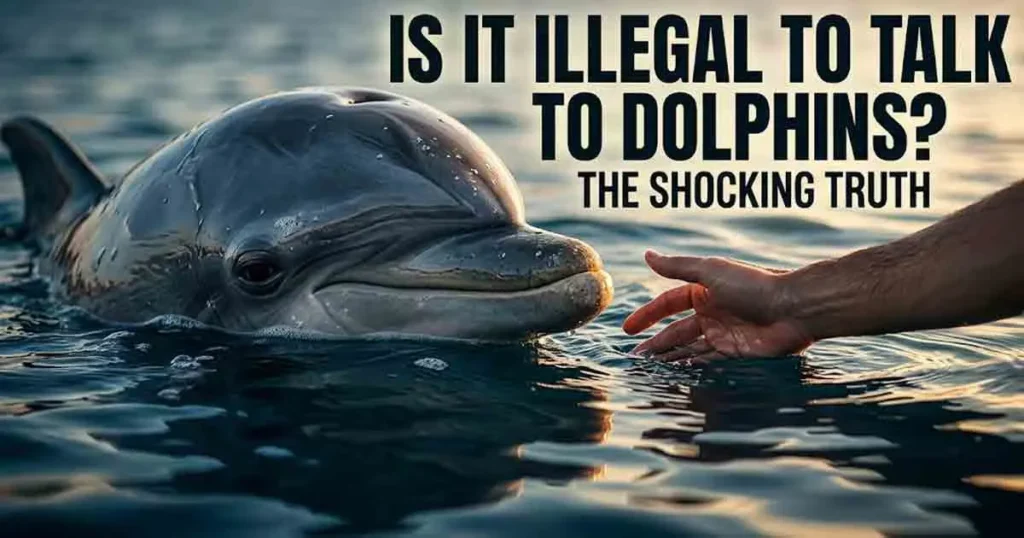

No, it’s not illegal to just talk to dolphins. While there is no U.S. law that explicitly prohibits dolphin talking, federal and state laws prohibit many forms of close interaction with marine mammals, such as acts that could reasonably be construed as attempts to communicate, when dolphins are harassed, fed, pursued or otherwise disturbed in the wild. It’s not a legal issue of what you say. It is about what these words make the dolphin do. This is the most crucial fact that any individual who comes across a wild dolphin in American waters must have in his mind.
Key Takeaways
- It is not illegal to communicate with a dolphin. Under federal law, what is illegal is coming too close to an animal so as to disturb, disrupt or harass the animal.
- There is no regulation in the Marine Mammal Protection Act that prohibits verbal communication with marine mammals. By themselves, words, whistles, or sounds directed at a dolphin from a reasonable distance are not prohibited by federal statute.
- However, in a sense, dolphin interactions with humans, or communication with dolphins, could be considered harassment under the Marine Mammal Protection Act if they interfere with the dolphin’s natural behavior.
- NOAA suggests that dolphins and other marine mammals should be viewed from a minimum distance of 50 yards (or 150 feet).
- Civil penalties are up to $10,000 per violation, for unintentional or non-criminal violations. Violations are punishable up to $100,000 in fines and one year in prison.
- Why is it that dolphins are not allowed to be spoken to? It’s not technically, though. Harassment is illegal and some forms of communication can be considered harassment, depending on the context, distance and impact on the behavior.
- So, is it really against the law to speak to wild dolphins? Not literally, of course. Wild dolphins may not be disturbed in their natural behavior.
The facts about talking to dolphins that the law states
There is a federal law that restricts communication with dolphins. It is known as the Marine Mammal Protection Act. The federal law was enacted in 1972 by President Richard Nixon to prevent the hunting, harassment, capture and killing of marine mammals.
There is no provision in the Marine Mammal Protection Act that prohibits verbal communication with marine mammals. Harassment is the focus of the law, not speech. Harassment is defined under 16 USC 1362 as any act which could disturb a marine mammal by causing disruption of behavioral patterns. The nursing, feeding, breeding and resting are behavioural patterns. Talking that makes a dolphin stop feeding or run away may be entering into harassment.
The trigger is not speech, but behaviour. If you attempt to communicate and draw a dolphin toward you, or elicit a response by making sounds or touching the dolphin, you are in legally risky territory.
NOAA has two levels of harassment
There are two types of harassment under the Marine Mammal Protection Act, and knowing the difference is key to knowing where the law is.
Harassment at one level is any act of pursuit, torment or annoyance that can injure a marine mammal or marine mammal stock in the wild. Harassment is a term used by NOAA to describe an act that could disturb but not injure a marine mammal or marine mammal stock in the wild by disrupting behavioral patterns, such as but not limited to, migration, breathing, nursing, breeding, feeding, or sheltering.
The first level of harassment (A) is acts that could cause injury. The second level, Level B harassment, is for acts that disrupt behavior but do not necessarily cause injury. The majority of dolphin communication situations that are brought to the attention of the law are of Level B. Even if a dolphin is not harmed and the harasser does not touch the dolphin, if they make clicking noises that disrupt the dolphin’s feeding behavior, they have committed Level B harassment.
You don’t have to touch the animal to be considered under the law. Does not need an intention to cause harm. Any act that has the potential to disturb a marine mammal violates 16 U.S.C. Section 1372. It is applicable in all U.S. waters, including the territorial seas which extend 12 nautical miles out to sea from the U.S. shores. It also applies to citizens of the United States while they are at sea.
Is it really illegal to talk to wild dolphins?
This is the one question that brings the most confusion and it deserves a direct answer.
It is not illegal to talk to dolphins in general. Harassment is what is illegal, and there are conditions in which some kinds of communication are considered harassment.
Dolphins can be viewed in the wild without any restrictions. If they attempt to affect or interact with their behavior in a purposeful manner, it may result in legal ramifications.
The practical scenarios are divided into the following sections:
- Dolphin watching from a boat and casual calls to dolphins: generally legal
- Clicking or whistling sounds made from a distance that do not disturb dolphin behavior: usually legal
- Attracting dolphins with electronic devices, underwater speakers or repeated vocalizations is legal but risky.
- Approaching a dolphin and calling it while in the area: risky and illegal
- Attempting to move a dolphin away from its intended direction, to stop it feeding or to make it change its behavior by communicating with it in any way: Potential Level B harassment violation
Imagine that you are snorkeling in the Gulf of Mexico. A dolphin is approaching and is curious. Say hi using your snorkel. Saying hello doesn’t make it a federal offense. The law is not about speech, it is about harassment.
Why is it that it is illegal to talk to dolphins? The Scientific Reason
Congress banned dolphin communication attempts in some formats due to the negative impact of human interaction on dolphin behavior. The Marine Mammal Protection Act of 1972 was a result of the loss of marine mammals throughout the waters of the United States.
What would happen if dolphins were taught to pay attention to humans or give them food? They come closer to boats more frequently. They do not spend as much time in resting, nursing calves or hunting. Dolphins exhibit measurable reductions in feeding success and calf survival in heavily-touristed areas. Studies in Sarasota Bay showed that dolphins that were frequently exposed to people had elevated cortisol levels. Stressed dolphins are more susceptible to disease. They are less successful at reproducing. These changed behaviors are learned by calves and inherited by their offspring.
In 2005, NOAA observed a case in Panama City Beach, FL where a dolphin named Beggar was regularly fed by tourists. There were health effects and that dolphin was “habituated” to human interaction and lost its natural foraging skills. The law considers communication attempts a gateway behaviour because the scientific record demonstrates that they reliably result in harm when they are not regulated.
In Florida and California, is it illegal to talk to a dolphin?
Florida and California are among the states with the most dolphin sightings and both are subject to the same federal Marine Mammal Protection Act guidelines.
Florida
The Florida Keys and the Florida Gulf Coast are among the most dynamic dolphin habitat areas in the United States. Think of a visitor to Key West. She’s on a cruise to see the sunsets. She yells come here, buddy again and again as the captain pulls the boat nearer and nearer, until dolphins appear. Both the captain and the tourist may be subject to questioning. The dolphin approacher, the tourist who actively approached the dolphins.
There are also state-level wildlife rules for Florida that complement federal MMPA rules. NOAA enforcement patrols are in place across the waters of Florida, and popular tourist destinations such as the Florida Keys National Marine Sanctuary have other local dolphin management policies.
California
Bottlenose dolphins, common dolphins and Pacific white-sided dolphins are all found along the Pacific coast of California. The same federal MMPA framework is in effect throughout the coastal waters of California and the exclusive economic zone (EEZ) which is 200 nautical miles off the coast.
NOAA Fisheries and other enforcement agencies are concerned with the impact of human activity on animals, rather than the exact nature of the interaction. Any vocalizing, calling or other action that disturbs the feeding, resting or socializing habits of marine mammals is considered harassment and is prohibited, even if the intention is to observe the animal.
What Happens if Dolphins are Harassed?
If you are seen harassing, feeding or disturbing dolphins, or any other marine mammal, you will need to pay some money. Civil penalties for unintentional or non-criminal violations may be up to $10,000 per violation.
The fines for failing to comply with MMPA provisions can be up to $100,000 and up to one year imprisonment.
Enforcement has increased in 2026. NOAA agents are on the ground to actively patrol popular dolphin areas. Fines begin at hundreds of dollars and escalate to six-figures for repeat offenders.
The penalty system is as follows:
| Violation Type | Maximum Civil Penalty | Criminal Penalty |
| Unintentional Level B harassment | Up to $10,000 per incident | Not applicable |
| Intentional Level B harassment | Up to $10,000 per incident | Possible misdemeanor |
| Level A harassment (potential injury) | Up to $25,000 per incident | Up to $100,000 fine and 1 year imprisonment |
| Feeding wild dolphins | Up to $10,000 per incident | Possible criminal charges |
| Commercial operator violations | Higher penalties apply | Criminal prosecution possible |
A critical legal distinction is that between captive and wild dolphins
US waters dolphins are fully protected under MMPA. There are different rules for captive dolphins in licensed facilities. The situation of semi-wild dolphins in managed lagoons is a gray zone that NOAA is increasingly looking at.
Permits are granted to scientists and institutions for research, rehabilitation or for some educational purposes, which would not otherwise be open to the public, and are subject to conditions designed to minimise damage and behavioural change. NOAA and APHIS have different roles. The MMPA applies to wild animals and is enforced by NOAA, and the Animal Welfare Act applies to captive marine mammals and is enforced by the Animal and Plant Health Inspection Service.
This implies that dolphin interaction, dolphin talking and even swimming with dolphins in a licensed dolphinarium or marine park are handled under a completely different set of laws than dolphin encounters in the wild. The MMPA harassment provisions are applicable to wild dolphins. Captive facilities are regulated by their own federal permits, conditions, etc.
If a dolphin approaches you
It is one of the most practical questions for anyone who is on or near the water.
The legal standard still applies if a wild dolphin approaches you willingly. It’s okay to not move. You can observe. The dolphin cannot be actively engaged, although it may initiate engagement.
When faced with an approaching dolphin:
- Stay calm and still in the water or on your boat.
- Listen without making sounds to attract and engage
- Please do not approach the dolphin.
- Never feed or make sounds to get a response
- Keep the suggested 50 yard distance as far as possible.
- Let the dolphin go away on its own, without chasing it away.
A lot of people think that talking or whistling at dolphins is harmless or harmlessly engaging. In fact, even verbal interactions can be considered harassment if they change the animal’s behavior or elicit multiple responses. The best position to be in is to watch and admire from a distance, and then allow the dolphin to decide how close to approach.
How to enjoy dolphins legally
These guidelines are designed to help minimize risk for individuals and operators who wish to interact with dolphins in a responsible and safe manner: Before any encounter, check local regulations; select a tour operator who is licensed and has a good reputation, and who has a strong wildlife ethics policy; maintain a safe distance from dolphins and never attempt to touch or feed them; keep noise to a minimum and avoid moving suddenly, which could startle the dolphins.
The following are recommended practices to help ensure that encounters are legal:
- At least 50 yards on the water and 150 feet away from the water.
- Observe using binoculars or zoom lenses, do not approach.
- Reserving dolphin watching charters with certified naturalists who are familiar with the laws and regulations
- The dolphins were never approached for swimming, but were always kept at a distance.
- No electronic devices, speakers or recorded dolphin sounds to attract wild dolphins
The expert and legal perspectives
NOAA Fisheries, the federal agency enforcing the Marine Mammal Protection Act, has always maintained that the 50 yard observation distance is the practical limit for avoiding harassment violations. The agency’s published guidance is clear that it is not about what the dolphin is doing, but about what humans are doing that affects the dolphin, including talking, whistling and using sounds to attract dolphins, when they are known to alter animal behavior, is considered potential harassment enforcement.
Legal experts say that dolphins approaching ships, changing course, stopping resting, or getting used to human interaction can be considered illegal under the MMPA structure if it is the result of a conversation.
If the harassment is intentional, and the dolphin is injured or protected populations are disrupted, criminal charges may be considered in the most severe instances.
In related wildlife law cases, Robert Corn-Revere, chief counsel of the Foundation for Individual Rights and Expression, has observed that the government’s enforcement efforts are always based on behaviour, and never the communicative act itself. This is also true for dolphin interaction cases under the MMPA.
Also Read: Is It Illegal To
Conclusion
It is not illegal to talk to dolphins in the literal sense of the word. The Marine Mammal Protection Act or any other federal law prohibits words spoken in the direction of a dolphin. The key point that all humans who come into contact with wild dolphins in American waters should know is that communication that changes a dolphin’s behavior, stops the dolphin from feeding, changes the dolphin’s course, or habituates the dolphin to the presence of humans is illegal under federal law.
The Marine Mammal Protection Act covers U.S. waters, coastlines and the exclusive economic zone, which is 200 nautical miles (nm) out to sea. Civil fines for offences begin at a few hundred dollars and go up to $10,000 for each unintentional occurrence. Fines for criminal violations are up to $100,000 and up to one year in prison. In recent years, NOAA enforcement has stepped up, and active dolphin patrols are conducted in high-use areas on the Gulf Coast of Florida and in the Pacific waters off California.
When encountering wild dolphins, the safest and most legal way to do so is to stay at the recommended distance of 50 yards, let the dolphin decide on the approach and do not attempt to attract, engage, or alter the behavior of a wild marine mammal.
Frequently Asked Questions
1. Is it illegal to talk to dolphins?
Not literally, but in the figurative sense. There is no federal law that explicitly prohibits the use of words by an individual when speaking to a dolphin. Any communication that disrupts a dolphin’s natural behavior, such as clicking sounds, electronic devices designed to attract dolphins, or vocalizations, can be considered illegal harassment under the Marine Mammal Protection Act.
2. Does that mean that dolphins are not sentient beings?
The act of talking is not prohibited. Harassment of wild dolphins is prohibited and some types of communication may constitute harassment if it interferes with the animal’s natural behaviour. Safe distance passive verbal acknowledgements are mostly legal. It is a legal risk to try to attract, engage or elicit responses from wild dolphins.
3. Is it illegal to talk to a dolphin if it approaches you first?
Yes, the legal standard is still in effect even if the dolphin initiates contact. You may remain still and observe. Do not actively engage, make sounds to encourage the dolphin to remain or approach the dolphin. The MMPA does not make an exception for dolphin-initiated contact.
4. Why do dolphins not have a right to freedom of speech?
In the literal sense, it is not illegal to speak to them. The restrictions are in place because repeated human interaction, such as communication attempts, do measurably and harmfully alter dolphin behavior. Habituated dolphins nurse and feed less, exhibit higher levels of stress hormones and teach their calves the same behaviors.
5. In how many states is it illegal to talk to dolphins?
Marine Mammal Protection Act is federally enforced in all 50 states. There is no dolphin communication law in any state, but all states are covered by federal MMPA enforcement. The states with the most dolphin sightings and tourism activity, Florida and California, have the most dolphin enforcement activity.
6. What will happen to a wild dolphin if he is harassed?
Civil penalties for unintentional harassment can be up to $10,000 per incident. Intentional harassment or feeding is a criminal violation, punishable by fines of up to $100,000 and up to one year imprisonment. The penalties for commercial operators are increased and their operating permits may be revoked.